

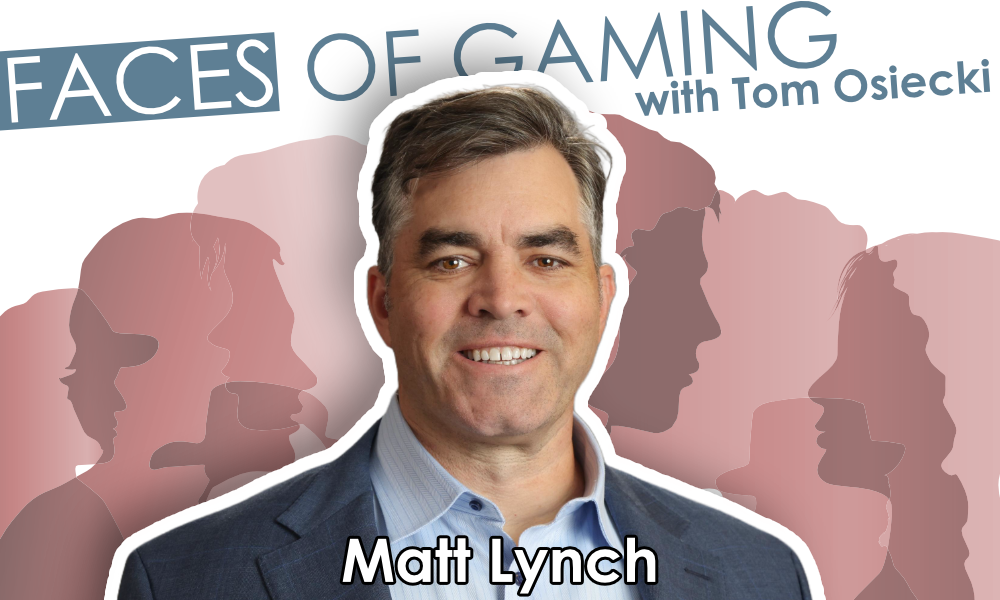

Matt Lynch spent the past 20 years developing experiences and skills unique to the tech industry, and then he made the move to the gaming industry.
After years as a high-tech industry leader, he joined the gaming industry in 2024 as President of Digital at Scientific Games, a leading global provider of lottery games and solutions.
“I didn’t play the lottery. I knew nothing about government-regulated lotteries and so I started to learn a lot. I did not realize how big the industry is; nor what a great benefit lotteries provide by helping fund good cause programs in their communities.”
An e-commerce expert with experience in subscription and marketplace-driven businesses, Lynch has developed customer-focused products that drive incremental revenue and grow customer lifetime value for companies like Amazon, Samsung, and Albertsons.
Today, the tech innovator has a new title: Chief Player Experience Officer at Scientific Games. By starting with the player and working backward, Lynch hopes to use his uniquely player-focused strategies to advance the lottery industry in the digital age.
A new role
“It’s a new role within Scientific Games, something that I helped to craft. I had previously been the President of Digital, but what I noted in my two years here is that we, as an industry and a solutions provider to the industry, spend a lot of time focusing on what the lotteries need, and we don’t spend as much time on player experience and what we’re actually doing for players.”
“So, thinking about the next generation of games that we need to build and how we invent on behalf of the player, player experience stands out as a way to focus this industry and move it forward. Player experience intentionally runs across all of the games that we deliver at Scientific Games, whether they’re instant scratch games, digital games, draw games, or the experiences we build both online and in retail.”
Lynch brought decades of digital and consumer-focused leadership experience to Scientific Games, including eight years at Amazon, where he served as Chief Operating Officer for online entertainment content and scaled several product categories into $1 billion+ businesses.
His leadership roles have included Head of Direct-to-Consumer at Firework, Senior VP of Digital Shopping Experience at Albertsons, President & Chief Operating Officer for Samsung SmartThings, and Senior VP of Global E-commerce, Consumer Pricing & Analytics at Symantec.
Changed worldview
Lynch was born in Minnesota, and his family moved around the country for his father’s job at UPS. They settled in Utah, and he began his career as a financial analyst. He went to grad school thinking he would become an investment banker, but ended up in the finance program for General Mills.
He and his new wife fell in love with Seattle, where he landed a role with Microsoft, again in finance, until Amazon recruited him and changed his worldview about business.
“It was early enough at Amazon when they only directly sold books, DVDs, and music. The concept was fascinating and my introduction to gaming as well.”
“The role that was pitched to me was, ‘Come help us build a video game retail business.’ I’d been a huge gamer my whole life. This would be a career change for me, moving right from doing finance to being more of a general manager.”
“I remember they made me write a seven-page working paper on what I would actually do and why I thought I could be successful doing it, which turned into a 60-page white paper that we proceeded to execute against.”
“My first three years were really about building out this business. Looking back on it now, who knew Amazon would become what it was?”
Jeff Bezos
Of all the tech jobs Lynch had over the years, I asked him which one most influenced him in his new role with Scientific Games.
“Jeff Bezos was very involved in Amazon at that time, and so we would have day-to-day meetings on how we’re running the business and the categories. Being able to learn from the people at Amazon about how they formed their operating model and leadership principles, I really got to see how retail structured itself to be successful, which was an amazing experience.”
“If I look back on all the experience, Amazon is what really transformed my mindset. I think about how ‘Start with the customer and work backwards’ is a core component of my mindset. Jeff has had this philosophy since day one at the company: You have to be relentlessly focused on the customer.”
“You have to have a really long view on what it’s going to take to win. And you have to invent fearlessly because customers aren’t going to tell you what they want. You have to really get in the weeds and figure out new solutions to bring to the market. I think going to Amazon really helped define where my career was going forward,” Lynch said.
Cybersecurity
Lynch moved to California to be near family and joined Symantec, a cybersecurity company. “Back then, Symantec was leading the digital side of Norton cybersecurity. It was about a $2 billion global business, and we were faced with transforming a business that had been in a slow decline as the use of mobile devices was growing. There wasn’t a need for computer security software.”
“We had done a good job building out new pricing models and introducing new products, but ultimately we integrated ourselves with LifeLock, the company that changed the entire consumer value proposition of what we were offering, to bring back growth.”
“I was there for four to five years when Samsung approached me about a startup that they had acquired. It was in the Internet of Things space, called SmartThings, and they had acquired this startup and wanted to run it under Samsung,” he said.
Albertsons
“I opted out of the company. And then, as I was looking for another startup, — I loved the startup environment – an ex-Amazon leader reached out about joining Albertsons. They were looking for somebody to lead their digital business and their e-commerce business. It was an interesting time because I think my first day in the office was probably day one of COVID here in California.”
Passion
After a short stint at another startup, Firework, Lynch was recruited to Scientific Games as President of Digital. I asked Lynch what appealed to him about Scientific Games and the lottery industry.
“The obvious reason is the team: the people at Scientific Games, the leadership team, and the Brookfield Business Partners private equity firm. The passion around the sector is undeniable, and it has a positive impact on society from a good-cause perspective.”
“Also, the challenge of how to modernize lottery and help drive change with so much entertainment competition available to players today. It reminds me of e-commerce in the early 2000s and the way traditional retailers were looking at e-commerce.”
“In the lottery industry right now, we’re still in that early e-commerce phase where we treat digital as a separate entity. We even call it iLottery. It’s not iLottery; it’s a different entity. My view is that it’s all lottery. It’s just where a player wants to enjoy their experience.”
“The first step is to stop thinking about digital and retail as two separate experiences. How do we start building that experience as more holistic? So, if you’re buying a game, you can continue to buy in retail stores, and we can make that experience better and more attractive.”
“How do we tie lottery players into the digital aspect if that’s what they want? What do they expect, and how do we deliver that experience more seamlessly? And today, I would say the challenge is that we deliver them in pockets. We aren’t approaching the whole ecosystem together.”
“There are two sets of players: A core lottery player—people who have always played the lottery—and, as an industry, we aspire to attract the next generation of players. Those are two different solutions that we’re trying to deliver on.”
The challenge
Scientific Games serves lotteries in 50 countries—including nearly every North American lottery—and is 100% lottery-focused. The U.S. based company has a global workforce of 3,500 employees spanning five continents and is the world’s largest creator, producer, and manager of lottery games as well as the fastest-growing provider of lottery systems and retail technology.
The challenge is that lottery regulations are governed by individual states, provinces and countries.
“Everybody in the lottery world would love to go digital. It’s really about the regulation and the politics because it’s approved by each individual jurisdiction. It’s very complex, given all the gambling that’s going on now with sports and prediction markets. How you move this experience online becomes more political in nature.
“In a state like California, we don’t have digital lottery sales. So how do we build an experience that integrates digital in a jurisdiction where players can’t buy a lottery game online, but we can still promote and build experiences that are digital in nature and drive people to a better experience in retail? That’s the challenge we face as an industry,” Lynch stated.
Second chance
Popular lottery promotions allow scratch game ticketholders to use second-chance programs for additional opportunities to win.
“Scientific Games creates second-chance programs for lotteries where, if players buy a scratch ticket and don’t win, they can go online and enter it in a second-chance drawing.”
“We have another product called Scratch Connect. Players buy a scratch game at retail, and there’s a QR code on the ticket that they can scan with their mobile phone to unlock a digital bonus game with its own separate opportunity to reveal winnings. Following a simple age confirmation, players can immediately begin the digital experience without creating an account or registering. But the retail ticket itself is still the bearer instrument and all prizes are redeemed at retail,” Lynch said.
Ultimate challenge
With the focus on moving forward into digital products, I asked Lynch if Scientific Games is facing the same concerns that brick-and-mortar casinos face when considering iGaming.
“We have measurements we use and KPIs when we look at net-new adult player acquisition. We’re gaining an understanding when we bring new people to lottery, and then, secondarily, we constantly look at that mix of retail-to-online spend.”
“Between those two dimensions, we are analyzing whether we’re driving new players or just cannibalizing existing business and shifting it over. We have the same concern as the casino industry. Retailers are very concerned about digital cannibalizing their business. We also don’t want that to happen because playing a physical scratch game is very different from playing a digital lottery game.”
“What makes lottery maybe more challenging is the anonymous nature of what happens at retail. Because sales can be cash-based, you don’t know who the players are, and that’s why we measure at a macro level what’s going on in retail and what’s going on online. Are we seeing the mix shift? The ultimate challenge for the industry is: How do we drive more known players?”
Game choice
“We have a solution called Game Choice in our lottery retail vending machines, which offer a choice of up to 40 games.”
Game Choice is a ground-breaking lottery product recommendation engine that, once players select one game, it combines AI and SG Analytics and says, ‘People who bought this game also bought these other games.’
“Think about it like Amazon. When you’re on Amazon and you see ‘customers who buy X also buy Y,’ we’re able to put together recommendations based on what people put in their shopping baskets as a first step toward personalization and segmentation,” Lynch said.
Younger adult audience
I asked Lynch how Scientific Games approaches trying to attract younger adults to lottery.
“The challenge we as an industry face is the relevance of playing lottery games, especially now, given products competing for people’s attention, whether they be casinos, sports, or prediction markets. Because lottery is so focused on retail and has a limited presence online, how do we show up in a different way?”
“How do we think about the next generation of scratch game players when they can open up a sports app and place a bet tonight? That’s very different from going to the store and buying a scratch game.”
“Scientific Games pioneered what we call an SG Signature Linked Game, where there’s a once-in-a-lifetime experience attached to a second-chance play opportunity. Multiple lotteries participate so they can offer more excitement to their players. For example, we have JURASSIC WORLD-licensed themed games. Players from 20 participating U.S. state lotteries who win the second-chance drawing receive a brand-immersive experience in Hawaii where the original JURASSIC PARK was filmed and an exclusive event with more opportunities to win prizes.
“There’s a big effort going on at Scientific Games to emphasize our existing licensed brands, as well as to expand our portfolio in order to attract a different demographic. Also, we’re developing game mechanics that appeal to a different audience and a younger adult demographic.
“I think our biggest advantage, outside of a retail presence as an industry, is the good-cause funding that we help lotteries drive, because that’s a core differentiator for us. How do we drive that message home through channels where people are? How do I get that message home through TikTok and where the next generation of customers are experiencing multi-channel media?”
Convenience
I asked Lynch what he thought the focus for lotteries would look like in the next five years.
“If I look forward a few years from a player perspective, are you able to buy a lottery game wherever you are, however you see fit—whether it be on your phone, at the gas station, or through DoorDash? Lottery that is persistent in a way that’s convenient to you, and then very personalized to you as well.”
“So, it’s not just, ‘Hey, there’s another lottery game.’ We’ve curated this game experience for you at the place you want to buy it, when you want to buy it, and how you want to buy it. That’s what we’re focused on because I think the next generation of players are going to demand that level of convenience. No one’s going to go out of their way to buy something when they can do other things on their phone. So how do you build that journey for players and really focus on convenience?” Lynch commented.
The differentiator
Lotteries frequently benefit a segment of the society where they exist. For instance, in the U.S., the Pennsylvania Lottery benefits senior citizens, and the Georgia Lottery benefits education.
The messages are strong and appeal to a segment of consumers that genuinely celebrates organizations that give back.
“It also adds to the complexity versus our competitors when you think about a sports app that has one app to serve the entire country. We’re building different experiences based on regulations in each individual jurisdiction, and how do you pull that together to deliver one message?”
“We have a passion in this industry around good causes and the good work we do. You can imagine how hard that is to get that message across when you have 150 lottery customers doing it 150 different ways based on their legislation.”
“And as an industry, how do we surface up all the amazing community programs that jurisdictions are helping fund? And then, within the states, how do we double down on how we’re helping communities and give tangible examples that have legs? How do we tell stories online and on social media that attract a player who’s going to be interested in lottery,” he said.
Secrets to success
I asked Lynch what he believes are the secrets to his success.
“The secret to my success is probably that I’m extremely curious. There are two components. I like hard problems, so I’m curious to learn. I’m okay if I’m wrong, but I like to learn a lot. The other thing that I would say is that I’m a big believer in people and a big believer in the inherent skills and curiosity that people bring. I’m less concerned about experience, so my hiring approach is very different,” Lynch related.
 Tom Osiecki is a casino consultant who writes an occasional column for CDC Gaming Reports called Faces of Gaming, about interesting and engaging people in the gaming industry.
