

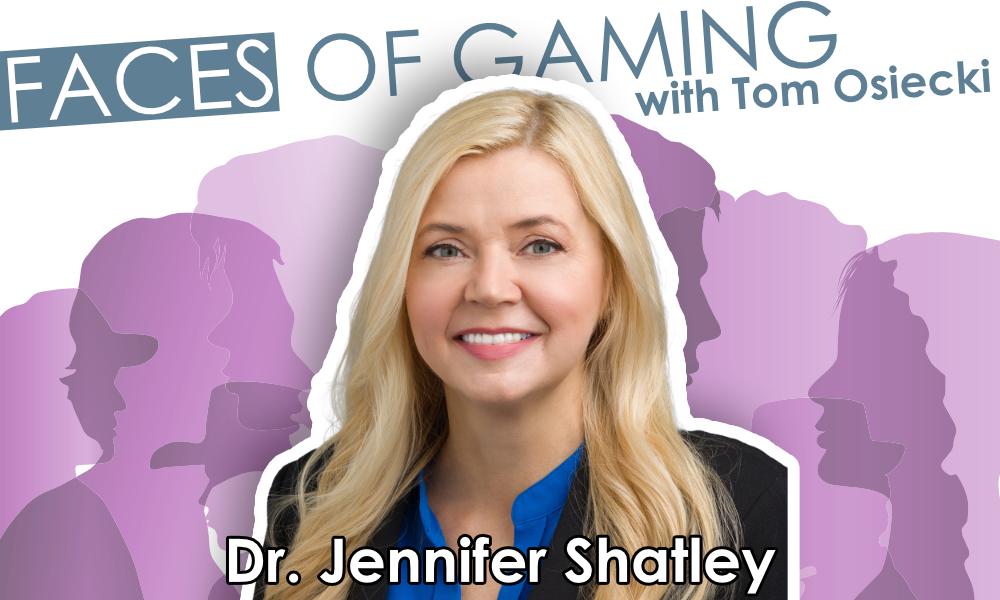

Dr. Jennifer Shatley spent the last 28 years using research and operational experience to create groundbreaking evidence-based programs for responsible gaming.
She spent 13 years in responsible gaming with the Harrah’s and Caesar’s organizations, operates her own responsible gaming consulting company, taught responsible gaming at UNLV, and created responsible gaming programs and policy internationally.
Today, Shatley is Executive Director for the recently-formed Responsible Online Gaming Association (ROGA). Due to her efforts, Shatley was selected as one of the 2026 CDC Gaming Ten Women Rising in Gaming, in partnership with Global Gaming Women.
You would think that someone with those credentials would come across as an academic. Not Jen Shatley. Her history is honed by walking the walk while overcoming challenges using national and international operational experience.
Overcoming challenges
Her vast experience started in a small rural town in Tennessee, all while facing setbacks that would stop a normal person.
“We moved to Tennessee when I was around six or seven, and the first town we moved to was Frog Jump, if that gives you any idea. We ended up in a town called Halls, just a very small agricultural town, not very exciting at all.
“I was 18 and working on a factory line, and it was one where they pressed magazines with big machinery. My grandfather had always worked in a factory, and he lost fingers in a machine. I was working on a line one night, and it kept getting hung up and stuck, and they were telling me to put my hand down there and get things out. And the woman telling me this visibly had missing fingers. And I was like, ‘I’m not going to do that.’ So, I realized that was not the career for me,” Shatley said.
Extensive damage
Shatley was an undergraduate at Christian Brothers University (“The same University that does the Christian Brothers Brandy”). She graduated and started attending LSU law school when she was standing outside in an entertainment area and was struck in the face by a full bottle of tossed beer.
“There was a fight going on and everybody was watching. A guy threw a full beer bottle at the other guy and hit me in the mouth and the face. It did some pretty extensive damage to my jaw. I ended up having jaw surgery. It knocked several teeth out. My two front teeth were facing the back of my throat. I had black eyes and a cut mouth,” Shatley related.

Sausage factory
“I grew up poor, so I had to use all of my loan money for school to pay for my medical services because I didn’t have insurance. I ended up leaving law school after that first year because of that incident. I moved back to Halls, Tennessee, and again, there were no jobs, and so I had to go four towns over this time to the Jimmy Dean sausage factory.
“I worked at the Jimmy Dean sausage factory for six months, and I was sitting there reevaluating my life, because I was planning to spend a year out of law school and go back. I was going to reset; but, as I’m sitting there at Jimmy Dean Foods, thinking, I can’t do this for a year, because I had to get out of Jimmy Dean.
“I went to University of Tennessee, Knoxville for my master’s, and then I moved back to Memphis, and when I graduated, I ended up getting a job at Harrah’s within two months of graduating. I thought I was going to go back to law school, but at that point I needed money,” Shatley recalled.

Shatley spent nearly four years in a role as Market Research Senior Manager for Harrah’s when the company headquarters relocated from Memphis to Las Vegas. Shatley declined the move and decided to return to law school, but changed her mind after Harrah’s increased the offer for her to continue the role as Director of Market Research, moving to Las Vegas in 2000.
Code of Commitment
Shatley progressed through Harrah’s and Caesars for over 13 years and eventually led responsible gaming programs as Vice President of Gaming Policies and Compliance.
Harrah’s created the first responsible gaming program in 1989 and later created a Code of Commitment.
“When I took over in 2000, Harrah’s created the Code of Commitment, and this was the first ethical statement of how they were going to operate as a business. I took on the role of managing all aspects of the code. The code was around how they treated employees, how they treated customers, how they treated communities, and eventually the environment.
“It was a brand-new role. It was very much focused on research. That was very interesting to me. It was writing intensive, so all of my sweet spots were in this role. When I got into it, I started looking at where we can do more. Where can we have a bigger impact? We could be much more proactive around responsible gaming, and we should be engaging guests well before they get to where they have a problem and need help. Responsible gaming should be more focused on prevention and protection rather than just trying to deal with a gambling problem that’s developed.”
Impetus
“That was really the impetus of it. I did a gap analysis and looked through what are we doing, and what could we be doing? How would we do that? Then I got a couple of other colleagues to help develop what that would look like. They would be highly-trained management staff that would actively interact with customers whenever employees had concerns.
“We based the conversation loosely on motivational interviewing techniques. The idea was to get the customer to think about the behavior, that thing that was concerning, and then hopefully motivate them to change that behavior as a preventive mechanism in order to change the risk profile.
“This was really risk identification before that was a thing. It was crude. It’s much better today. I’m proud that the things we created at Harrah’s back in the early 2000s are exactly what we’re doing today. We’re doing it better. But we created all of the basis of everything that’s done today in responsible gaming.” Shatley declared.
Today over 100,000 individuals have received Shatley’s training and Caesars’ Responsible Gaming Ambassador initiative. She participated in the evolution of RG from the early days of handing out brochures to the creation of comprehensive, evidence-based programs.
Brand-wide
Shatley developed the brand-wide responsible gaming policy and implementation for 50+ global properties. “I had to basically create everything from scratch; all policy manuals, all procedure manuals, all training, and the technology to support it.
“I had to go physically train people. I actually went into surveillance rooms and set up the technology on their computers. I was a one-man shop, and I did it all. I had to figure out how every single employee interacted with this program and what their responsibilities were,” Shatley said.
System-wide self-exclusion
Shatley innovated a responsible gaming IT application leveraging technology to improve compliance and effectively implement, track, and maintain the responsible gaming policy.

“We were the first company to share all self-exclusions across all of our operators and across all of our properties that had their own systems. So, we had to create an enterprise system that sat above all of the systems it interacted with to say, ‘This person is excluded and if they come to your property in St Louis or your property in Indiana or Louisiana, you have to exclude them.’ The first technology we built was to operationalize shared self-exclusion across all of our properties, and then it had to interact with all of our systems.
“I think the most important part of what we created was called an RG log, where we could track concerns that were reported about a customer, what happened based on that concern, and then what was the outcome. It was risk identification and auditing of how we responded and how did they respond? That could be seen across all of the properties as well. That was the most important part of that technology solution,” Shatley said.
First RG television campaign
Shatley launched the industry’s first television campaign focused entirely on responsible gaming awareness.
“It was the first television campaign that was just a responsible gaming focus, no marketing message. Again, we did a lot of research. I’m very much focused on research and evidence,” Shatley stated
Logan Avenue Consulting
“I left Caesars in December of 2014. At that point it was sort of managing the day-to-day operation, and that lost my interest. I really wanted to do strategy, creation, and innovation; so, I left and I started my own consulting company, and I still have that running.
“My favorite thing I did in consulting was when Caesars was interested in Japan. I was their consultant working in Japan for about two and a half years. I got to do a lot in Japan around the development of the RG regulations and looked at how to integrate RG into the culture,” Shatley recalled.

International Gaming Institute
Shatley is a contributing professor for the UNLV International Center for Gaming Regulation.” I worked at the International Gaming Institute for about three and a half years as Consulting Lead when I was getting my Doctorate in Public Policy. I think the most interesting thing we did there was we were working with the San Manuel Tribe of Mission Indians on how to culturally adapt an RG program to respect their traditions and culture,” she said.
Shatley worked for over a year at the Responsible Gaming Council in Canada as a consultant leading their research department.
ROGA
Shatley has been Executive Director of the Responsible Online Gaming Association (ROGA) since the beginning of March 2024.
ROGA brings together the nation’s largest online gaming operators to advance the industry’s commitment to promoting responsible online gaming. ROGA’s members include most of the largest companies in the industry, including Bally’s, BetMGM, DraftKings, Fanatics Betting and Gaming, and FanDuel. Collectively, they account for 85% of the online gaming industry in the United States, pledging an initial investment of more than $20 million to support an effort to ensure consumers can enjoy online gaming in a responsible way.
“There was an acknowledgment that all of these different companies were doing their own things in RG, but collectively we could make a bigger impact. And so, these organizations came together and formed ROGA, and I started the week before it launched.
“When online gaming came to be, we basically took all the programs that we were doing in bricks and mortar and just kind of plugged them in, right? What we’re trying to do here at ROGA is look at how do we take advantage of some of the things we have in the online space that we don’t have in bricks and mortar; like the constant contact with the player, the player data, the built-in ability to set limits on time and money.
“Here in the online space, you can physically do it on the platform because they have those tools. So how do we take advantage of those unique characteristics and how do we continue to evolve RG and innovate and make it better, and collectively do this across the industry?” she questioned.
ROGA initiatives
ROGA is introducing unique initiatives that will recognize the differences between bricks and mortar and online gaming.
“We are the first group that’s explicitly focused on responsible gaming in the online space, and we are creating initiatives. One is the certification program to make sure that operators operate to the best practice standards and also to give them a stamp of approval.
“It also gives customers that stamp of approval confidence that a site is legal, because most customers don’t know what’s legal. It also gives regulators an understanding that this company has received an RG certification. It’s being done through RGC, through the Responsible Gambling Council; so it’s a third-party verification that this operator meets robust standards,” Shatley related.
Data clearinghouse
This year, ROGA will launch its data clearinghouse, enabling self-exclusion across all ROGA members. Once in place, when a player excludes on one platform, they will be excluded across all ROGA platforms in all jurisdictions.
“We’re launching the data clearinghouse in the third quarter of this year to better support players. Right now, in state programs, the states that offer self-exclusion can’t be shared outside of that jurisdiction. So, I can exclude in one state and drive right over the state line and gamble. And it’s across all operators, so I don’t have to go to every single operator site and do it and it’s very simple. In some states you have to physically go somewhere and sign paperwork, usually with police enforcement,” Shatley remarked.
Know Your Play
ROGA’s Know Your Play (KYP) initiative is a research‑driven education program that equips college-aged students with helpful information on responsible gaming, mental health, and financial literacy. Built with the Responsible Gambling Council, EPIC Global Solutions, and Kindbridge Behavioral Health, KYP provides practical, evidence‑based tools that help students make informed decisions.
Over 125,000 individuals across all 50 states have interacted with KYP content.
“There’s been several programs targeted towards student athletes over the years, but nothing for the general student population. I saw that as a gap. We really needed to talk to students generally, and give them not only RG training, but financial literacy and mental health, because it’s all tied together. This is really around decision-making, risk-taking, and again, financial literacy. These things that are intertwined affect students of that age because they’re on their own for the first time,” Shatley said.
AiR Hub
ROGA is a founding member of the new Artificial Intelligence Research Hub (AiR Hub) at the UNLV International Gaming Institute—a first-of-its-kind initiative dedicated to advancing responsible gaming through applied AI research. AiR Hub is a central ecosystem for industry research into how AI can support responsible gaming outcomes.
“This was an initiative that I thought was incredibly important for the industry, especially as they innovate with AI; and, if they start using it for RG, to understand what the meaningful things are, benchmarking and what’s working, what isn’t. That’s really where the air hub is focused,” she said.
Part of the player experience
I asked Shatley what she thought was the focus of ROGA?
“The question is what other types of information we can use collectively to help make RG decisions or help promote RG. It’s all about making responsible gaming part of the player experience, not a separate, standalone thing. So, it just becomes part of play.
“Right now, a lot of players ignore the RG component or the RG page or the tools because they think they are for problem gamblers, and they don’t have a gambling problem so it’s not for them. We’re trying to change the mindset that these are resources for everyone. The whole intent is protection and prevention, and that all players should be engaged in responsible gaming,” Shatley stated.
Surprising motivation
After nearly three decades in responsible gaming, I asked Shatley what motivates her every day. Her answer is surprising.
“The industry moves very fast, and this is something that really is a niche area, and it does affect the wellness of people. I’m very excited about that. I like to innovate new ideas and new ways to do it. That excites me, the strategy, the innovation of how we can make this better for players.
“There’s another answer that I don’t usually talk about. When I was 13, my 17-year-old sister was killed by a drunk driver. We didn’t know this person, but obviously it had a huge impact on our lives. I have seen the disastrous implications that addiction can have on others and on individuals.
“That drives me as well because it really is about protecting players, their wellbeing, and about protecting others; because we know one problem gambler affects others. That really is a motivating factor for me, making a difference and trying to help prevent those types of impacts from happening to other people,” Shatley said.
Driven
I asked Shatley what she thought is the driving force behind her success.
“I’m self-driven, like I’m a very driven person. You do not want to play cards with me or board games, because I’ve been told I’m a little competitive. I just think that always pushing, always driving, always trying to be better is how I’ve lived my life; and I do the same thing within my career. It’s all about risk taking. It’s all about looking at what are we doing right now, and what can we be doing in a year from now?” Shatley declared.
 Tom Osiecki is a casino consultant who writes an occasional column for CDC Gaming Reports called Faces of Gaming, about interesting and engaging people in the gaming industry.