

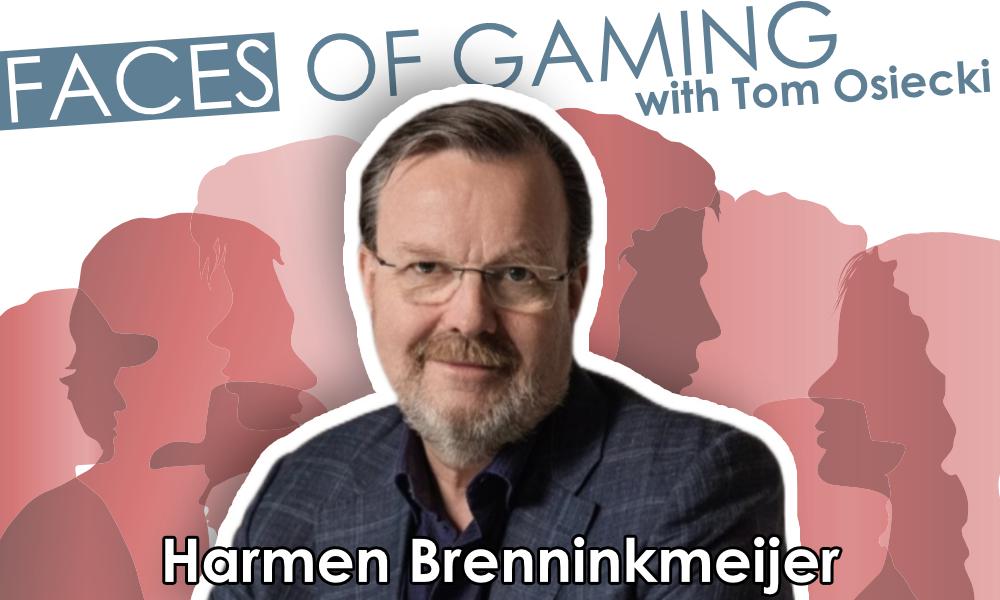

When it comes to expanding global gaming through innovation, Harmen Brenninkmeijer represents a bridge between traditional casino international operations and the technology-driven future.
As an operator, supplier, technology innovator, developer, association leader, investor, and consultant, Brenninkmeijer breathes the rare air of an elite entrepreneur and visionary trendsetter.
In a lifelong career of business creation, Harmen Brenninkmeijer puts the serial in serial entrepreneur.
Global expansionist
With more than three decades in the gaming industry, Harmen has built a career defined by entrepreneurship, innovation, and global expansion. A serial entrepreneur and investor, he has led ventures spanning technology development, manufacturing, and distribution, helping shape the gaming landscape across more than 75 countries, with a particular focus on emerging markets.
Currently, Harmen is Executive Chairman of NYCE International, a publicly listed company on the Aquis Exchange that represents more than 65 leading gambling companies while actively developing strategic technology ventures. NYCE International goes beyond traditional representation by taking stakes in promising ventures and creating equity value alongside product representations.
Harmen is a global expansionist who helped bring technology-driven operations into emerging markets worldwide. He was the founding chairman of the European Gaming Organization and is known for helping transform traditional gaming operations with systems, game design, and player tracking well ahead of industry norms.

Yet the story didn’t begin in boardrooms or casinos. It began in the Netherlands, where early setbacks helped shape the resilience and ambition that would take him around the world.
Netherlands
Harmen grew up in the Netherlands where his family name was well known. His father was a businessman who owned several clothing department stores. “I grew up in an environment where work was very important, and you focus on what you need to do, and you contribute. It was a lot of work. Effectively, I was instilled with work. So, that was a good thing,” he said.
Eventually two things happened that changed everything for Harmen. His father lost the business, and he went to the United States as an exchange student. “I was 15 years old, and then I started to become quite ambitious, in the sense of, like, okay, now what?”
A ferocious reader plagued by migraines, Harmen became a Rotary exchange student in Florida after winning a competition where only 30 applicants were awarded from 3,000 entries. “I participated in DECA Distribution Education Clubs of America, got the first prize in the district, second prize in the state of Florida, moved on to the nationals, and did very well, and that became a big thing. All these experiences made me more ambitious.”
Hanging curtains
“I jumped into a couple of jobs and started to hang curtains in West Palm Beach, on Palm Beach Island. Now you must imagine that the wealth that Palm Beach has, even at that time in 1982, was impossible to imagine in the Netherlands. Impossible even within my family; so that really got me stoked,” Harmen recalled.
Harmen returned to the Netherlands to finish his business degree and had the opportunity to return to the United States with the same family where he was an exchange student. “They paid for my college because I didn’t have the money. As a result, I wanted to really make that work.”
After spending time in the flower business, Harmen returned to the states as a translator where he was offered a job in the sign business.” I then became the export director at a very young age, 22, and built an export business in about 33 countries, and that really got my juices going for international business,” he said.
Entering casinos
While attending an exhibition, Harmen met David Thompson, who just purchased Mikohn from John Acres and Mike Stone. After starting as an agent, Harmen became CEO of Mikohn Europe, when Mikohn went for an IPO in 1993. He developed Mikohn’s gaming divisions throughout Europe, Africa, and parts of Asia, where he built one of the earliest multinational gaming distribution networks outside of North America.
“Basically, we were the only controller that linked to most of the slot machine manufacturers at that time. So, at that time, video slots came about. They were introduced into the marketplace in the early ‘90s.

“It started to take off in existing casinos in Europe, and I made deals with Aristocrat, I made deals with Bally, I made deals with IGT, and everybody else that was active at that stage. Now what happened is I saw these American casino signs, the very flashy neon signs, very, very American, very in-your-face. I thought it was fantastic.
“I said to David, okay, we need to take that product and package it and then bring it together. And then, after saying no, lo and behold, in 1993 he bought three signage companies, did an IPO together with the controlling technology side of the business, plus the controller and the LED displays, and that became Mikohn Incorporated, which became a substantial company,”’ Harmen stated.
Harmen received funding to build a factory and later lost the funding before the factory was built. He was able to keep going when Switzerland opened with A and B casino licenses and he worked with Peter Schorno, who had a company with games called Golden Games which added Mikohn’s controllers and jackpots.
During that time, Harmen developed a reputation for fairness in distribution deals. “Now, during that period, I already had all these distribution deals with Aristocrat, IGT, and everybody else. I was relatively neutral because I did business with everybody, and people knew that I could keep my mouth shut. As a result, they would talk to me about pricing, and they would get a fair price,” he said.
European Gaming Organization
In 1993, Harmen became the Founding Chairman of the European Gaming Organization.
“Because of that neutral position, I started to have a bit of a voice, and then we had a situation in the European industry that there were way too many exhibitions, and everybody was complaining about it. They said, “We’re just running from country to country, from show to show, because the whole market was growing, we need less exhibitions.”
“I said the best way to do that is to create a European-wide association. So that’s when we started to play with the idea. I talked to the guys from Jens Halle, Paulus Karskens, Sebastian Salat, and Gerhard Burda, all the different people that oversaw the different companies at that time and basically said, ‘Can we do this simultaneously?’
“I also felt there was a massive need for proper information. We needed to create a depository of information because of what was happening in the gaming industry, and that is still the case today. There is too much extreme information on either side, too much programming, too much against gaming, and there is not enough in the middle to show what gaming should be about,” Harmen declared.
“I was elected as the first chairman for the first couple of years and was continuously unanimously elected on the basis that I was quite neutral. I was very active and we accomplished quite a few things, so we pushed the major show in London, which then became ICE.”
Extremely difficult
In 1997, Harmen became CEO of Avalon Casino Development, working closely with a leading German Gauselmann Group to invest in and manage three casinos. This included the establishment of the Playboy Casino in Rhodes. “The first one was the Grand Casino in Hungary, which we acquired, and we turned into the number one casino of Hungary (tax paid). The second one was a casino in Northern Cyprus, and the third one was the Playboy casino, which was basically a build up from an acquired Greek government-owned casino license in Rhodes.”
“Playboy Casino was extremely difficult to do because the project already had the license as Playboy, and there was a termination on the casino license within four months. The whole project was only in concrete stage, and it was a protected building. Within four months, we had to open the casino. As it was on an island in southern Greece, so almost an impossibility. We worked literally 20 hours a day. We worked very, very hard on making everything possible, and that was special at that time,” Harmen recalled.
Amazing challenges
In 2001, Harmen became CEO of Octavian International. Capitalizing on the transformation power of networked gaming systems, Octavian’s expansion was propelled by an incredible 26,000 connected machines across 900 locations in Russia and entry into 24 global gaming jurisdictions worldwide.
He grew Octavian into a major supplier of casino management systems slots, networked gaming technology, and Lottery solutions, which prompted Harmen to tell me about the amazing challenges of operating in Russia.
Harmen was brought into Novomatic because of his connections to Russia and found out that Johann Graf, founder and owner of Novomatic, was not in favor of going into Russia. Harmen then took a small 1,000 machine order and used it to catapult to 26,000 machines.
“It was an incredible number and an amazing situation. It was just with one customer, and we sold many, many more machines. Russia was very difficult. I was basically operating without having to bribe anybody or do anything that one is not supposed to do, because I was also the distributor of IGT, and it took me quite a long time with the Gaming Board of Nevada to get that cleared. I wanted to make sure that everybody understood that we were absolutely doing everything on the up and up, which was very difficult. In 2001, I paid my people well. Some of my people were paid more than Putin was paid as president at that time. It was an incredible situation,” he said.
A new tax law was initiated in 1994 when Russians had never paid tax before under communism. “They didn’t know how to enforce it. So, the first thing that they did was fight everything in court. They would fight because they didn’t know what could be declared and what would be allowed as a write-off. Because it was also so new they threw me into court all the time.”
Harmen’s problems in Russia came to a crisis when Putin announced in 2006 that he would close the Russian market in 2009. Weeks prior to that, he sold Octavian to a Chinese Group, whereby they enforced a force majeure clause and then his deals in Russia suddenly evaporated.
A lesson in gaming investments
In 2010, after starting the Gaming Incubator, Harmen joined Inspired Gaming in 2013, where he created deals in Latin America, Greece, and beyond. The company expanded Server-Based Gaming (SBG) solutions globally, bringing innovations into developing regions, helping to deploy 35,000+ live terminals across many countries.
Octavian developed one of the first online gaming systems in 2001 but shelved it after IGT made it an issue upon getting the distributor rights for Russia. After Novomatic took over Octavian (2010), Harmen said, “the Gaming Incubator was my ecosystem to get my feet into the iGaming business because I saw a lot of technology opportunities”.
“I invested in several companies, got a number of deals going; but as is the case with a lot of startups, it is very, very difficult to make them work in the gaming industry because often they run out of capital. The reason they run out of capital is not because they spent too much or too easily. It’s just that in gaming, because of the regulatory environment, everything takes much longer. So, it makes it more difficult for new products to get introduced, and for new products to get accepted, and to get a track record to take off.
“Now that situation has slowly changed, especially with games themselves. Because iGaming can introduce a game tomorrow, and if that game flies, then every other operator would like to have that game. That’s why game aggregators are becoming so important into the iGaming side of the business. That, therefore, made it very different. I have been involved from the sports betting platforms to the games themselves; developing games, building games, aggregation, remote game server, and then all kinds of different pieces of software related to the iGaming side of the industry,” Harmen declared.
Propensity for technology
I asked Harmen what was in his makeup that keeps him on the cutting edge of technology in gaming,
“Yeah, I just wish that I could not be so early. In other words, I see things. I often start looking at it, I start spending a lot of time on it and then I’m too early. Then what happens is I run out of capital, or I don’t have enough capital, and then suddenly I need to wait for the next block. That’s where I have often not been so strong.
“Why do I see a lot of the trends? I don’t know. It comes relatively naturally with my propensity to read a lot, my interest in following what’s happening in the world, looking around quite a bit, having lots of conversations with different people, and being able to put different viewpoints together when I look at new trends.
“So, for example, when I look at the AI trend today, I look at what will that mean for gaming. When I look at quantum technology, what will that do for gaming, where is that going to make a difference? How is that going to make a difference for gaming production? iGaming to me was no surprise,” he said.
Blockchain, consulting and investing
Keeping with Harmen’s propensity to dive into new technology, he got involved with Quanta, a Blockchain technology provider, in 2019 as a key contributor in the development of blockchain-powered consumer products and services, advancing the integration of blockchain with traditional technologies
In 2015, Harmen founded Dynamic Parters International as a vehicle to delve into consulting.
“Dynamic Partners is more of a consultancy business, my consultancy bucket. Why do I like consultancy at times? Because I like to talk to governments, I like to be able to talk to people about what can or should be done. How can I help? And that doesn’t belong in a company with a product, so therefore that’s Dynamic Partners.”
The Global Chain
Keeping the frantic pace of a serial entrepreneur, Harmen also created The Global Chain in 2016.
For this venture, Harmen oversees investments in gaming and technology companies, identifying high-potential opportunities. Global Chain works closely with high portfolio companies, providing strategic guidance, connecting them with key industry players, and helping them scale effectively in competitive markets.
NYCE International
In 2022, Harmen formed Hong Kong-based NYCE International, where he serves as Executive Chairman.
“NYCE is the concept that we came up with after COVID, where I didn’t want to leave the gaming industry after I moved the other business into the aviation technology company. I wanted to start looking for, okay, now what’s next? I believed that because so many people were let go of their positions, very senior people, people that had tremendous rolodexes, and people that had a good network.
“I said, “Let me try to represent a number of gaming companies, put that all together, and then try to find people around the world that want to use their talents in order to connect, let’s say, the products that we represent to the operators. That’s what NYCE is all about. So, NYCE is a sales marketing organization, but it’s really about discoverability. It’s about the fact that we bring a lot of new, innovative, smaller companies to the market that now get greater exposure faster and are being introduced to operators that would otherwise be very difficult for them to find,” Harmen stated.
Harpinion
Harmen recently started a podcast called Harpinion. I asked him why he decided to go from entrepreneurship to media.
“Many people feel when we age, we have all these experiences and what are we going to do with it. I felt that what is not covered well in gaming in general is covering a combined talk about politics, gaming, and finance. The reason why that’s not covered well is because it is so difficult to find people that can talk about all these three subjects with experience. I also believe that not enough people understand the world well enough to really understand the differences. I always say gaming is a very global business, but you need to go local.
“For example, I started talking to people like Shaun McCamley. I was speaking to him about the fact that in Vietnam, originally, the casino that he managed, Ho Tram, did not allow for locals to gamble, only people from overseas. Yeah, that is a problem. So, you need to talk about that. He explicitly explained in the podcast what his reasoning is, and why he thinks what is happening today is much better.”
Technology and AI
I asked Harmen what he was thinking about the adoption of technology and AI to gaming.
“Let me paint a picture for you. Old gaming is a random number generator, where it concerns electronics, right? Everything is RNG driven. It is random. There is no control logic. Now, what if we could create a gaming environment, and I have started creating something like that, where a government could introduce gaming and says, I don’t want gaming to be this large, or I don’t want people to bet unlimited, or I don’t want a slot machine that forces people to go quite deep in order to feel, let’s say, the game.
“I believe that AI can help to create a system with a controlled logic still random enough that nobody can set the logic; but we will have to make some adjustments within the certifications and within the regulations as to what’s allowed. It is possible today with technology that we can create games that can allow people to exactly set the amount of money that they are willing to lose when playing.
“Obviously, the chances of winning aren’t as great as if they leave it unlimited or if they make it much higher, but it’s possible. So, wouldn’t it be great if you could go to a gaming authority or country and say we can introduce different levels of gambling, where the players decide for themselves that they can afford? I think that’s where new opportunities lie. I believe that gaming can be run and developed in an environment more responsibly than what is the case today, and I think that’s important,” Harmen said.
Shootouts
I asked Harmen to name the biggest risk he faced in his career.
“Going to Russia was a big risk at that time. Picking up everything and basically saying I’m going to establish myself within Russia, and I’m going to build this business that was complicated. We’re talking about the year 2000 and onwards, and at that time Putin just came to power. There were so many uncertainties. Russia went through a tremendous economic upheaval in 1997. There were all kinds of things that didn’t really work properly, and it was a big risk.
“And it was an industry where there was real danger. Having visited Russia since 1992, I was there in 1995, and I think it was something like five casino directors that were killed in shootouts, some were foreign. So yes, there was a big risk, but I felt it was worth it, and honestly, I wouldn’t have wanted to miss it, it was a fantastic experience,” he declared
Success secrets
I asked Harmen what he thought was the secret of his success.
“Listening and being flexible. I am very strongly opinionated, but my opinions are weakly held, so prove me otherwise. Be true to your word, and as I like to travel around, do what you say at all times. So, in other words, I don’t just make decisions out of my office. I try to experience the environment and then make decisions. So, I try to be with everyone. The most important thing when you do business internationally is finding the right partners. I’ve not always succeeded, but many times I have,” he said.
 Tom Osiecki is a casino consultant who writes an occasional column for CDC Gaming Reports called Faces of Gaming, about interesting and engaging people in the gaming industry.