

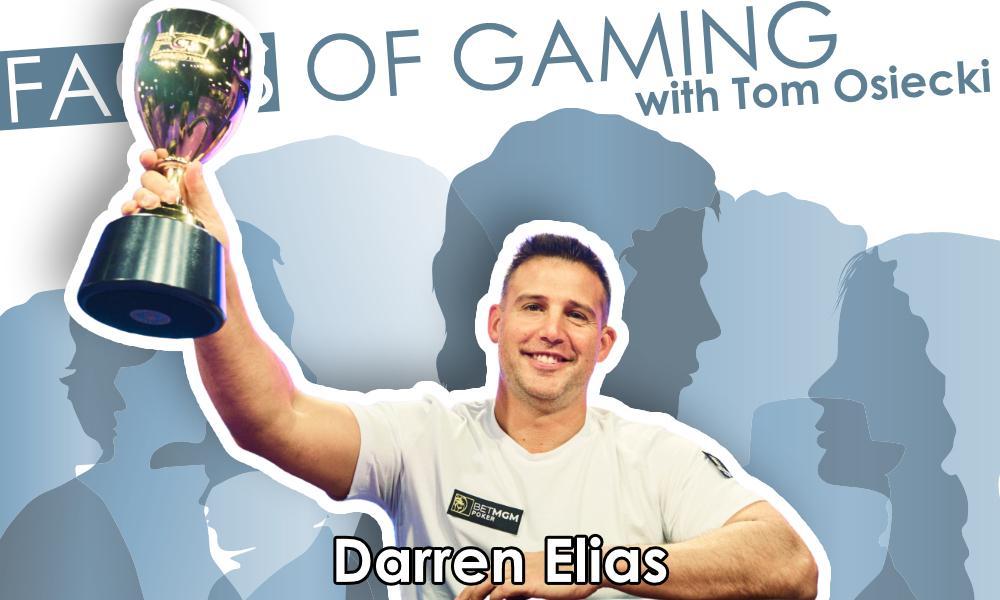

Darren Elias began playing online poker in college and became the number-one-ranked online player. In 20 years of professional poker, he won an estimated $20 million dollars and is recognized in the poker world as a consummate competitor and professional.
His nickname, “The End Boss,” reflects the respect many poker professionals have for his ability to dominate late stages of major tournaments.
He powered through online poker in the 2000s to become the number-one-ranked online player in 2009. Pivoting to live tournaments, Elias holds the record for four World Poker Tour titles – the most in history. All before his 40th birthday.
Elias is known for his technically skilled tournament play and as a model of disciplined poker through emotional control and his ability to remain objective. He is recognized among poker professionals as a bridge between the glory days of online poker and today’s high roller poker elite.
But in the highly competitive world of elite poker players, Elias expresses that his driving goal alongside winning at poker is time spent with his family.
Moving around
Darren Elias’s father was a college football coach, and Darren moved with his family several times before high school.

“My dad was a college football coach. I think I moved seven times before high school, mostly around the East Coast. He was at Vanderbilt, and then LSU when I was in elementary and middle school, and then took a head coach job in Erie, Pennsylvania, when I was in high school.
“I don’t want to say I was isolated, but because I was moving around so much, I was kind of on my own and gravitated more towards games and being on computers, because I was constantly making new friends and having to pack up and move every three or four years.”
Cutthroat
Elias remembers his first exposure to playing cards was with his family, especially playing against his grandmother.
“At seven or eight years old, we would play cards at family get-togethers and with my grandmother where we would play for quarters. She was cutthroat. She’d take all my quarters and brag about going to the laundromat with my money, so she was a good inspiration. We played pretty tough against each other,” Elias recalls.
Moneymaker
In high school, Elias was inspired by watching Chris Moneymaker on television, which was the start of his poker journey.
“I think around 2003 I was a junior in high school, and we would all sit and watch Chris Moneymaker, and then we all started playing Texas Hold’em. I was always a little more into it than my friends. I would go home and read a book about poker or start to play online and then created an account. That’s when I fell in love with the game and started to take it a little more seriously. So, by the time I went to college, I was playing pretty much full time online, not for a ton of money, but playing a lot,” Elias remembers.
Poker took over
Elias went to college in Southern California where he was a math and physics major hoping to one day work at NASA.
“I was a two-sport All-American in high school, swimming and water polo, and attended University of Redlands in California on a water polo scholarship.
“I was looking to get out of Erie, Pennsylvania, so I went to a small Division Three school in Southern California, where for the first two years I was swimming and playing water polo before poker really took over and got serious.” Elias said.
Not typical
Not your typical college student, Elias started playing online poker in college, which led to winning an initial $15,000 (which he ‘spun up” to $100,000). His ability to keep winning led to bigger games and travel across the country and Europe, all while not yet 21 years old,
“I didn’t have a lot of money initially, and online poker was pretty good back then where you could make a lot of money. I was able to build a nice bankroll to set up to play bigger games. I eventually started playing in live tournaments when I was old enough, but you have to be 21 to play in Las Vegas.
“In some California card rooms, you could play at 18; so, when I was 18, I started to play more in person and travel to jurisdictions where I could play, so I would go to places like Monaco or London. I was in Europe a lot before I was 21, trying out the live game,” Elias recalled.
Resistance
Elias’s poker playing travel schedule naturally concerned his parents.
“There was a lot of resistance from my parents initially.“I totally understand their perspective and had to prove to them that I was responsible for a couple years. I wasn’t some crazy gambler running all over the place. I treated it very seriously. I kept good records and spreadsheets, I chose which games I was playing in, and always tried to treat it like a business, which I think they saw. I sat down with them and worked out where I was going to finish college. I’m still going to get my degree, just in case. But it may take a little longer, maybe a different degree than I started with, but I’m going to keep playing poker to see where this leads me,” Elias said.
Planes and hotels
Playing poker online out of his college dorm, he would participate in satellite tournaments where he would qualify for plane tickets and hotels in bigger tournaments. Like I said, not your typical college student.

“I would play online and qualified for tournaments all over the world: Australia, I went to Melbourne, London, Paris, Madrid, Monte Carlo. Eventually, China, I went to Macau, but that was later when I graduated. I was enjoying it as a young twenty-something getting to see the world and play a game that I loved. I thought it was great,” Elias declared.
Could not do both
I asked Elias about the tipping point that led him away from his career dreams of working for NASA to a decision to become a professional poker player.
“I had to decide the summer when I turned 21. I was working with this one professor who was hooked up with NASA, and I had an internship in Hawaii to work at this Mauna Kea Observatory.
“It was also the first summer I was eligible to play the World Series of Poker, and I couldn’t do both. So, I had to choose, and I decided to go with poker. I changed my major to creative writing, and those courses were a little more flexible, the professors were more comfortable with my travel,” Elias said.
Like Doyle Brunson
While stretching out college and traveling, Elias entered into a stage as a wandering gambler, living from tournament to tournament.
“I was a wild 22-year-old road gambler. I remember I was playing in a big tournament in Biloxi, Mississippi and I had $200,000 cash in my trunk. I was driving across the country, stopping at casinos, and really didn’t know where I was going to live, where I was going to settle. I was just looking to the next tournament, to the next game.
“I did that for a couple years, and ended up back near my family in Pennsylvania, where I settled in Philadelphia, and that was my home base for operations where I was still traveling and playing a lot. I started playing a little more in Atlantic City. I had this brief phase where I was a road gambler, like Doyle Brunson, back in the day, I guess,” Elias remarked.
Darrenelias
Before becoming famous in live tournaments, Elias established himself online as one of the strongest internet tournament players in the world.
Playing under the screen name “darrenelias,” he achieved two World Championship of Online Poker (WCOOP) titles, an FTOPS championship and became number one in online tournament ranking in 2009. He eventually earned more than $8 million in online winnings.
He continued until online poker’s infamous Black Friday.
“In April 2011, the U.S. government basically banned online poker in the United States, and, every website you would pull up had been blocked, your money frozen. A lot of players relocated to different countries where you could still play for a brief time. I got an apartment in Canada, in Ottawa, where I would go up and play online poker. I didn’t want to permanently relocate out of the United States; so I think that’s why I shifted more to playing in person,” he said.
Work ethic and attention span
I asked Elias what made him such a winning online player.
“I think I had a good work ethic and a very long attention span. I don’t mind sitting in front of a computer for 12 or 14 hours doing the same thing. I can get locked in and observant, paying attention. I was always one who would observe how everyone played and took notes, probably more so than my peers. Where a lot of players would just play kind of a rote strategy that’s the same against everybody, I was trying to adapt, watch what my opponents were doing and build counter strategies to beat them more so than some other players; so I think that was a big part of it.”
Between 2009 and 2012, Elias went from playing tournaments wearing sunglasses and headphones. He was learning the live end of his craft.
“I had a lot of struggles in live poker at that time, while I was still doing very well and winning online. I was living in Philadelphia, playing a lot online, but losing in live tournaments. Having a losing year as a poker player is something that happens, but you don’t want to have many consecutive losing years.”
Back-to-back
Elias’s breakout came in 2014, when he won the WPT Borgata Poker Open, winning $843,000, and weeks later winning the WPT Caribbean event. Between 2014 and 2018, Elias won a record four WPT championships: the Borgata Poker Open (2014), WPT Caribbean (2014), the Fallsview Poker Classic (2017), and the Bobby Baldwdin Classic (2018).
These victories resulted in a record-breaking four WPT titles cementing him as the most successful player in World Poker Tour history.
“That was a whirlwind to win the first one at Borgata. My wife is from New Jersey, and we were engaged at the time. So, to have her there, my family was there, my mom came, my brother came, and to have them there at your home casino to win your biggest accomplishment in poker was pretty cool.
“That was awesome and that momentum carried. The next tournament I played was in St. Martin, in the Caribbean, and there was definitely some momentum effect. When you’re doing well things kind of go in your favor in poker. You’re able to find some plays you might not play and maybe luck is on your side a little more. I was definitely riding the heater there. I think, at the time, I was the only player to win back-to-back world poker tour events in the same season, so that was super fun, and it was a great run,” Elias stated.
The End Boss
I asked Elias about the reputation that earned him the nickname “The End Boss,” along with his self-described ability to be objective.
“Yeah. I think that came from players who really do not want to play against me and being related to as the final boss in a computer game. I seem to do very well in the end game of poker tournaments. If I got down to two players, I usually won. I’m a pretty strong heads-up player, so a lot of times at the end of the tournament you’re facing me and I was always pretty good at closing out a tournament and getting the win.
Insane highs and lows
Press descriptions of Elias often paint his style as stoic, extremely disciplined, emotionally controlled, difficult to exploit, elite at heads up play, and strong in high pressure situations. I asked him where that kind of style came from.
“I mean, in poker the highs and lows are insane. I think if you’re going to ride that roller coaster emotionally that’s pretty difficult. A lot of things are out of your control, so I’ve always kept an even keel and tried to be more focused on the process than the results. You can have a great hand and be 99% favored to win, and play it perfectly, when something crazy can happen and you can lose. You can either get upset about that and let it affect you, or you can just accept that as part of the game and move on. So, I’ve always tried to stay levelheaded and keep an even keel,” he said.
Bracelet
With a long list of championships behind him, Elias finally won his first World Series of Poker bracelet in 2025, a win that had eluded him for years.
“I have been playing the World Series of Poker every year since I’ve been 21, so that’s nearly 20 years now. Up until recently I hadn’t had a ton of success. Last year I played an online bracelet event, an $800 event, and ended up winning it for about $200,000. That was my first bracelet, and definitely takes a little weight off your shoulders, and my buddies are busting my chops a little less about not having any bracelets,” he said.
Bridge
Darren Elias represents a unique bridge between online poker and today’s live tournaments. As he talked about this, he pointed over his shoulder to a photo of him playing against poker icon Doyle Brunson. “I’d say I’m probably one of the few players who grew up in the online generation, but still played against the old timers. I’ve played against Doyle Brunson, RIP. I have a picture of us playing right here. There are all of these old-time legends I played with in my career, but also still have a foot in the online technical game. I know the young kids, their screen names, how they play, that kind of thing. So definitely a bridge between the two,” Elias stated.
More technology, less bravado
I wondered what Elias thought of how the game has changed in 20 years.
“Well, firstly, I would say players have gotten better. I mean, I think that happens in any sport or discipline as people figure things out and are closer to the end goal of playing optimally. The technology and computers have been a huge part of it.
“If you look at the biggest tournaments in the world, most of the professionals or winning players in there are technical people who study a lot, they know all the spots. Really what they’re trying to do at the highest level is take the human element out of the game, which was a huge part of it 10 or 15 years ago, where it was more mano a mano, when it was more ego and bravado; that kind of thing. Now it’s much more technical,” he remarked.
AI and poker bots
“I was hired in 2019 to play against the best computer bot in the world. Open AI and Carnegie Mellon owned this computer software, and they wanted to test it. That was the start of, I would say, the computer evolution, where I was in this computer experiment, playing against a robot all day.
“They had a team of computer scientists working with it, but they were not poker players, so it was interesting talking to them, trying to fix some things. I was shocked at how quickly this computer system got better. It went from two weeks of playing terribly and getting smashed to being the best player in the world, just from learning and playing against me.
“Talking with the team and getting to see that strategy really opened my eyes to, like, this is the future of poker and poker study; so you can’t ignore it. I’m a little slow to accept the poker computer revolution, that that was a wake-up call,” he remarked.
Massive minority
Elias stated that one of his biggest challenges is finding balance between poker and family life.
“Yeah, it’s difficult. I would say 90% of professional poker players in America live in Las Vegas. I’m in the massive minority that doesn’t live in Las Vegas.
“I live in New Jersey, and I have to travel to play all these tournaments. I have to do more and be away from my family more than a lot of these guys.
“I’m in a different ball game, and I don’t dislike that. I love living where I live. My wife has a big Italian family. We have a support system for the kids. I love that, but I’ve really had to differentiate when I’m playing poker and working and when I’m on family time.
“When I travel to the World Series of Poker to play five or six events, I’ll be gone 10 to 12 days. During that time, I’m 100% locked in on playing cards, I’m resting, I’m studying, I’m playing 10 or 12 hours a day, fully into poker, trying to win bracelets, trying to win as much money as I can. When I come home from that, I’m basically trying to relax and be a dad and be with my family. I have this dichotomy of work life and family life that’s a little more separated than most people,” Elias confided.
More risk averse
I asked Elias what he thinks contributed to his longevity in professional poker.
“I’m probably a little more risk averse than some of my peers. There are many pitfalls that I’ve seen friends and players fall into, whether it be sports, gambling, drugs, things like that, where I’ve always been lucky enough to avoid that, and discipline.
“I would say a big part of that is I’m not really interested in those things. I’m interested in playing cards and winning money and being with my family. I think that served me well.”
BetMGM Poker
In 2021, Elias contracted with BetMGM Poker as ambassador and recently re-signed.
“I just signed an extension this year for three more years. I love working with BetMGM because it is a natural fit. They have an online product as well in New Jersey, so I live in their markets and I play online. In my role as ambassador, I’m available for marketing, commercials, promotions, things like that. Then I also do consulting on the back end where I’ll give feedback on poker schedules, what tournaments to run, what stakes to run, where to run them, big picture things.
“I advise on what BetMGM can do with poker in the future, where to run certain events, where we should devote our energy. Kind of a twofold thing where I’m representing the company on TV, wearing a patch and in commercials. But I’m also trying to contribute what I’ve learned from being in the industry for 20 years to help BetMGM succeed in poker.”
Power of observation
I asked Elias what the secret to success in poker has been for him.
“For me, I would say the power of observation. I’m very attuned to what people are doing at the table, whether that be their strategy or their body language, like looking for physical tells or patterns and how people play. I think I’m pretty strong in those areas. There’s a wealth of information at a poker table. What people are wearing, what they’re saying, how they’re acting, all of these things can contribute to your strategy and how to beat people. So, I think that’s always an area that I focused on, and I probably devote more energy towards that area than the real technical aspect of it,” he related.
 Tom Osiecki is a casino consultant who writes an occasional column for CDC Gaming Reports called Faces of Gaming, about interesting and engaging people in the gaming industry.