

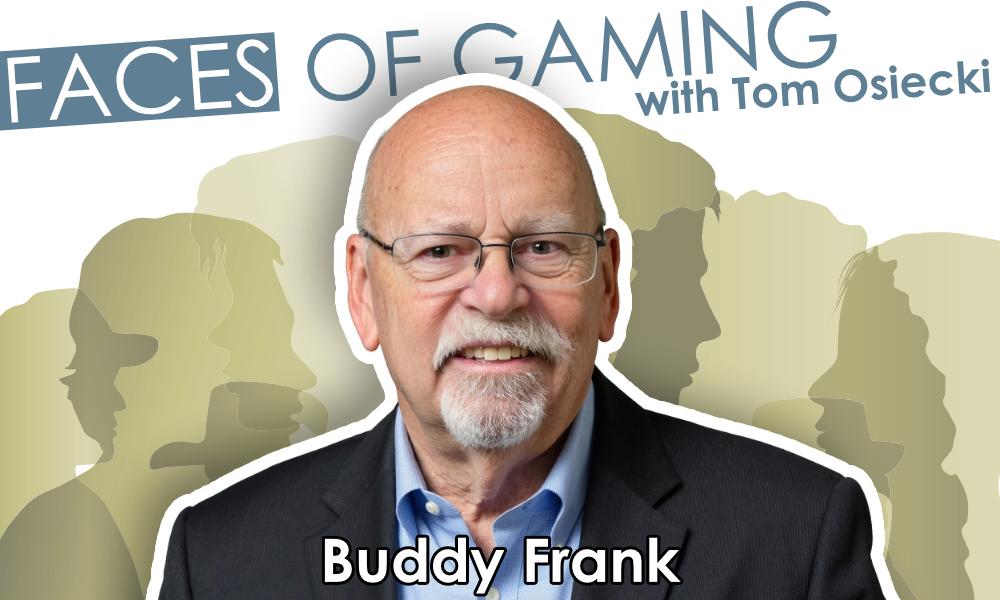

Buddy Frank is an award-winning slot operator who has written over 280 columns for CDC Gaming in the monthly newsletter “Frank Floor Talk.”
In 2023, Frank was inducted into the EKG Slot Awards Hall of Fame in the Slot Operations category. He earned a Lifetime Achievement Award from the University of Nevada, Reno Alumni Association in 2024.
Frank, who is best known for his longtime column dedicated to slot operations and casino management, talks about how it started and what his message is in “Frank Floor Talk.”
Operational perspective
“Former publisher Jeff Compton and I had known each other since my Fitzgerald’s days. I wrote random stories for his early CDC Gaming Reports. When I retired, he suggested, ‘We want to do something from the working side of the casino, and we’re going to call it Frank Floor Talk.’”
“I like talking about things from that operational perspective. There are subjects in the industry that every manager feels strongly about, but feels restrained from saying. If you get a slot director off the record, and guarantee that you won’t quote them, they will say things like, ‘The slots are too goddamn tight and corporate management, and/or the CFO, is making us tighten them again.’”
“I can say that because I’m retired. The only boss I answer to is my wife. Once I’ve completed her ‘honey-do’ list, she allows me to write what I want. Therefore, I can say things I know that the industry wants to talk about but feels they can’t. I really enjoy that role.
“I occasionally begin to worry, ‘Am going to run out of subjects?’ But my God, there seems to be a new pressing issue every month. Today, the hottest things are prediction markets, sports betting, persistence machines and will AI take my job? Those are incredibly important now; but a year or two ago those subjects weren’t on anyone’s radar.
“There are always subjects like that: Are we comping enough or too much? Is snail mail dead? Why don’t we ditch video poker? Will online casinos doom brick & mortar? What scam or cyber fraud is circulating now? Etc.
“There is just a wealth of information/disinformation that I think we need to discuss. And if nothing else, I hope my articles get people talking about those subjects,” Frank said. “I still like teaching, so occasionally covering our history and the industry basics for newer arrivals is also something I believe is important.”
Sparks
Frank’s family moved to Sparks, NV when he was 10, and he fondly recalls good times when his mother took him to a local casino for lunch (he loved the original Awful Awful burger at the Sparks Nugget) and then allowed him to use a crayon to mark an eight-spot keno ticket in the restaurant. She would then play it for a dollar.
“So, I guess you could say I’ve been gambling now for almost 70 years, most of them legally,” he joked.
I asked Frank, from the perspective of a young local growing up in the Reno area, if he ever had the idea that he would eventually end up in the casino business.
“Not even a little bit. I don’t think most locals paid much attention to casinos unless they worked there. In fact, I think in those early days, Nevada casinos had a bit of a negative social connotation with the general population. It was subtly felt that ‘decent people’ didn’t waste their money in casinos. Thankfully, those attitudes have changed nationwide as our industry matured into a welcome entertainment destination.”
Frank went to the University of Nevada, Reno and joined the cross-country ski team.
“I enjoyed skiing, particularly Alpine skiing. In fact, skiing is what caused me to change my major. I was studying electrical engineering, but I skied way too much and flunked out the first semester of my senior year.”
Journalism
He lost his college draft deferment, but joined the Navy where he discovered a love for photography.
“I went back to school, originally hoping for a career in photojournalism. But once there, I drifted more toward writing for the print and broadcasting more than just photography. That led to a position as the student newspaper editor for Sagebrush at UNR. To this day, I still love journalism.”
Frank was also working winters on the nearby ski patrol and helped recover a few young students caught in an avalanche. He wrote a story about that incident and won a scholarship from the Hearst Corporation. “Using that money, a small Sagebrush salary, a monthly stipend from the GI Bill, and a part-time job ‘pasting up’ local newspapers, I was able to work my own way through and graduate with BA in Journalism,” Frank said.
Springs and levers
While he didn’t get the degree, Frank’s time with electrical engineering and math was very helpful as he moved into slot operations and the emerging new technology he would help champion.
“When I started, the slot side of our business was pretty much the world of mechanics. And when I say mechanics, I mean you probably had to be able to use a metal lathe, a drill press and know basic electricity. The industry changed right in front of my eyes into a world of technicians, and I was part of it. I don’t think anybody calls them mechanics anymore. Today they have to be skilled in networking, video displays, software, computers, databases and more. And so, for me, it was kind of the right time, right place,” Frank commented.
Television reporter
After graduation, Frank spent the next 10 years working as a television news reporter for Reno’s CBS affiliate, KTVN-Channel Two. “I had a little bit of hair back then, so I was also the weekend anchor. And of course, at a small market station, you fill in everything from running the cameras to processing film. I’ve done the weather, sports reporting and legislative news at the state capital, including covering Nevada’s Gaming Control Board and Commission. I really enjoyed it. Being out in the field and talking with the public is what I found was most rewarding. It was also a skill that translated well to being on the floor with team members and casino guests,” Frank recalled.

You can learn
Frank’s introduction to gaming came from a friend, Terry Oliver, who worked for Lincoln Management. That was a group formed from several former Summa Group executives. They managed multiple Howard Hughes casinos in Las Vegas and one in Reno. The group (Phil Griffith, Max Page, Paul Manske and Oliver) eventually left Summa and purchased Fitzgeralds Casino Hotel in Reno. They hired Frank as an outside publicist, writing one or two stories on a weekly basis. They soon made him full-time as their Marketing Manager. During his tenure, the group acquired two more casinos in Reno (the pioneering Harolds Club and Nevada Club), along with operations in Las Vegas, New York state, Colorado, Mississippi, Arizona and Illinois. Frank was part of the advance team for all those ventures
“Then Terry Oliver came to me and said, ‘We need you to become the slot director.’ And I honestly told him, ‘I know absolutely nothing about slot machines,’ but he said, ‘You can learn.’ It was a wonderful career opportunity, and a good fit since many of the then-current slot operators lacked marketing and technology skills. I think that was a huge advantage. But I did have to work hard and study to learn the slot side,” Frank said.
Eldorado & Atlantis
Fitzgerald’s various casinos targeted mid-range guests. After a decade, Frank moved to the Eldorado Reno so he could experience a high-end luxury property. Likewise, wanting to learn more about “locals” casinos, Frank later joined Atlantis Reno. “Like Stations and Boyd in Las Vegas, the Atlantis catered to that hometown crowd with some added convention business. It is in places like this that you learn about high levels of repeat play, video poker, value-based products, floor efficiency, good food, frequent events and the like. Nevada local operations closely mimic what occurs at geographically isolated Native American properties.

Middle of nowhere
After the Atlantis, Frank took a position at State Line/Silversmith casinos in West Wendover, NV, just next to the Utah border.
“I went out there in the middle of nowhere because they made me a partial ownership offer, and I thought that was an opportunity too good to refuse. It didn’t work out, but I learned a lot there. At the time, I was becoming an expert in advanced slot systems. Ironically, this property didn’t have one! They were almost completely manual. And my God, was that ever a learning experience. But it was also an invaluable education in the basics and, surprisingly, improved my system skills even more,” Frank recalled.
Most Wanted List
Frank tells a Wendover story about a guy who was playing Megabucks.
“I get a call that someone downstairs has just put in two coins in the Megabucks machine and hit a $10,000 jackpot. He should have won $17 million by playing just one more coin (a $3 bet). It was a frequent myth in our industry that this had happened, but I had never seen it documented.
“I knew this could be a great national story. It would get us publicity and would encourage people to always play max coin. I’m starting to interview the winner, and all of a sudden a plain clothes guy from the sheriff’s office pulls me aside and says, ‘I need you to go outside in the parking garage. There’s a white van out there, and you need to talk to them.’ He made it clear it wasn’t a suggestion, but an order.”
“I go out there and it was like one of these things from television’s ‘FBI.’ The agents were in the van with computers and cameras and everything, and said, ‘The guy you were talking to is on our most wanted list for serious and violent crimes in Utah. We’ve got to nail him, but we don’t have a Nevada warrant right now to make an arrest.’”
“Our casino was located right on the Nevada side of the state line, but our attached parking lot was across that line in Utah.” At the FBI’s insistence, Frank convinced the guy to go to the parking lot with a dubious promise to get some additional perks along with the jackpot.
“Anyway, I got him out to the van, and boom, they make the arrest and hauled him away,” Frank exclaimed. “Needless to say, I killed the story immediately. No one needed to know that winning at Stateline could land you in prison. For months I struggled to decide if I’d done the right thing (getting a violent crook off the street) or was being a bit of a snitch and providing the worst possible casino guest service? Today, I’m pretty sure what I did was right (and yes, we did pay him the jackpot).”
Blossoming everywhere
Frank moved to the San Diego area with the Native American-owned Viejas Casino as Vice President of Slots in 2002.
“I knew Native American gaming was starting to blossom everywhere, so when an opportunity arose, I quickly joined Viejas (just east of San Diego). It was a wonderful market, but like many Nevada operators, I’d never heard of them.
“I kind of rolled in there thinking, I’m an experienced Nevada guy, and I’ll show these ‘hayseeds’ how it’s done. But I was shocked to find out they were doing better than most Las Vegas casinos.”
“While I was certainly able to apply some of my experience to improve their operations, they also helped me see many things in a new light and the value of applying some Native American culture to standard business decisions.”
“Because they had no casino history, they developed some of their own unique techniques, many of which I quickly adopted as my own. Perhaps the best of these was that rather than planning just for the next quarter, tribes were more interested in what strategies would benefit their grandchildren, and their great-grandchildren. I believe my time with Native Americans produced (for me) some of the ‘best of the best’ practices,” Frank said.
Pechanga
After five years at Viejas, Frank accepted an offer as Vice President of Slot Operations at Pechanga Resort & Casino, Temecula, CA. At the time, it was the largest casino in California and is still rated No. 3 nationally in terms of slots. That last 8+ year stop of his full-time career featured many highlights, including setting a Guiness World Record for the largest slot tournament (over 2,000 machines at once), the industry’s first high-speed network floor, and hosting the Bally Users’ Conference.
Frank recalled the issues of going from 2,000 slots to 4,200, which forced Pechanga to explore lottery machines, Class Two bingo-based machines, and finally, with changes in laws and regulations, all Class Three machines (today Pechanga has expanded to 5,500 C3 slots).
“I experienced major revolutions like seeing the floor evolve from what I jokingly called ‘hooked together with tin cans and strings.’ We pioneered an ethernet-based slot system over a high-speed digital network. This gave Pechanga some significant advantages.”
He tells the story about pitching this high-speed network to the tribe along with the VP of IT. “The tribe asked, what’s the ROI on our multi-million dollar investment on this when it is installed? And we had to be honest and say, ‘None.’ But we added, before the end of the year, this is going to be really big. With a high-speed foundation, you can do a lot of things in marketing and promotions that no one else will be able to match.” Today almost every casino has made that move, but Pechanga was one of the first.
“In many ways, Pechanga did that over and over and again. They took risks, and they were willing to explore and try things if they thought it had a long-term return that would benefit both them and future generations. I think that is a major difference between some of the leading tribes and the corporate ownership groups,” Frank commented.
Guinness World Record
I asked Frank how his team won a world record for slot tournaments at Pechanga.
“Because of the high-speed slot system, we could make 2,000+ video- based machines instantly switch away from their standard game themes to a universal tournament format. That meant 2,000 players could play the same game at the same time, and the scoring was completely automated. They played like crazy, and at the end, the machines all quickly reverted back to regular revenue games. The buzz on the floor was electric. Happily, that day produced some record revenues too. We were certain that we could pull it off, so we had Guinness come in and observe. Somewhere on my office wall here, I’ve got one of the plaques that declared we set an official record,” Frank stated.
Teaching gaming operations
During his years at Fitzgerald’s, Frank started teaching gaming operations at the University of Nevada, Reno.
“It was wildly popular at UNR because then no one else in the country was academically teaching casino topics. Professors offered probability theory and business principles; but we decided to teach basic marketing and operational principles as they applied directly to casinos. I remember one of my very first students in Casino Marketing was a fellow named John Farahi, who’s now the CEO and chairman of the board of the Monarch Corporation, which owns Atlantis. Years later when he hired me to run his slots, he became my teacher in management and financial oversight.
That was just another reminder that even today, this is still a remarkably small industry where relationships and past deeds matter,” Frank said.
Frank continues to do random guest lectures and teaches “Advanced Slot Operations” every fall at UNR.
Consultant
After retiring in 2016, Frank formed BF Slot Strategies and began consulting.
“Sometimes I think everyone questions their own value, thinking that perhaps their time has passed. But I keep discovering that experience still counts. This sounds hokey, but I honestly feel a need to ‘pay it back.’ A lot of people were very kind to me during my career, offering great advice and counsel. I’d go to lunch with them, and they would teach me wonderful lessons they’d learned from the school of hard knocks.
“I feel an obligation to do that to the next group who’s coming up. My time in the spotlight is long gone, but theirs is just beginning, and if I can help them somehow do better, I really enjoy that.
“I’ve got a few clients on the supplier side, some data providers and a few operators who just want a little advice, either short-term or long-term, about how they might improve their operations or maybe they just want to hear a second opinion,” he said.
Greatest tools
I asked Frank if he thought that AI would help or hurt casinos.
“It may hurt. But if it does, it’s your fault. I think AI is one of the greatest tools we’ve ever had, and it is simply getting better and faster and better again. But that will only help you if you learn and adopt it. I mean, take full advantage of it, know its shortcomings, as well as its strengths.
“I got into slot systems early and really embraced them. I really dove into the system side of our business. Yet I noticed that many of my colleagues didn’t take full advantage of all the features and benefits of a robust system. That gave me a huge advantage in my career.
“There’s a standard saying on the floor that ‘the worst system is the one you own.’ That is a definite result of not utilizing what you have well. Believe it or not, I’m convinced that while there are some differences, all of the major systems today are terrific. If you are having issues with yours, invest in more training.
“Guess what? That’s the same advice I’d offer to those who are scared as hell about AI. Just get in there and learn how to use it. It’s just a tool that can be powerful. It’s not going to put you out of work. On the contrary, it can make you even better if you make the sweat investment. You’ll reap countless rewards in your career. You don’t need to be a coder or systems analyst; you just need to keep current and effectively adapt to these tools.”
The best they can be
With over 280 columns, I asked Frank what he is trying to communicate with Frank Floor Talk.
”I truly want to help operators be the best they can be. I often dip into management topics about how you should look at your team and how to treat your people, which is a continuing subject. The basic lessons are 100 years old, but they only work with consistent application. If you do a terrific team event, don’t wait years to do another. You must constantly implement these kinds of things.
“On the other end of the scale, new and emerging trends can throw a wrench into everything. Like tightening your slots too much. Like too many REITs. Don’t forget the diversions of resort fees, paid parking, price gouging, IRS rule changes, cashless and Bitcoin.
“I try to bring up topics that I think people should be discussing. I mentioned resort fees above. I mean, they just drive me crazy. The government has cracked down a little bit now, saying you have to be more transparent with the actual total fees. But didn’t it seem obvious for years not to surprise and anger our guests with last minute hidden fees? It’s a hot topic now, but when no one was addressing it, I liked bringing it up frequently,” Frank said
Super threat
I asked Frank to discuss some of the prominent trends that he sees affecting the casino industry.
“There is a real threat now with prediction markets. Essentially, they are unregulated gaming. Of course we’ve always had unregulated gaming, but we’ve never had the federal government promoting it. Were you aware that Truth Social is the official site used by Crypto.com to place these bets? Or that the president’s son is on the advisory boards of Kalshi and Polymarket? OMG.
“It is scary. An 18-year-old in Utah can bet on sports or almost anything else, and the state that specifically prohibits gambling in any form has no say in it. That’s terrible. Some argue that it’s just sports betting, and not to worry since that’s only a small part of our casino industry.
“Consider that many of us never thought we’d have Class Two machines based on Bingo. Who would have predicted that we’d have slot machines based on Historical Horse Racing (HHR)? With those precedents, I could see someone using prediction markets to allow unlimited use of unregulated online slot machines.
“This kind of thing is a big issue right now. But it’s almost certain we’ll have bigger issues in the future. And we’ve had bigger issues in the past.”
Distinctive voice
Buddy Frank’s distinctive voice has 30+ years of casino slot operations experience backing it up. His column challenges the industry with a common thread. Frank believes in avoiding past industry mistakes, working to get the slot floor right and is convinced that technology is not a bottleneck. He adds: “Its improper execution can be.”
Finally, I asked Frank about the secret to success in the gaming industry based on his vast experience.
“The secret to success in casino management is for all your teams to get out of their silos and start working together. I would not have had any success in my career, but for the fact that I had a very close relationship with the IT Team, the Marketing team, the Finance team and the Regulators. If you don’t have those departments on the same page and you are not talking to each other on a continual basis, you’re going to fail. At the very best, you won’t succeed nearly as much as you could have,” he said.
 Tom Osiecki is a casino consultant who writes an occasional column for CDC Gaming Reports called Faces of Gaming, about interesting and engaging people in the gaming industry.