
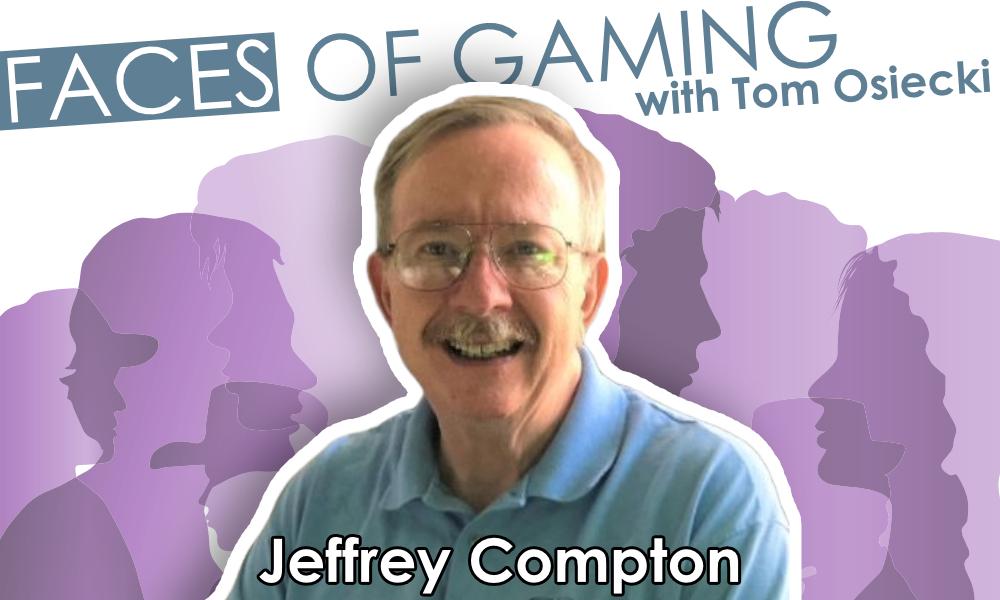

Back in the day when Jeffrey Compton was a finance major at Babson College, he created the school’s Publicity Committee, which oversaw the marketing for college activities. He also became the school’s first theater critic. The night before he received his Bachelor of Science in May 1977, Compton received a special award for being “Babson’s Consummate Commentator, Communicator, and Critic.”
So, from his earliest days, Jeffrey Compton demonstrated the distinctive blend of a love for the arts, a sharp mind for business, entrepreneurship, and a unique way of looking at the world.
Founder and long-time publisher of CDC Gaming, Compton is recognized as one of the most innovative figures in gaming media. In the midst of an onslaught of monthly gaming magazines, Compton’s singular approach to publishing helped create a new kind of information source that was quick, digital, and focused on the needs of gaming executives. CDC Gaming is fast information delivered daily through the internet.
Today, CDC Gaming is the most respected source of up-to-date gaming industry news, assessments, and observation. CDC Gaming gained popularity among casino executives, regulators, suppliers, and analysts and established a reputation for concise, curated, and timely reporting.
Faxes
Jeffrey Compton’s journey taking CDC Gaming from a niche newsletter to a trusted form of gaming information began with daily faxes from his father. Those faxes contained stories about the gaming industry and sparked Compton to realize that speed and digital was the future of gaming publications.
Early days
Compton was born in Cleveland, OH, in a facility that primarily oversaw unwed mothers. “My mother was 40 when she was pregnant with me. She had had a history of miscarriages, so she went to the best doctors at University Circle in Cleveland. They suggested the closest facility was Booth Memorial Hospital, which was a home for unwed mothers, but they had the best delivery room facilities,” Compton said.
His parents were William Compton, who owned a manufacturing plant, and his wife Rosella Compton, who was a real estate and stock investor.
Compton received his BS and MBA from Babson College in Wellesley, Massachusetts. “After I received my BS, I worked two years in corporate America – for Laventhol and Howarth, a CPA firm, and ATO, a corporate conglomerate. “The experiences convinced me that I was not cut out for traditional corporate jobs,” Compton said.
“I didn’t see a path in either of those firms. And if you look at the history of Babson, their big deal has been entrepreneurship. Now, entrepreneurship does not mean starting the next Apple or the next Amazon, what it means is taking charge of your career. I’m in charge of my career, not some outfit I work for. I quickly concluded that I do not work well in large companies,” Compton said.

A natural marketer
Compton’s influences in life came from a wide range of varied interests that began with his family and was impacted by his later-in-life diagnosis with Asperger syndrome.
“My father was an engineer and a natural marketer. I majored in finance and I’m a natural marketer,” Compton said.
Compton says that his grandfather “was a very successful painter.” He also shares that his mother “had a very, very good voice” and sang in a downtown department store where she worked, where employees sang on a small stage to “get people into the store during the depression.”
Compton’s brother Bill Compton “tried to get into the theater in New York and ended up having the family produce a play in Boston while I was in college called ‘The Haunted Host’, which starred a guy who didn’t even have his equity card at that time. His name was Harvey Fierstein.
“We set up a business while I was in college called Quik Charge of Boston. Back then, if you wanted to go to the theater, you had to go down to the box office and buy tickets. At Quik Charge, you could use something called a credit card and use it over the phone. That’s how I got my interest in theater, and that’s how I became a college theater critic; because I was able to get tickets to all the openings because of Quik Charge,” Compton related.
Asperger syndrome
Compton openly speaks about his Asperger syndrome of which he says, “I don’t consider it a handicap and certainly not an excuse, just a variation.”
“I am diagnosed with Asperger syndrome (aka high-functioning autism), a condition characterized by significant difficulties in social interaction and nonverbal communication, along with restricted and repetitive patterns of behavior and interests. I am either deeply interested in a topic (visual and performing arts, history, religion, news, gaming) or not at all (sports).
“People ask me, how does it work? I’ll give you an example. When I was four years old, my mother took me Christmas shopping at Halle Brothers. They had a contest for kids to enter and they’d enter in groups. My mother said, ‘Can my kid enter the five to seven group?’ So, they said, okay, and I won and she got a $25 gift certificate.
“The contest was how many states can you identify on a blank map. You went up and they would light up 10 states, and you’d say what the 10 states were. By the time I was in fourth grade, I could name the presidents of the United States backwards in order, and later the kings of England, or the czars of Russia or whatever. But don’t ask me what a half-back does in football.”
I asked Compton if he thought Asperger’s was a help running his business.
“Now, I didn’t hear the word Asperger’s until I was in my 40s, but I realized when I read about it, and then when I was tested, that I fit into that. Now it’s a big help for me, and I make the most of that. Asperger’s can be a big help in certain situations,” Compton stated.
Tension devices and Monte Carlo Nights
“After getting my MBA in December 1979, I moved back to Cleveland to help my father manage his business, Comptrol Inc, a small manufacturer.
“My goal was to help my dad take his small business to a medium-sized business that would be marketable in 10 years, especially if we grew the international side of it.
“First it was a distributorship, and then it became a manufacturing business. We made tension guides, devices that maintain tension in mechanisms. We also made the devices that weighed and balanced car parts for the car manufacturers.”
Compton took over “Monte Carlo Fun Nights,” a scholarship fundraiser that took place on the Cleveland State University campus in the Mather Mansion, a large Millionaires’ Row mansion located on the campus. “The house turned into a huge casino, and it worked perfectly.”
“It helped my father with a student project he was funding by setting up ‘Monte Carlo Fun Night’ (1981-1994), the city’s largest casino night. During those years I developed several interesting Nevada connections, including Anthony Curtis and Dr. William Eddington when I attended the first Executive Development Program in 1991 in Lake Tahoe.
“When Dr. Eddington handed me my certificate, he referred to me as a ‘wannabe,’ a remark he later apologized for when he asked me to be a keynote speaker in 2001,” Compton said.
I asked Compton if his interest in gaming can be traced back to Monte Carlo Fun Nights.
“Yes, definitely. I enjoyed it. The thing that struck me about casino nights, or casinos, is that people can have a good time no matter who or what they are. They could dress up and enjoy themselves. And you know 90 percent of the people are having a good time and can either win or lose. And so that kind of piqued my interest in gaming. I sold real estate in Cleveland for a couple of years. And between the booming real estate market in Las Vegas and my interest in gaming, I decided to move to Las Vegas in 1994,” Compton recalled.
Guide to Slot Clubs
While playing at the Golden Nugget, Compton observed “this card thing” where players inserted a card and were rewarded with tickets redeemable for free meals and rooms.
“I reconnected with Anthony Curtis – and came up with the idea of writing a book on slot clubs, ‘The Las Vegas Advisor Guide to Slot Clubs,’ his third book – and a substantial hit,” Compton said.
Compton had walked into the Gamblers Bookshop and asked the owner if there were any books on slot clubs and he was told no. He walked out, walked back in again and asked how many times a book on slot clubs was requested. “And he said ‘three times a week,’ because it’s the biggest hole in the literature. So, my next stop was Anthony Curtis’s office. And Anthony says, ‘What do you know about slot clubs?’”
Curtis was at first skepictal, and then Compton went on to complete six months of research.
“I joined every slot club in Las Vegas back then. I wrote the book and it was quite a hot seller. I kept getting calls from casinos asking me to come to lunch because they wanted to know my opinion of their slot club. I realized that this is a good gig, except lunch isn’t enough to pay me. So, at that time, I talked to Bob Dancer, a budding video poker expert, and said, ‘Why don’t we set up a consulting organization,’ which did fairly well through the years. We realized that Compton Dancer Consulting had a lot to offer to the gaming business in two growing areas: slot clubs and video poker,” Compton said.
Exactly what I’m looking for
“During that time, I kept getting faxes from my retired father of articles he saw in this publication or another about gaming – and I realized that a daily report discussing recent news stories could be a valuable tool for the industry. And then luck sent me Ken Adams – who was writing a monthly report that was exactly what I was looking for – except it would be transmitted on the internet every day, not printed and mailed monthly. So, that’s how it happened,” Compton recalled.
“And so, I came up with the idea that we do it once a day, and we did it for two or three weeks without showing it to anybody. Then we sent it mainly to our consulting clients, and I realized it had an interest beyond that,” Compton recounted.
Constant innovation, arts, and The Flash
“We constantly involved innovation. I was raised by my father, who never used an ATM machine in his life but was big on keeping up with the innovations in your industry,” Compton said.
“I moved to New York in 2005 and was engaged in another project with my wife Norma Foote, while CDC Gaming was a subscription piece at the time. But my heart was in this arts project.
“It was supposed to be a web site for arts consumers, where you could go and look up the city you’re visiting, or the city you live in, and see what’s available. Between my wife’s Alzheimer’s, the fact that the arts project was draining time and money, plus the growing threats to CDC Gaming, I sold the site to a larger outfit.
“But I gained a lot from that. For example, I learned the value of an Associated Press subscription, where you can run Associated Press stories on your site in their entirety. Plus, how to set up a website cheaply, but still a good website. So, I learned an awful lot. And I also worked with a writer, Brooke Pierce, who is now one of our editors at CDC Gaming” Compton said.
Compton discovered that the AGA was putting out a newsletter; and he and his wife realized it was a threat.
“I realized that if I did not do something, the business was going to go down the drain. So, and you think I’m a fighter, you should have met my late wife. We decided that’s when we set up the Flash, because the Flash would be earlier in the morning before the other piece came out,” Compton stated.
Different interests
“By 2007, I realized that Bob Dancer and I had very different interests. His bobdancer.com products and site had taken off; and I was more interested in distributing the daily newsletters than consulting. At the time we had two other associates, John Stone, who wanted the consulting end of the business (CDC Consulting aka CDC Results), and Dave Newton, who founded CDC Seminars. Though CDC Gaming has strong business relationships with both firms, they are independently-owned.
“In 2012, due to my wife’s deteriorating condition (she passed away from early-onset Alzheimer’s in 2017), we moved back to Cleveland.
“Also, another reason I moved back to Cleveland was my father was 95 years old, sharp as a tack, and I wanted to spend his last years with him,” Compton said.
Adapting to change
Compton realized that a subscription-based publication would be left behind by changing market conditions and moved back to Las Vegas to pursue a publishing strategy based on advertising.
“In 2015, my father had died and my wife was now in a facility, and she is as happy as you can be in those circumstances, except she no longer recognizes me.
“So, I realized that I needed to switch CDC Gaming to a strategy based primarily on advertising. If I want to grow this organization and be able to support my wife in the nursing home, I had to develop an advertising program in addition to subscription income. So, I moved back to Las Vegas.
“By that time, I had hired a guy out of college, Cory Roberts, a recent graduate of Case Western Reserve University who majored in music and computers and was growing in the business very quickly. I knew that he could manage part of it and I could manage part of it. So, I moved back to Las Vegas and luck sent me Jim McGlasson, who pioneered our very successful advertising program until he retired at the beginning of this year. At the same time, I was flying to Cleveland quite often to visit my wife,” Compton said.
Specialized products
Compton introduced new multiple specialized products to the existing Flash, and Weekend Report for CDC Gaming.
“I worked on the advertising program and refining the publications when we added Last Call. I came up with the idea and Cory came up with the layout and how it would work. When Covid hit, we developed the idea of doing advertising pieces called Focus on Partners, where one entire email event is devoted to one company.
Semi-retired
“After Covid, in 2020, Compton decided to semi-retire as Publisher and assumed the title of Publisher Emeritus, transferring the Publisher role to Cory Roberts while retaining financial management. “And I moved back to my favorite place in the world – Cleveland. Early this year, I handed the Business Manager role to Lulu Roberts – and will only be doing special projects going forward such as market research and managing the subscriptions,” Compton said.
“The process became that Cory went from tech advisor to Publisher. You know how they do the ‘40 Under 40’ at Global Gaming Business. Cory is the youngest person to ever get that,” Compton stated.
Merger
In late 2024 through January 1, 2025, CDC Gaming and Inside Asian Gaming (IAG) merged to form a new global media company called Complete Media Group.
Following the merger of CDC Gaming and Inside Asian Gaming, Cory Roberts was recently promoted to the dual role of Chief Operating Officer and Publisher of CDC Gaming, effective January 1, 2026.
Both CDC Gaming and IAG continue to operate under their established brand names in their core markets, the Americas for CDC, and Asia-Pacific for IAG.
Andrew W. Scott, Vice Chairman and CEO of IAG, became CEO of Complete Media Group. Cory Roberts, Publisher of CDC Gaming, assumed roles as Chief Operating Officer (COO) and Chief Technology Officer (CTO) of the combined organization.
“The merger was Cory’s idea. He met members of the IAG staff at CDC Gaming G2E functions, plus connected with Andrew Scott at various international shows. Cory’s wife Lulu was born in China, so they were quite comfortable going to Asian shows; and interacted with Andrew, and Andrew proposed the merger,” Compton related.
Gaming industry challenges
With his years of experience as a media leader in gaming, I asked Compton what he thought about the challenges facing the industry today.
“I don’t see a lot of bad, except that there was a bigger step than we thought when we went to internet gaming, and especially internet sports betting. We are operating a large temptation to a lot of people. It will take time for society to get used to it.
“The second one is it AI. I use AI every day and it is a big part of my life, but it’s technology that we have to learn to control. That’s the same thing with the gaming industry. Nobody has taken more advantage of technology in the gaming industry than I have. How many magazines were there when I started? How many magazines are there now? So, that is a major issue we have to confront.
“The problem is gaming has been evolving by changes in legislation, changes in society, values, and changes in the decreased cost of computerization; you know, automation. That’s how the industry has to adjust, including the media that covers it,” Compton declared.
Success secrets
I asked Compton what he thought led to his success.
“Probably the reason I’m in the gaming industry is a grounded education between Babson and my father. My father was an engineer. He had no formal training in business, but he had a good instinct. He also had a huge ethical moral compass.
“So, I think a lot of it was the influence of my father and going to Babson twice. And so, it ended up a very dynamic combination – and luck,” Compton mused.
Lifelong toolbox
Compton’s skill as a mentor was obvious when he related what he tells people about the lifelong toolbox.
“I always tell people, you need five F-words for your lifelong toolbox. One is facts, especially in today’s society, you should know what you’re talking about when you’re talking about it. The second one is friends. The third is fun, enjoy what you’re doing. If you’re not enjoying it, find something else to do but it should be fun. The fourth one is failure. We all will have it, and frequently it was just bad luck; but we all have it and shouldn’t be ashamed of it. And the last one is faith. Religion has been around for thousands of years, and it helps people – and all art has its roots in religion,” Compton stated.
Highly regarded
Compton’s contributions to CDC Gaming as founder and publisher made it a must-read resource. CDC Gaming had retained the leadership role in real time news and analysis, despite the ever-changing gaming environment. As the gaming industry grew nationally and internationally, Compton identified a growing need for coverage that was immediately accessible and highly curated.
From identifying slot clubs as the future, to creating a daily newsletter on the internet that has remained vibrant through the years, Jeffrey Compton remains one of gaming’s most innovative media leaders.
Entries in the Faces of Gaming series:
- Allie Evangelista – From immigrant hotel housekeeper to a Hard Rock Hotel president
- Michael Minniear – Engineering the gaming industry with a passion for disruption
- Jeffrey Compton – Visionary, communicator, arts lover, entrepreneur (now reading)
- Jason Guyot, Foxwoods – Reimagining the future
- Dan Kustelski – From West Point to South Africa to Chalkline
- Keith Winters – Disrupting casino games with chance, skill and a steering wheel
- Joe Billhimer of Cordish Gaming Group – from Katrina recovery to playing the long game
- Erica Kosemund, Choctaw Casinos & Resorts – The oracle of branding and partnerships
- Bill Miller, CEO American Gaming Association – From a family of lawyers comes a political optimist
- Steve Neely – Casino career lessons built on a frame of life
- Circa owner Derek Stevens – A sports-specific brand with a downtown Vegas vibe
- Phil Satre – Chairman of the Boards
- Michael Kaplan – Writing the book on advantage players, for gambling and for life
- Andrew Cardno — Data Scientist, Dyslexic, Taekwondo Master, Author, Futurist, A Modern Renaissance Man Who Really Should be Dead
- Dr. Katherine Spilde – There’s no place like home
- Mattress Mack – Furniture mogul, marketing genius, sports betting champ
- Jeff Connor, owner of Lockdogs – A better mousetrap
- Antonio Perez – An optimistic realist
- Kara Napolitano – Human rights advocate and trafficking expert
- Next Gaming CEO and skill-based slots evangelist Mike Darley
- Dennis Conrad – Executive, founder, creator, speaker, author, columnist, and innovator
- Adam Wiesberg – A journey from sign salesman to dealer to El Cortez GM
- Gary Ellis – Las Vegas entrepreneur
- Alan Feldman – From Mirage and MGM to responsible gaming expert
- John Acres – the Thomas Edison of gaming
- Alex Alvarado — Vice President, Casino Operations at MGM National Harbor and Casino Aficionado
- Lauren Bates — A successful VP at Konami and Chair of Global Gaming Women, all before her 40th birthday
- TJ Tejeda and EZ Baccarat – Reimagining a centuries-old game
- Chris Andrews — Don’t cry for the bookmaker
- Wes Ehrecke — From gasohol and pork chops to president of the Iowa Gaming Association
- Steve Browne – Casino philosopher, master gaming instructor and father of a rocket scientist
- Noah Acres – Shaking up the industry one player record at a time
- Kate Chambers – ICE queen, casino exhibition maven and keeper of fairy dust
- Joe Asher — From the newsstand and racetrack to sports-betting icon
- Paul Speirs-Hernandez — Randomness, chance, reward, and luck
- Ainsworth’s Deron Hunsberger — From finance and sales to president
- Roger Gros — Chronicler of the gaming industry for four decades and counting
- Debi Nutton — Everi board member, gaming trailblazer
- Cache Creek’s Kari Stout-Smith — Dancing backwards in high heels
- Andrew Economon — Making downtown Las Vegas cool again
- Richard Marcus — From the wrong side of the casino tables to the right
- Willy Allison — From New Zealand bloke to world game-protection leader
- Tom Jingoli — From gaming enforcement agent to COO of Konami Gaming
- Tino Magnatta — Interviewing the interviewer, 3,000 and counting since COVID
- Deana and Brady Scott — Still talking shop with the owners of Raving Consulting
- Kevin Parker — “Putting everything into everything I do”
- Laura Penney — Putting in the Work as CEO of Coeur d’Alene Casino
- Andre Carrier — Paying it forward
- Jean Scott — The original casino influencer, still frugal gambling after all these years
- Anika Howard — From Harrah’s First Interactive Employee to CEO of Wondr Nation
 Tom Osiecki is a casino consultant who writes an occasional column for CDC Gaming called Faces of Gaming, about interesting and engaging people in the gaming industry.
Tom Osiecki is a marketing and management consultant for Raving Consulting and can be reached for consulting engagements at 775-329-7864.
If you know of a fascinating personality in the gaming industry you would like to see profiled, please send Tom Osiecki an email at tosiecki@cdcgaming.com

