
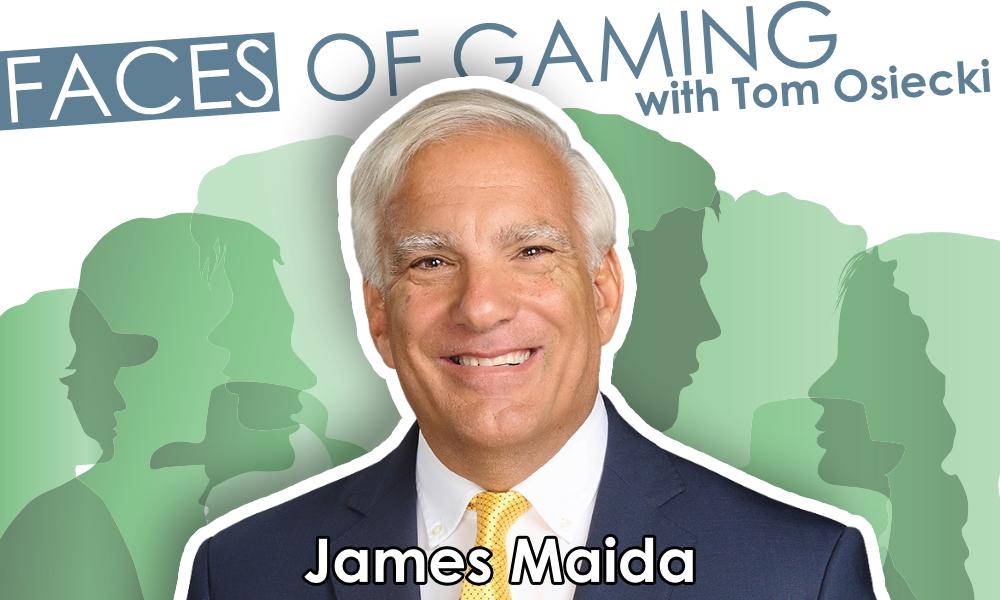

James Maida started Gaming Laboratories International in a loft above his bedroom in Marlton, New Jersey as a side hustle to raise money during law school.
The world’s leading independent gaming laboratory began with a small investment and the recognition of a need for regulation and certification in the gaming industry. Today, GLI is more than a company; it has grown to become an international institution.
“I was testing and providing test reports to make money to help me while I was going through law school. The plan was, when I completed law school, I would go off and be a tax and estate planning lawyer. In 1989, at the end of my second year of law school, I thought, you know what? Let me see if this is going to work. I could always be a lawyer. Let’s see if we can build a company,” Maida said.
Gaming Laboratories International is a company that tests and certifies electronic gaming equipment for 710+ jurisdictions to the standards set forth by the regulators in each jurisdiction. This includes land-based, online, and lottery devices and systems. They also created the GLI Standard Series, which is a collection of standards that have been adopted by most jurisdictions.
James R. Maida, Esq. is President and CEO of GLI. He began his gaming industry career in 1985, testing gaming equipment with the New Jersey Division of Gaming Enforcement. In 1989, he and co-founder Paul J. Magno created GLI as an independent gaming testing and consulting firm. Since then, GLI has grown to a global company with 31 locations and more than 1,600 employees. The company consults and tests land-based, online, and lottery games and systems for more than 46 state agencies, 250 tribal gaming commissions over 710 jurisdictions, and 1,000 equipment suppliers.
Maida has testified as an expert witness in numerous gaming cases on both the federal and state level, including appearances before the U.S. Senate, U.S. House of Representatives, the National Indian Gaming Commission, and multiple state legislative committees.
Rutgers School of Law awarded him the Arthur E. Armitage Sr. Distinguished Alumni Award (2013), and he received the New Jersey Ernst and Young Entrepreneur of the Year (2019).
Maida has been named one of the “25 Most Influential Persons in the Gaming Industry” and one of the “Most Influential People in Gaming.” He has also been honored by the Annual Saratoga Institute on Equine, Racing, and Gaming Law for his lifetime achievements by the Oklahoma Indian Gaming Association with its prestigious Modern-Day Warrior Award; and he has been inducted into the AGA Gaming Hall of Fame and the Mississippi Gaming Hall of Fame.
Fascinated with computers
“Growing up, I was really fascinated with computers. I had a very early Compaq computer; it weighed like 40 pounds—it was like a suitcase. I love math, I love computers, I love computer science and programming. My father, older brother, and younger sister all went to Lehigh University.
“l went to Lehigh University, and I studied computer science engineering. I was one of the first computer science graduates from the engineering school. My dad was a lawyer, and he counseled me that being a lawyer was great, but he was an accountant first, and he thought that college or university study should give me a hard skill in case I decided not to go to law school. I would have something that would be a career coming out of school.
“He encouraged me not to go directly to law school. Right after college at Lehigh, I started with the New Jersey Gaming Enforcement, testing and certifying slot machines, which is computer science, quality assurance, and mathematics, exactly what I was trained to do,” Maida said.
Testing in a loft
As Maida tells it, he worked for New Jersey Gaming Enforcement for two years and started going full-time to Rutgers Law School, where he earned a Juris Doctorate with High Honors and Honors in Taxation in 1990. At the same time, he was testing casino games and writing certification reports.
According to Maida, he started receiving calls from new gaming jurisdictions. “People started calling me and asking, ‘Can you help the state of Montana? Can you help the state of South Dakota test gaming devices?’ Then the South Dakota Lottery VLTs and Deadwood came along in 1990. Before that, it was something I was doing in the loft of my house, going to law school during the day, and then testing games and writing certification reports.”
Maida went on to explain that there were no other companies doing testing at the time, just a few consultants.
“In 1989, New Jersey had its own lab, Nevada had its own lab, and Montana had its own lab. Those were the three places in the United States where you could play a slot machine legally. There was no riverboat gambling at the time. When a few of these states, South Dakota and then Louisiana, started with electronic bingo and electronic video poker, they kept saying, ‘You know what, it’s going to be silly if every state sets up a lab.’ They were dealing with this in Australia as well, where every state in Australia was setting up a lab. They said, ‘Why don’t you? You know, this would be a great idea, James, we just don’t have time to do it.’ So, frankly, they talked me into it, saying, ‘Can you just be a lab for a few of these states, and we’ll get you started?’”
Organically growing
The start of GLI began with contracts with the South Dakota Lottery and the South Dakota Gaming Commission. That was followed by Louisiana and then Minnesota tribes who were the first to enter into a compact for Class III gaming. This was followed by West Virginia video games at their racetracks.
“Basically, as tribes started negotiating compacts, I was assisting them where I could, and that started spreading. Riverboat gambling started in Davenport, Iowa, and we tested all the machines for the Iowa Gaming Commission. And then, of course, across the river, Illinois jumped in and then before you knew it, states and tribes were expanding every week. So basically, we just expanded organically with the industry,” Maida recounted.
A $12,000 investment
“Today’s GLI began with a $12,000 investment, and in over 37 years, we never took a bank loan and never had an outside investor. We ran this company by using our cash as it was coming in and being thoughtful about it and reinvesting globally. That strategy continues today. Our mindset today is that we just don’t waste money. We’ve always been very conservative and made sure we were doing the right thing,” Maida said.
International growth
In 1993, Australia was ramping up government labs. “They asked us to come talk to them, and that’s when we were able to go to Melbourne, which is in Victoria, and Adelaide in South Australia, where they were just starting using VLT’s just like they had in Victoria. They offered us a contract to test the VLTs and systems locally. The only caveat was that we had to partner with somebody. We opened a joint venture with the University of South Australia, and then, before we knew it, we were doing work throughout Australia.
“Today, we have 31 plus offices, and we’re in virtually every country that allows for gambling machines and legalized gambling. It’s over 710 jurisdictions,” Maida said.
“In the 1990s, we went to Africa because the post-apartheid government needed experts to come in and audit the local casinos. The new government built a regulatory framework with provincial gaming boards and later formed a national board. To do the testing locally, we partnered with the local standards company for several years. In Europe, we opened an office in Amsterdam because it’s largely English-speaking, and we were doing more work in Norway, in Iceland, in the Netherlands, and throughout Europe. That’s where we put our home base. Finally, when Macau started gambling, they needed an expert to come in, and we were one of their experts on setting everything up technically. In all these cases, we went into countries because they were serious about regulation and we wanted to help out,” Maida recalled.
Technology adaptions
After 37 years of operation, GLI has been the vanguard of technological changes, often dealing with change ahead of the industry. I asked Maida how GLI faced rapidly changing technology.
“We saw the first bill acceptors come on. Then the invention of Ticket-in Ticket-Out (TITO). Protocols that enabled machines to talk via serial communication to back-office systems were invented in the 1990s as well. Up until then, casino systems did not have complex communication with slot machines as it was all pulse-based communication. We’ve seen the invention of Wide Area Progressives, where people in various casinos could play against each other for a large jackpot. We have seen every major development in gaming technology, such as curved screens. Compare that to when we started, there were only a couple of companies that had video. Everybody else had the electro-mechanical spinning wheels. So, yes, we’ve been there along the way, and it’s been fun. Then technological advances in sports betting and online gaming have come along. We had to adapt constantly.
“Those were just a few of the major highlights. The pandemic brought us the massive global expansion of online gaming and sportsbooks a lot faster than we probably would have seen. The pace of technological change has not been so dramatic that our company couldn’t grow with it, but it has pushed us at times,” Maida recalled.
Obsessive guest service
With over 1,600 employees scattered across continents, I asked Maida what is the one thing he focuses on every day.
“We have a little over 1,600 employees. And what keeps us all going? It’s the mindset of all our team members where everyone is focused on customer service.”
“Every morning, we wake up, and we try to understand, is there anything left over from yesterday, or the day before that we have not quite closed the loop on? This allows us to make sure that those customers continue to be delighted. We all make personal sacrifices to make sure that customers come first. And we’re laser-focused on that.
“If you don’t take care of your customers, somebody else is going to, and what we do is important. It’s important work for the regulators. It’s important to suppliers, so they can place their equipment in the field, and it’s important for the people who play the games to make sure that things are compliant. Our job is to keep our regulatory customers free of scandal, free of problems,” he said.
Move at the pace of innovation
“We need to make sure that we can move at the pace of innovation, because the worst thing that can happen is if a great idea gets gummed up at the lab and can’t get it out and get into the field on time. We never want to be the company that slows down innovation. At the same time, we must make sure that everything meets the rules, standards, and regulations.”
Constituents
GLI’s constituents are lotteries, operators, regulators, suppliers, and tribal gaming. I asked Maida how the company serves such a wide range of customers.
“Technically, we work for regulators. Tribes have regulatory bodies, so do states, and so do federal or national governments; they hire us to do the work. Suppliers submit the work to us, and we are paid by the suppliers. Our fiduciary duty is to certify things to the regulators. After we certify equipment, we can provide field inspections. We provide inspections on cybersecurity, systems, and gaming devices for operators. So, operators are a really big part of our business. And we’ve been doing lottery work for years, testing random number generators, ball blowers, and ball drawing equipment, along with their systems. Now, lotteries are modern. And they’re doing things like electronic scratch tickets, and iLottery, where you can buy your scratch ticket online and numbers games online.
Bulletproof
In 2016, GLI purchased a company named Bulletproof and began talking to clients around the world about cybersecurity.
“I think cybersecurity is something that the industry should take more seriously than it is today. Some companies don’t love to spend a lot on cyber protection. I understand, but I don’t agree with it; because for what you didn’t spend, it’s just a drop in the bucket for how damaging the effects could be if you get hacked. Cybercrime and the technology behind it are moving very fast. Cybersecurity measures are here to stay. Cybercrime is a real problem, and the industry has to make that a priority,” Maida said.
Not good or bad
I asked Maida what he thought about the growth of iGaming that is beginning to outstrip revenues from brick-and-mortar operations.
“I don’t think it’s good or bad. When you look at what some of the research work that the AGA has done, and other studies, iGaming creates more land-based gaming and land-based gaming creates more iGaming.
“There is a synergy. The industry has to continue to be concerned about offshore operators’ illegal gambling. We need to continue to take responsible gaming very seriously – making sure that we don’t target people who have gambling problems or are predisposed to gambling addiction. As long as we do all the right things in this area, the world’s going to change, but you’ll never replace a live casino, because there’s all forms of entertainment in a casino that can’t be replaced. But having an online option is good, as long as we do it the right way,” Maida remarked.
Pushing the envelope
I asked Maida what he thought were the current trends and influences in the industry for the near future.
“The current trend right now is that there’s a lot of new technology that is starting to question, what is gambling? Should this be regulated? So, the prediction market situation is something that bears watching. And then also, sweepstakes gaming. There continue to be many technical people who develop with technical scenarios trying to expand or push the envelope into what is legal and therefore regulated. That kind of work is good because it challenges the boundaries of technology. But I also believe that things have to be regulated so that we don’t cause issues in society. I do encourage people to be as technical and creative as they can be, but we also need to put the inventions into a legal framework,” Maida declared.
Outside investment
Recently, CVC Capital Partners announced its intention to invest in GLI as strategic investment partner.
“We grew ourselves over 37 years. But today we are hiring people in their 20s, and we think a lot about succession planning, and we think about how to make our current employees feel comfortable that they’ll have jobs in 20 or 30 years.
“A company can never be about the founders or a handful of executives who grew the company. Rather, it must be about making the company a long-term sustainable institutional organization. I want to make sure that there’s always a plan going forward.
“It felt like the right time. We want to make sure that regulators feel comfortable with the certainty that GLI will be here for a very long time, with a very strong capital partner, CVC Capital Partners, one of the largest private equity companies in all of Europe.
“That’s the way that we approached this. It’s really for our team and our team members and our employees – and it’s really for the industry. We want to make sure that no one ever has to worry about what might happen to GLI,” Maida said.
Paying it forward
Maida runs The James and Sharon Maida Foundation with his wife Dr. Sharon O. Maida, a Rutgers and Kutztown alumna and a specialist in the orientation and mobility of blind and visually impaired children, and their four children.
“Sharon and our foundation helped to build a school for the blind in Kenya. Closer to home, we were pleased to help build five geriatric Institutes in New Jersey, within the RWJ Barnabas healthcare system, the largest in the state. In this way we can make sure that those over 65 get the best health care that’s age appropriate.
The Maidas also believe in providing scholarships to those who want to realize their dream of a college and graduate education. “We passionately believe that everybody should have similar opportunities as they achieve their degrees.” For instance, at Lehigh University, the Maidas provide scholarships and stipends for those studying abroad.
They also provide scholarships at Rutgers Law School through the Maida Fellows’ Program, where law students are provided stipends, both during the summer and the school year so they can provide pro-bono work for local nonprofit agencies. In this way the Maidas are paying it forward in multiple ways.
“We see philanthropy as not just a donation, but as investing in a cause and making sure that those who receive the investment multiply and double the investment by helping more people out and paying it forward themselves,” Maida said.
Success secrets
I asked Maida what he thought was the secret to his success.
“I think the secret to any success in business is you must be focused on execution. In our case, we have to be focused and almost obsessed with customer service. The secret of our success is that we say what we’re going to do then we must do what we say. We deliver on time, on budget, and always with the highest quality. And when things start going off a little sideways, you have to just stop momentarily, gather your team and focus on the task at hand. I think that’s the secret to any company’s success,” he said.
Regulatory trust
Few individuals have influenced the modern regulatory framework of gaming as industry pioneer James Maida. Under Maida, Gaming Laboratories International has become the standard of regulatory trust in global gaming. It is amazing to think that it all started in a loft in a townhouse.

 Tom Osiecki is a casino consultant who writes an occasional column for CDC Gaming Reports called Faces of Gaming, about interesting and engaging people in the gaming industry.
