
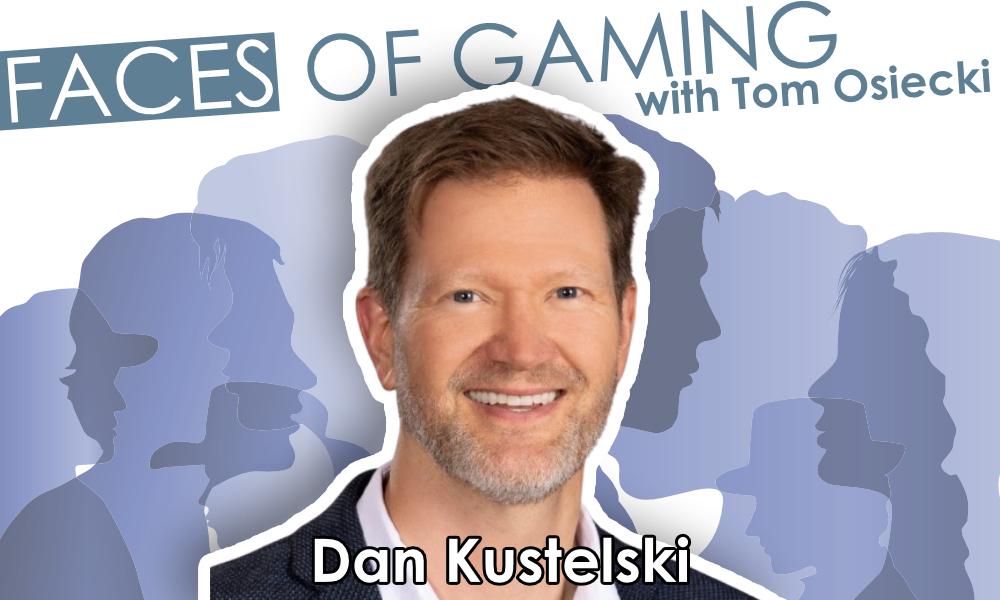

Dan Kustelski is co-founder of Chalkline, a company that serves as a conduit between traditional land-based gambling, igaming, and marketing.
Kustelski’s background blends military engineering training, international sports business, and online sports betting expertise — and eventually included the founding of a tech-driven sports engagement company.
Chalkline works with casinos, affiliates, and operators to build and convert their databases of players with a completely turnkey B2B white-label gamification platform.
Founded in 2016, Chalkline launched its platform in 2017 and has had 50M+ free games played across all clients.
And it all started at West Point.
Combat engineer
Kustelski was raised in Nashville, Tennessee, where his father was a Marine and his brother also attended West Point. At the end of his five-year military career, Kustelski was stationed in Bosnia as a combat engineer “in charge of the U.S. sector’s demining.”
“So, I was a combat engineer. We would blow things up and dig holes for the tanks, organize obstacles for the enemy forces. Towards the end of my military career, I served in Bosnia as the head of the Mine Action Center, which was responsible for demining. This was in 2000 and they had just gone through their civil war, and there were landmines all over Bosnia.
“We were helping them turn what was previously farmland, that now had all of these anti-personnel mines, back into farmland. I was in charge of the U.S. sector, helping them do it themselves,” Kustelski said.
I asked Kustelski if any of his West Point training and experience carries on to today.
“I would definitely say that West Point and my military background laid the groundwork for leading teams of people, working hard and the practice of making decisions with limited information. I learned in the military, and certainly as an engineer, to apply processes and establish best practices, and then reiterate on top of that,” Kustelski said.
MBA entrepreneurship
After leaving the Army, Kustelski decided to follow his self-described adventurous streak and sought out the best university in Africa for an International MBA.
“I found the best school that I could in South Africa, and that was in Johannesburg at Wits Business School with a focus on entrepreneurship. I knew nothing about starting my own company or even exploring that opportunity. After four years at West Point, and then five plus years in the Army, running my own business was just a completely foreign idea. So, I pursued it academically. Had I not done that academically, I probably wouldn’t have had such an entrepreneurial spirit in the beginning of my career that probably led to where I’m at now,” Kustelski recalled.
MBA degrees outside of the states require that the candidate write a thesis. Kustelski’s love for sports led him to interview the major professional sports teams for his thesis in South Africa, including soccer, cricket, and rugby teams. “I interviewed a bunch of those people about how to run a sports team; what are the ways that they needed to organize themselves in order to maximize revenues and unlock additional revenues other than things like ticketing,” Kustelski said.
The ICC World Cup was held there in 2003 and FIFA announced that it was going to hold the 2010 World Cup in South Africa. Due to the contacts he made during his thesis, Kustelski was able to land a job at Octagon International in sports marketing.
Sun International
“I knew all of the sports teams because I worked at Octagon; the local teams, and international teams. A gaming company that produced and built online casino and online sports betting software came to me and said, “We need you to come and do marketing for us because we’re going to be partnering with a lot of these teams, and you already know them all.’
“I said, ‘Okay,’ but at the time I was not very familiar with the fact that I could actually gamble online. I didn’t know that it was really a thing. I learned pretty quickly about the industry, and pretty soon, we had a sports betting license out of Cape Town,” Kustelski recounted.
A few years after the launch, Sun International partnered with the group, eventually ending up purchasing the online sports betting business and appointed Kustelski General Manager, Betting.
Chalkline
In 2015, Kustelski decided to bring his young family back to the United States and began serving as COO for a U.S.-based horse racing/ADW wagering site, WatchandWager.com, based in Lexington, KY. His brother Joe just sold Etix in 2016.
“We were talking about what’s going to happen over the next five years. And I said, “I think sports betting is going to be legal and it’d be interesting to start up a business that helps the 1,000 existing casinos transition into online. Because my experience at Sun International was that it’s one thing to buy a company but it’s another thing to transition a very retail experience into online and digital engagement.
“We combined my brothers’ experience as a ticketing exec and in B2B SaaS companies with my experience in the sports gaming and gambling industries. We’re going to be a tech company that’s going to enable land-based casinos to start to transition online. A lot of my experience with Sun International pointed us in this direction where, ‘how do we help these land-based casinos think digitally, be digital?’” Kustelski said.
“At Sun International, we were going to launch SunBet to our loyalty program and what we found out very quickly was that they had physical addresses for their loyalty members but few email addresses. It was a small percentage of the total loyalty program. Promoting this new digital sports betting product in front of the loyalty program at Sun International was going to be a challenge. We took some of those lessons learned from the previous experience and brought that to Chalkline to help land-based casinos collect email addresses, mobile phone numbers and learn how to engage online,” Kustelski said.
Sports gamification
I asked Kustelski to describe what Chalkline is known for in the crossover between bricks and mortar casinos and digital.
Kustelski said, “We provide mobile sports gamification to casinos for them to engage with their patrons on the their mobile phones and that gamification is just simple free play sports predictions.”
“If you’re in Oklahoma today, you care about the Oklahoma Thunder, you care about the Oklahoma Sooners. These are all passion points for the patrons that go to the casinos in Oklahoma. All you have to do is put a game in front of them and say, ‘predict who’s going to win and stand a chance to win $25 in free play.’
“Through that process, you’re collecting very valuable first-party data that the casinos probably don’t have yet. They probably don’t have that person’s mobile number nor mail address. So, ultimately, we are a data company. Sometimes it’s their own patrons, sometimes people that are on the loyalty program, and sometimes it’s casuals that are coming into the casino. It’s the start of a digital relationship with people,” Kustelski stated.
Chalkline’s website states that it will help you “Build your database fast with the best sports games in North America.” And that “Chalkline mobile players spend 6.5 times more at retail.”
Selling picks and shovels
“Where Joe and I felt like we were the strongest was we offer tools to the industry that will enable them to prepare themselves for more digital engagement. And that’s where the picks and shovels come in. That analogy is from the Gold Rush. Back in California, where you either buy the gold mine and mine the gold yourself. Or you’re standing outside the mine with a pair of jeans and a pair of boots and picks and shovels, and you’re saying, ‘buy my equipment, and then you can go find the gold yourself.’
“That’s where we thought, let’s enable casinos to do this themselves. We’re not going to be an operator. We’re not going to run casinos’ digital operations or sportsbooks. All we’re trying to do is to empower them to do this themselves. And that was the genesis of Chalkline,” Kustelski said.
Prediction vs prediction
Kustelski went on to describe how his prediction games differ from the prediction markets.
“So, mine is completely free to play. There is zero money so that anybody can enter for free. You can win a real prize. In the equation of gambling, I’ve taken the consideration out of that equation. Anybody can enter my games. That’s where we’ve taken a lot of friction out of the digital relationship. Whereas with currently-defined prediction markets, they are pay to play with a funded account and then predict,” Kustelski said.
Deliverables
I asked what Chalkline provides clients with and about the price point that starts at $3,500 per month to much more for enterprise licenses.
“We’re very affordable considering the impact we make. On the low end the charge is $3,500 bucks a month. On the high end, we’ve been multiples of that depending on the client requirements. But for the most part it’s kind of in between that $3,500 to $5,000 dollars a month.
“I give you a white labeled microsite with a buffet of games from local and national sports events.

“The first thing we do is provide our casinos with gameplans for a 12-month calendar. Normally, I’m talking to the marketing team.
“We do all of the planning; we do all of the creative and we usually just take a logo from their website. We do absolutely everything except Ts and Cs and the actual prizes. We create the website, but for the most part in a matter of probably three weeks, we’ll have absolutely everything up and running for them so that they can test it,” Kustelski said.
Local vs tent pole
Kustelski said, “Chalkline creates games for all the major sporting events, but it’s the local events that really generate results.” Using the example of a Philadelphia casino, Kustelski states, “We will create a bunch of Eagles, Sixers, Flyers, and Philles games, because they over-index for local casino patrons. We’re also going to offer all the major tent pole events, the Super Bowl, college football championships, the Kentucky Derby and the Triple Crown and March Madness. March Madness is a massive event because it’s very localized, and casino patrons have a lot of fan passion around their local teams. Localized games outperform other games by three to one.
“Local rivalries matter so much to those people at a local level. As an example, Mississippi casino patrons know when Ole Miss and Mississippi State play. Chalkline ensures we offer prediction games around the Egg Bowl, to predict who’s going to win between Ole Miss and Mississippi State,” Kustelski said,
Massive value
Chalkline uses their casino partner’s slot free play, gift cards, and other lower-level value items as prizes. For larger prize packages Chalkline will tap into casino’s sports sponsorships for grand prizes that cannot be bought like attending player meet and greets, and court side seats. “Stuff that casinos effectively already paid for. Patrons would love to get a signed helmet or a signed shirt or meet and greet. It’s massive value with not much cost to the operator,” Kustelski said.
According to Chalkline’s website, 50M+ games have been played across all clients with a games library that includes nearly 30 titles and features games for players at every level of sports fandom. Chalkline has a full-featured platform that drives repeat game plays and strong social virality. Their “Verified Player” feature integrates with loyalty programs and can provide prize multipliers for players with status.
Robots do it
Since Chalkline’s participants played over 50 million games, it is not surprising that the platform automates the creation of the games.
“The robots do it. Our background in building sports betting software enables us to consume 25 different sports, all teams, all the leagues across the globe. We automate probably 80% of the creation of those games. Our platform is building close to 1,600 games per month. It’s all about personalization.
“I’ve got clients, like Three Rivers in Oregon, where the Ducks are playing in the college football playoffs. I don’t want to send an Oregon Ducks game to my friends in Minnesota or maybe in Southern California, I want to send it to them. And so, we make all these localized games for all of our casinos and that requires systems and processes and a platform that can do all of that with relative ease,” Kustelski said.
Better analytics
“The casino industry is becoming much more data-driven. We feed their CRM systems that help us find the value of our players. At Prairie Band in 2024, we had a case study that we presented at G2E, and it stated that the players that play our games are 650% more valuable than the average player at the casino.
“Our analytics module is called Bettor Analytics. We give our clients access where they can actually look at all the data and see down to the player level. For example, we sent 20 emails to this person. These are the 10 that they opened. This is the sport that they predominantly play. This person is really good. They’ve actually won a few times. All of that information. We get an idea of what their favorite teams are because people typically pick their favorite teams, right? We’re always trying to provide that level of analysis back to the operators,” Kustelski related.
The future
“Games and predicting sports are going to be a part of every casino in the next five to ten years. Every single casino is going to have that as part of their arsenal because it’s fun for the patrons, builds the digital brand for the casino, and they allow the casino to collect valuable information. It’s a very cheap form of engaging with patrons. Some are going to be offering sports betting, but I would argue, a lot of times people don’t want to place a bet. They actually just want to predict who’s going to win between the Dallas Cowboys and the Eagles, and that’s good enough for them. We are an entertainment provider. It’s about offering a bunch of different ways to entertain folks, and this is going to be one of them,” Kustelski said.
 Tom Osiecki is a casino consultant who writes an occasional column for CDC Gaming Reports called Faces of Gaming, about interesting and engaging people in the gaming industry.
