

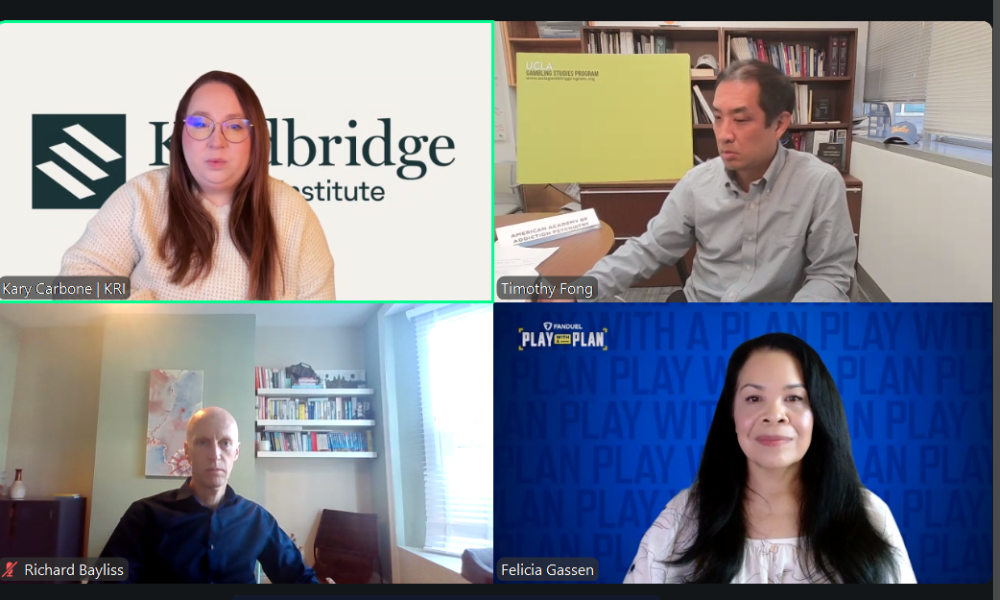

During Wednesday’s webinar “Why Financial Literacy is the Next Chapter,” Dr. Timothy Fong recounted how an acquaintance lost $500 betting on football games over a weekend.
Fong, a clinical professor of psychiatry at UCLA and co-director of the UCLA Gambling Studies Program, said it was money that could have been used on other things.
“But he enjoyed it and said that’s the price I want to pay today,” Fong said during the webinar, sponsored by the Kindbridge Research Institute in recognition of Responsible Gambling Education Month. “I think when we go back and we dial it down, I think we oftentimes miss the fact that spending money is part of the story of gambling, and we oftentimes miss that spending money doesn’t always generate harm.”
But in Fong’s experience, wagering large amounts of money all too often leads to problems that are serious, if not quite crossing the threshold into a medical or psychological condition.
“A gambling disorder is a very different thing we’re talking about – a clinical condition characterized by a number of biological, psychological, social things,” Fong said. “One of the big pitches today for us to view this is just that lens of financial literacy. And I, as a physician, you know, for years still am a bit uncomfortable with that term because it’s not how we traditionally approach patients.
“We don’t use the word ‘How financially illiterate are you, sir or ma’am.’ We don’t say how much has your financial illiteracy contributed to your gambling? How much do you know about budgeting, investing, savings, taxes, personal wealth? How’s that tie into gambling? It’s a long-winded way of saying I think we have to emphasize that what we’re talking about isn’t just harm. I like the term impact.”
Gamblers are besieged more than ever by opportunities to impart with their money. And, potentially lose it more quickly.
That sort of quicksilver pace, while exciting, is fraught with issues.
“There’s not time to pause for reflection,” said FanDuel Senior Director, Responsible Gaming & Community Impact Felicia Gassen. “You can deposit money into your trading app, your gambling app. You’ve got your loans. You’ve got pensions. You’ve got all of these things that are interchangeable, and gambling is just one part of that. So, the kind of education of where gambling sits in amongst the rest of that is really important.

“Traditional RG (responsible gaming) education can focus on how products work. We can give you tools, but that doesn’t necessarily help you understand the impacts of your gambling on other aspects of your life.”
Richard Bayliss, PlayTech Director of Product Compliance and Safer Gambling, noted the emphasis in any responsible gaming program is education that allows people to make better informed decisions.
“We know that just having knowledge on its own doesn’t always necessarily change behavior,” Bayliss said. “You’ve got to be able to support that for players as well. For me, it’s more about increasing people’s ability to make their own decisions and make more informed decisions and not increasing their responsibility to protect themselves.
“It’s not about telling them what to do with their own money. It’s about helping them understand their situation, recognize risks, and understand what options they have to either help support a behavior change or control what they spend.”
Bayliss added that the onus should not be on the players. Instead, various stakeholder should collaborate to make the gaming space safer.
“Operators have a responsibility themselves,” Bayliss said. “There are regulations in place that mandate what they must do, but there’s also the businesses themselves that want to look after their players. They don’t want them for the short-term. They’d rather have them for the long term, they’d rather they enjoyed their gambling, spend what they can afford, but no more than that. Gambling has its place as entertainment, but it shouldn’t ever go beyond that.”

