

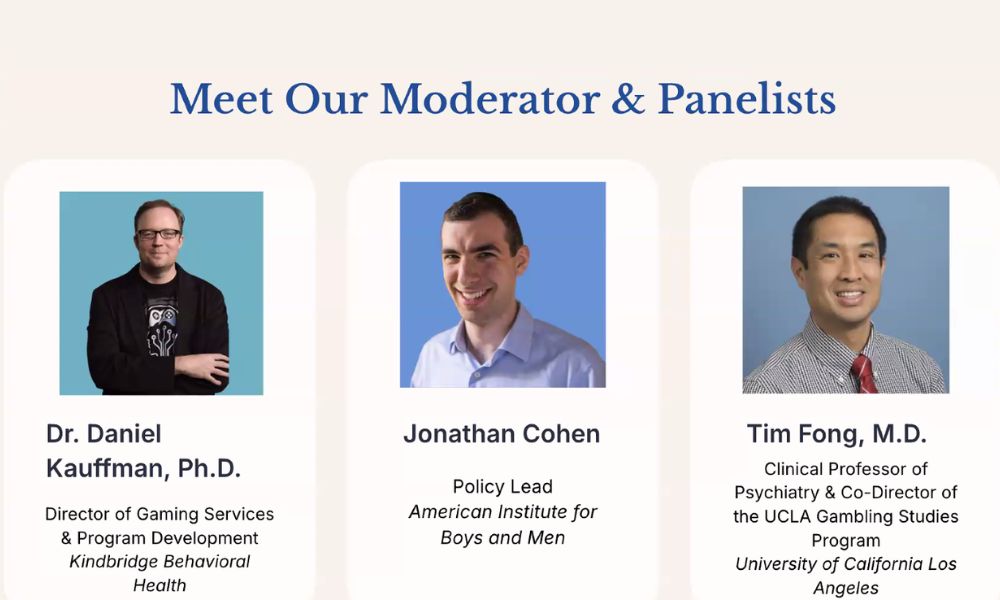

During the Kindbridge Research Institute’s Financial Stability and Responsible Gambling Initiative webinar Behind the Bet: Addressing Gambling and Mental Health Among Young Men, Dr. Timothy Fong, a clinical professor of psychiatry at UCLA and Co-Director of the UCLA Gambling Studies Program, said young men he treats with gambling addictions have undeveloped prefrontal cortices and are inclined to risky behavior.
With access to “supercharged” sports betting apps on their mobile phones, it’s no wonder they become addicts.
“You basically created this sort of toxic cocktail of social, biological, economic circumstances for men, and then handed them a free-for-all gambling app, or multiple free-for-all gambling apps, that are designed almost to make all the situations worse,” Fong said during Thursday’s webinar.

Jonathan Cohen, the sports betting policy lead for the American Institute for Boys and Men and author of Losing Big: America’s Reckless Bet on Sports Gambling, noted that many young men don’t remember a time when the seventh-inning stretch at a baseball game wasn’t sponsored by a gaming operator. They don’t remember when gambling ads weren’t intertwined with sports.
“We really just have a generation of beta testers,” Cohen said. “It’s kind of clear that we’re, for better or worse, finishing our beta test on social media kids. Turns out the results are terrible, but we’ve sort of finished that beta test, and now we’re going to do whatever comes next, a different iteration of that. I think we’re now just running a new version of that test, but with gambling and kids.”
Dr. Daniel Kaufmann, Kindbridge’s Director Of Gaming Services & Program Development, says attitudes and focus of young men have changed. When he spoke to college fraternities in 2015, he was recognized as a counselor who could help students with gambling issues.
In 2025, at the end of talks, students wanted to know if Kaufmann had strategies for how to win more often.
“I realized at the end that I didn’t give them the product they thought they were requesting or ordering from Kindbridge,” Kaufmann said. “That’s sort of my context. Is there a messenger problem here? Does it matter who delivers this message or the context or the setting, and not just what the message says, which is ‘let’s be more careful, let’s be responsible, let’s be smarter.’ Who is appropriately equipped to create the opportunity for change here?”
Fong said that recently a man had “the gall” to tell him there was no link between gambling and mental health. But when Fong treats patients, he sees a clear and direct connection.

“What I see is when young men come in, they turn to gambling to soothe their emotional pain,” Fong said. “And then on the flip side, the gambling just makes for more emotional pain, the crisis of loneliness, the crisis of isolation.”
“In June of 2026 we’re seeing a very clear link when men are using gambling as a way of trying to soothe their mental health,” Fong added. “We’ve seen this. They’re using gambling as a way of feeling better, trying to feel normal, trying to cope with life … It’s hard out there, and vice versa, we’re seeing that same thing. We’re seeing gambling impacting their mental health, making their mental health worse, more depressed, more anxious, more troubled.”
