

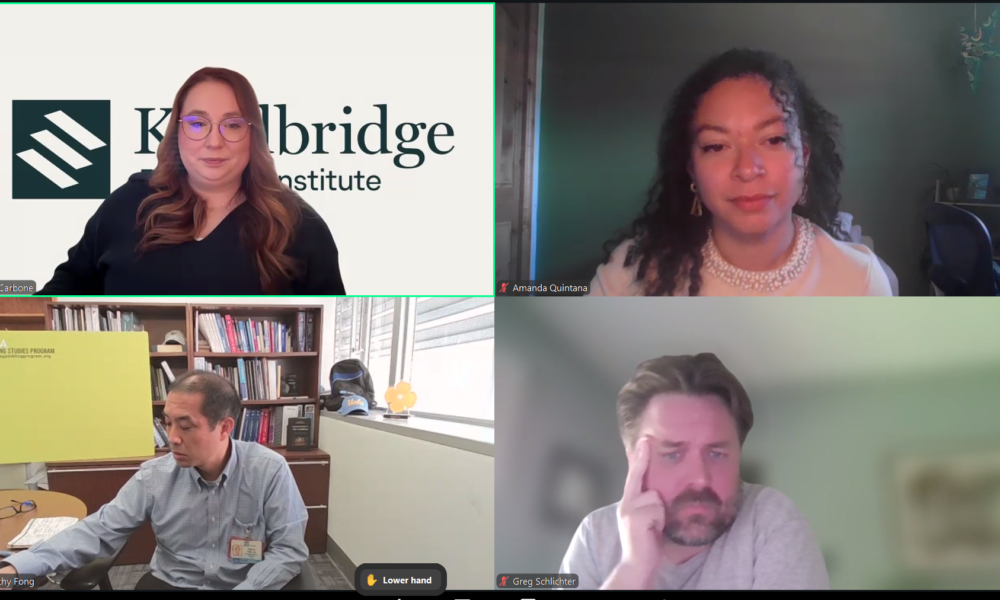

Dr. Timothy Fong, a professor of psychiatry at UCLA’s Semel Institute for Neuroscience and Human Behavior, recently spoke to a teenager whose mother had opened a prediction market account for him. She thought it was a video game, and gave him access to the account and allowed him to use money from her financial sources.
In no time, the young man lost $40,000.
“The mother said she didn’t notice it because there was no debt,” Fong said during Thursday’s webinar Financial Health, Gambling, and Prevention: A Cross-Industry Conversation. “It was just drained from her checking account. The young man had no sense that this was creating any sort of problem at all, because he doesn’t know the value or concept of money, because he’s 14 years old. This was all digital.”
The webinar, hosted by Kindbridge Research Insitute’s Kary Carbone, project lead for its Financial Stability & Responsible Gambling Initiative, discussed a recently released FSRG Insights Report. It also explored how early signs of financial stress may offer opportunities to identify and address harm before escalation.
“Gambling-related financial harm can show up in a million different ways,” said Fong, who co-directs UCLA’s Gambling Studies Program. “The most obvious is when someone says to me, ‘I am really straining and suffering because of the money I lost, spent or owe.’ But that’s not always the case. Financial harm, sometimes we’re realizing, it’s subtle when it’s discovered. Later it can be really, really, really drastic.”
Trans Union Director, Research & Consulting Greg Schlichter said financial problems because of gambling can start off slowly before they manifest as larger issues.

“What starts off as a little bit of tightness … can quickly compound to a serious problem with long-term ramifications,” Schlichter said. “That’s why you want to identify these things early. One missed payment, no matter how small, is going to be a red flag on your credit report for at least seven years.”
Amanda Quintana, Colorado Lottery Player Health Manager and a member of the National Council on Problem Gambling Board of Directors, said that many of the pauses that used to part of the gambling experience – going to an ATM to get cash, the time it takes to get to a physical location, or the setup of a physical space – have been eliminated because of digital gaming.
“Now it’s more instant or continuous with just that digital environment,” Quintana said, “but it can also become really blended into everyday financial behavior through digital wallets or linked accounts, and so that risk can build in a faster way. It also may become harder for players to recognize in the moment what’s happening, how quickly things are happening. … What we’re seeing is just a lot of this comes down to what feels like normal behavior for players versus what might actually be a signal for risk, and that gap is where we have a real opportunity to intervene earlier.”
Quintana also said the language used can be problematic. She noted it’s a constant battle to get operators to use terminology that describes gambling accurately, although there has been progress.
“We’re really at least seeing a shift in the field where more people are referring to gambling as gambling,” Quintana said, “and there are a lot more operators who are at least trying to take more transparent steps to communicate directly with a player and say this activity carries risk. There are tools that you can use. There are budgeting tools, there are these tools maybe that can be helpful for a player, to at least share that responsibility.”
Fong said often, his patients don’t recognize that gambling may be affecting finances, and they think it’s normal to live paycheck to paycheck. Fong added that changing the conversations around financial concerns and asking difficult questions would be a step in the right direction.
“How difficult will it be for you, given your current financial situation, to pay for basic things, food, clothing, shelter, entertainment?” Fong said. “That’s changing the narrative of how we approach it. That would catch earlier signs of stress.”
