


Casino operators are not exactly short on vendors.
A single property can rely on different companies for its casino management system, payments, cash handling, slot technology, printers, kiosks, digital signage and a growing list of systems behind the operation. Increasingly, operators are asking those companies to work together.
That has influenced how JCM Global approaches partnerships. The company has spent decades building technology used throughout casino operations, but many of the problems its customers are trying to solve involve systems and products outside JCM’s own portfolio.
For Cliff Buckley, JCM’s Director of Sales and Business Development, the value of a partnership comes down to what it does for the operator.
“The partnership has to be meaningful and show value to the casino operator,” Buckley said. “It has to be the right fit, regardless of how innovative the technology may be.”
A good idea still needs a reason to exist
Buckley has been in gaming since 1991 and has spent nearly a decade with JCM. That experience has given him plenty of opportunities to see technology that gets attention but doesn’t necessarily answer a need.
“You may find something really cool, but if it doesn’t solve a problem or an issue, it’s really not that big of a value,” he said.
JCM looks for partners whose technology can be deployed and supported in a casino environment and whose capabilities complement its own. In some cases, a partner brings software or specialized technology that can build on infrastructure JCM already has in place, like its FUZION system.
From the operator’s perspective, Buckley said that can mean “a broad ecosystem of solutions, deeper functionality, faster innovation” in addition to what JCM could deliver on its own.
His threshold for pursuing one is fairly straightforward.
“If it’s not solving a problem, we shouldn’t be doing it.”
Who owns the problem?
Partnerships can introduce their own headaches if the responsibility for making everything work falls back on the casino.
Buckley points to support as one place where the relationship between suppliers becomes particularly important. When JCM leads a partnered solution, the operator can call JCM first. Its team investigates the issue and brings the partner in when necessary.
That keeps the casino from becoming the referee between two vendors when something goes wrong.
“You don’t get finger pointing,” Buckley said. Instead of “It’s not our problem. It’s their problem,” our approach is “It’s our joint problem, and we’re going to figure it out together.”
For operators evaluating the growing number of technology partnerships in gaming, Buckley recommends looking past the announcement itself.
“You need proof of integration, not just proof of a relationship,” he said. “The real test comes whether the partners have built a solution and they work together seamlessly.”
He would also ask what happened once that solution reached the casino.
“Did they deliver measurable value, and did they make the casino operations simpler rather than more complex?”
Years in the count room led somewhere
JCM’s work in count-room automation is one example of a partnership that began with something its team kept seeing at customer properties.
Through JCM’s Intelligent Cash Box system, the company had spent years working in casino count rooms and watching what happened after cash boxes were removed from machines and brought in for processing.
“We recognized there’s an opportunity to take a very manual process and automate it,” Buckley said.
JCM talked with CFOs, count-room managers and the employees doing the work. Across those conversations, the same problems surfaced: labor turnover, absenteeism, workplace injuries and accounting inefficiencies.
“When we asked if we could bring an automated solution, we got a resounding yes.”
JCM developed a prototype and evaluated more than two dozen automation providers before selecting a partner to bring the ICB ASAP solution to market.
Buckley calls it “the best example I have of looking at something that everybody deals with, and nobody knew how to fix. We did.”
An open highway
Payments provide another example of why interoperability has become important.
A wallet provider may have a payment solution, but that provider still needs a secure way to get the transaction onto a slot machine and back off when play is finished.
Buckley describes JCM’s FUZION technology as the “highway” that makes that connection possible. JCM intentionally left that highway open to different providers.
Buckley also said FUZION is system agnostic and can work with different systems providers, giving properties the ability to use JCM technology alongside technology they have already selected.
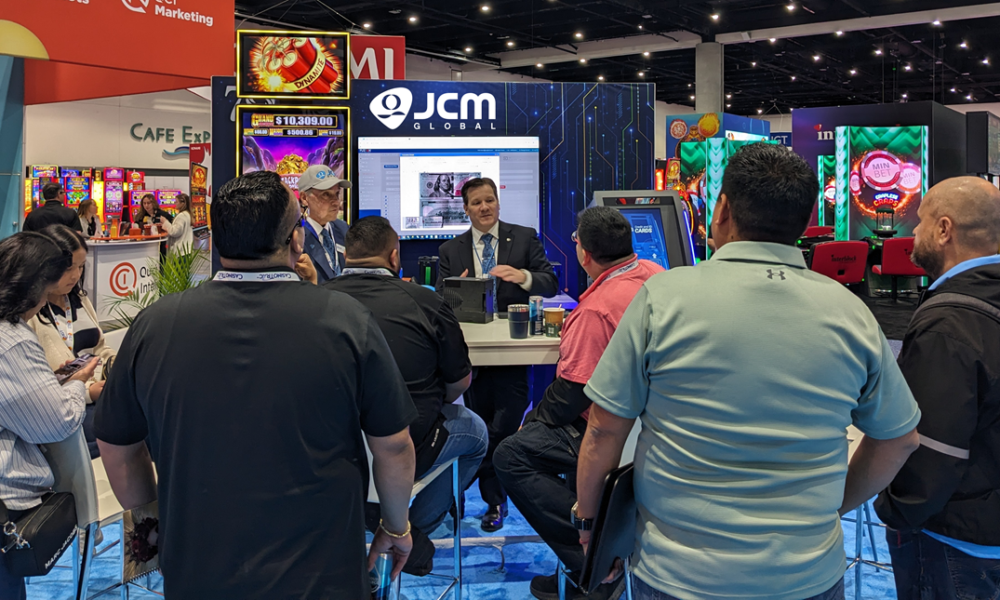
That approach will be on display at G2E. JCM plans to have FUZION operating with multiple partner kiosks and slot machines so customers can see the integrations working together. The company will also show count-room automation technology and a new bill validator, iVIZION 2, developed through collaboration with the U.S. Treasury Department in preparation for upcoming changes to U.S. currency.
For Buckley, seeing those products working together is more meaningful than seeing two company names beside each other on a press release.
And as operators walk G2E looking at what could make sense for their properties, his standard is a useful one.
“You need proof of integration, not just proof of a relationship.”
The rest comes down to what happens at the property: whether the technology works, whether someone stands behind it and whether it solves a problem the operator needed solved in the first place.
