

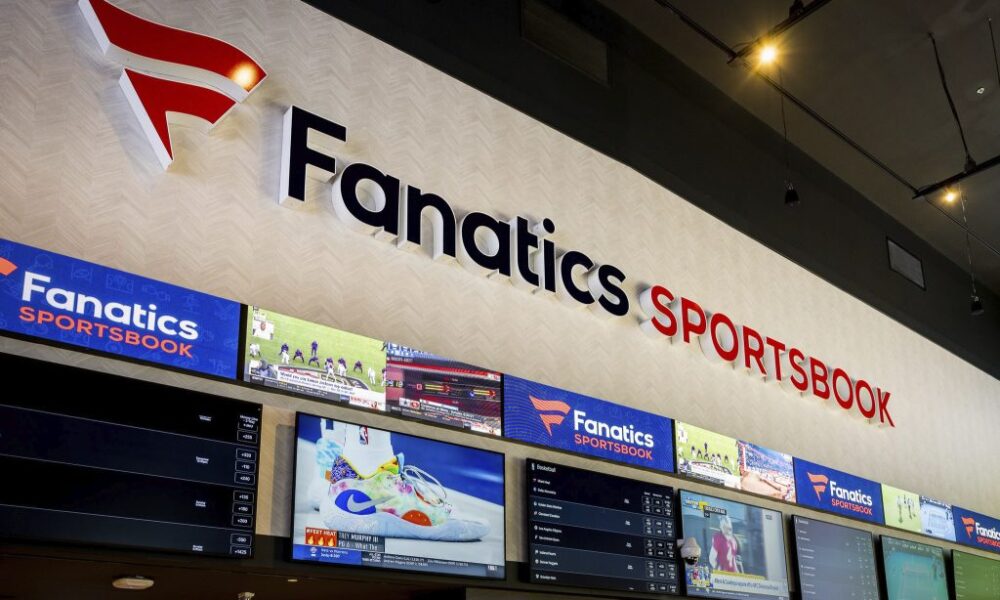

A one-stop shop for sports betting, merchandise, and collectibles, Fanatics is tilting the online-commerce playing field, according to a research note from Truist Securities analyst Youssef Squali.
As Squali wrote, Fanatics customers can buy team apparel, place wagers, and acquire trading cards, all in one visit to the company’s website. CEO Michael Rubin’s view was that this quintuples the value of the customer, compared to consumers who make three discrete visits to three separate sites to consummate similar transactions.
“Fanatics ONE and FanCash are the connective tissue, linking activity and rewards across businesses and giving consumers more reasons to return,” Squali elaborated. “FanCash is the currency of sports, which can be earned and burned across the platform and through external partners.”
Rather than attempting to launch all three verticals simultaneously, Fanatics has sequenced them. Its merchandise was the entry point, overtaken now by collectibles, which “monetizes the file at the highest margin and now captures the resale spread as well.”
These two verticals subsidize the sports betting vertical at present, justified by the lifetime value of Fanatics customers, Squali wrote.
FIFA merchandise expands Fanatics
Spending on sports, according to Squali, has increased at more than double the pace of other consumer activities over the past 96 years. Although Fanatics is said to be underexposed internationally, it has a 140 million-person customer base in the United States, according to Truist figures. By acquiring rights to FIFA merchandise, starting in 2031, this would greatly expand Fanatics’ horizons, Squali contended.
Fanatics was founded in 1995 by Rubin and after he bought its e-commerce arm back from eBay in 2011, it doubled down on merchandising.
“Since then,” wrote Squali, “management has made over a dozen acquisitions that expanded the depth and breadth of the company’s offerings and caused it to disrupt several segments of the market.”
At present, Fanatics is on pace to accrue $14 billion in 2026 revenue, along with cash flow of $1.6 billion. Management hopes to grow that to at least $30 billion in annual revenue by 2031 and possibly $50 billion by 2036.
In the gaming sphere, Fanatics is perceived by Truist as encroaching primarily on DraftKings, FanDuel, BetMGM, Caesars Sportsbook, and theScore Bet. Already the company has displaced Caesars as one of the NFL’s three sports betting partners. It was able to grow, in part, by snapping up PointsBet’s infrastructure when it bought that operator.
The coming wave?
Squali likened Fanatics’s cross-verticals business model to those of Amazon Prime, Uber One, and Door Dash. All combine multiple services, including retail.
Seeing this as the coming wave in commerce, Squali wrote the Fanatics ONE loyalty program “follows this same strategic direction, using shared rewards to connect distinct offerings, encourage repeat engagement, and capture more of a customer’s spending within one ecosystem.” Out of 140 million Fanatics customers, 30 million subscribe to Fanatics ONE.
Fanatics calibrates the annual value of a bettor at $350 per year. However, those who purchase and wager generate annual per-user value of $880. Combining betting and collecting sees that valuation jump to $3,020, vaulting to $5,100 per year from those who buy, bet, and collect.
The primary driver is the Fanatics online application, which the company credits with 27 percent of Fanatics.com’s business. Users are said to spend 3.7 times as much on Fanatics as non-users.
Fanatics unlocked potential
Much of that potential, however, remains unlocked, according to Squali. Out of 25 million active customers, only three percent are shopping on more than one vertical.
The analyst observed that figure “is pretty low today, but could ramp over time and become an important driver of frequency.” Likening it to Uber, which sees 20% cross-sell, Squali wrote, “This shows that there could be a lot of headroom for Fanatics to cross-sell and upsell its multitude of services to customers.”
Another advantage enjoyed by Fanatics, he contended, was its FanCash rewards program. Since this is redeemable for merchandise, it can be used to incentivize sports betting. For example, sports betting engenders 20 points for every dollar of wagering, while prediction-market activity generates 15 points for every $100 in trading and igaming translates to 50 points per dollar of handle.
Squali pointed out that Fanatics has been tracking closer and closer to 10 percent of U.S. online sports betting handle. It has seen its market share grow from an initial 2.7% in 2023 to 8.9% in September 2026.
This growth has come at a cost mainly to FanDuel, whose handle share dropped from 37.2% to 32.6% over the same time period. By contrast, DraftKings has been static at 36% handle share.
