

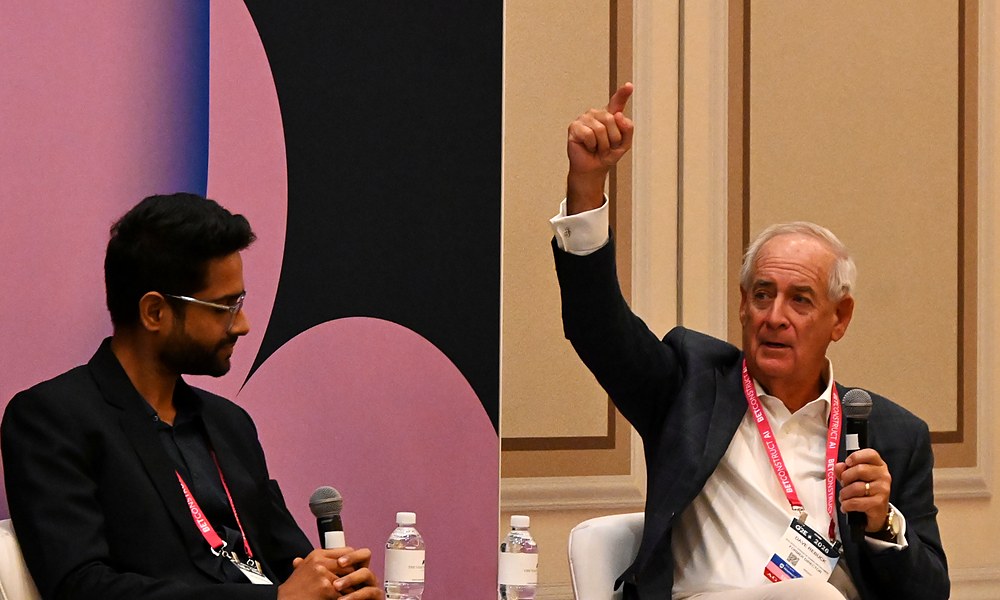

Skill games, in contemporary gaming-industry parlance, connote slot-like devices commonly found in bars and convenience stores. Online skill games are quite a different animal, according to panelists at Global Gaming Expo on September 28.
“Online Skill Gaming in 2026: Where It Stands and Where It’s Headed” was the topic. Closing Line Consulting owner Dustin Gouker moderated. His panel consisted of two skill-game makers and a former gaming regulator.
Desirée Dickerson, CEO of THNDR, makes skill games for third-party providers like online sports betting sites and lotteries. “We think a lot about skill,” she said, which in her case is defined as games that are decided by factors within a player’s control: “Skill will determine the outcome of the game.” Gouker noted that such was the standard that daily fantasy sports purveyors used to establish their legality.
Direct-to-customer games are a province of Topdog. Co-CEO Justin Narang allowed that “skill is a word that gets used around just about anything these days.” He distinguished Topdog’s games from gambling products by saying, “There is no RNG that comes in and decides the outcome.” Topdog, he said, is concentrating on building sports games like football and basketball that can be played in real time.
As Gouker put it, “You’re playing a game where there’s strategy and you’re involved.”
Added former New Jersey Division of Gaming Enforcement Director Dave Rebuck, “Most of the state and tribal regulators are trying to determine, ‘Is it a gambling game?’” He said they’re working off laws written in the 1950s and 1960s, crafted to keep criminals out of gaming. “We’re kind of stuck in these old definitions.”
Say “skill games,” Rebuck continued, and regulators will look at devices in retail settings, as in Pennsylvania, where they are “essentially slot machines embedded in five- and ten-cent stores. What we’re dealing with here are products that are delivered through online applications. Are these games gambling or not?” Rebuck said they can’t be tested or seized. “This is a very difficult position.”
“Games-of-skill laws are sometimes hundreds of years old,” Gouker lamented. “Skill gaming was obviously going to go online because we do all our shopping online.”
The industry, Narang responded, is merely catering to demand. “This industry is not new,” he said. “We’re not trying to find a loophole in the gambling laws,” but following them very carefully.
For Dickerson, the answer is to find a way for the online industry to self-regulate, rather than put the burden on state lawmakers and regulators. To that end, she said game makers are working with the International Gaming Standards Association to develop industry protocols.
The borders between gaming and gambling have been fudged, Rebuck contended. He cited the Garden State’s Amusement Games Law, which opened the door to penny arcades, Dave & Buster’s and Chuck-E-Cheese, “which have a license to offer skill-based games in a retail-based setting.” Why? Because lawmakers were convinced it was a low-risk proposition.
However, Rebuck made allowances for the likes of Narang and Dickerson, saying they’re “coming at us looking for permission, instead of coming later and asking for forgiveness.” He did caution that the growth of online offerings “could turn into a pretty crazy environment,” as all things are offered to all niches.

Seconding that emotion, Gouker said that children’s arcades “ultimately look like a casino now. Everything in there is gambling.”
Rebuck agreed. He said he gives thanks he no longer has to regulate arcades and “these devices that look like and play like video poker.”
One problem, Gouker resumed, is that there is no overarching definition of what constitutes an online skill game. Dickerson volunteered that THNDR offers no card games in Arizona, preferring derivatives of sudoku or Tetris.

It’s hard, Narang added, to put skill games onto a single metric. “There has to be a learning curve” to them, he insisted. “A very unfair practice” of some companies is to pit high-winning bots against real players.
What Topdog wants to do, Narang continued, is give sports fans something they can’t otherwise perform. To that end, it built stat-heavy, online, NBA squads. “All you’re doing is drafting your team, five or six decisions around each player. This game has worked extremely well for us.”
Dickerson offered that, at THNDR, “We have a skilled slots, which I know makes everyone cringe.” She likened it to Candy Crush puzzles, with prizes for matching fruits. “It is literally a puzzle game that you could play in the App Store.”

Panelists frowned on dexterity-based games, with Narang saying, “While dexterity games are great, you feel (pretty bad) if you lose three games in a row.” Drafting a fantasy team, he said, entails much greater skill.
THNDR, Dickerson said, doesn’t make dexterity games at all. “But a lot of folks are doing them,” despite some of the fraud and security concerns that come with them.
Given that skill games online are a small industry yet, Gouker queried, are rules being creating without knowing what they should be?

“The consumer should be aware of what they’re engaged in,” Rebuck responded. “A funny thing with our humanity is that people fall into depending on the craziest things. I get worried we’re establishing a program that allows kiddie pre-gambling,” leading to social harms down the road.
Gouker replied that the present discussion is a good thing. Sweepstakes-based gambling “got smacked down, because they didn’t engage in these conversations” with the gaming industry and its regulators, he said. Rebuck then cited the cautionary example of ipoker, a billon-dollar industry until the federal government targeted it on Black Friday.
Dickerson noted that education of regulators and legislators is crucial, such as explaining her games’ math models and historical disclosures. Accordingly, she said, she made slick-sheet one-page explainers that she hands out at legislative conferences.
But regulators needed to understand, Narang said, that there will always be a risk of harmful spending. “Having said that, it’s a totally different experience” in a skill game.
Concluded Gouker, “I wouldn’t want to be a policymaker trying to wrap my head around this. Whatever your priors are about the online-gaming space, throw them out. This stuff is moving fast.”
