

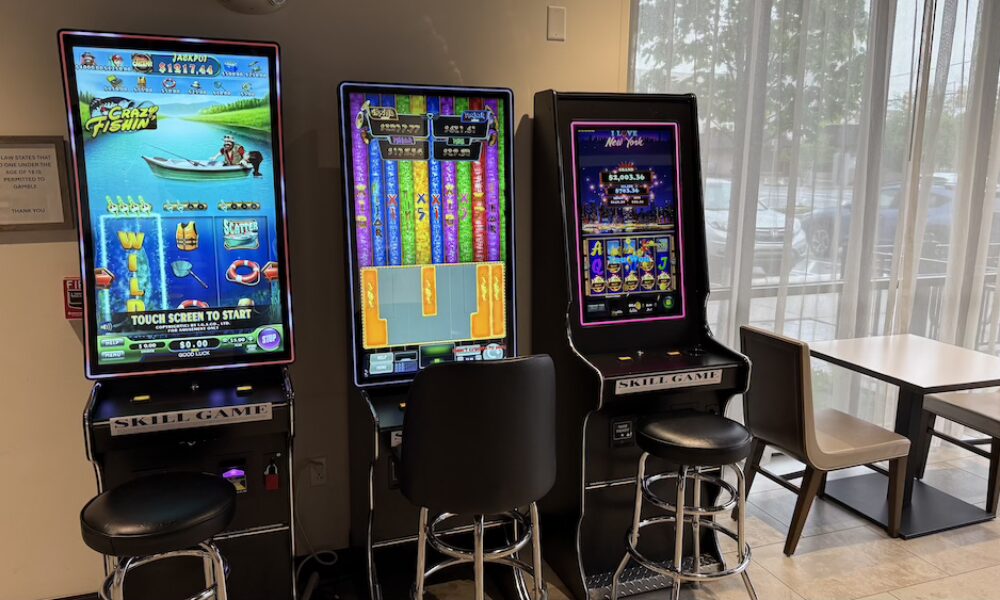

The Pennsylvania State Police are warning businesses with skill games to remove them or their machines could be seized next month, as a crucial deadline approaches for lawmakers to regulate the machines.
The state Supreme Court ruled in June that skill games are equivalent to slot machines, making them illegal without legislative reforms to state gaming laws. Currently, about 70,000 skill games are available in the state in stores, taverns, gas stations, and other locations.
The machines are not taxed or licensed by the Pennsylvania Gaming Control Board (PGCB) the way slot machines are at casinos and the Supreme Court gave state lawmakers until October 13 to find a solution.
Slot machines pay a 54% tax on gross gaming revenue, with Governor Josh Shapiro, a Democrat, earlier this year proposing a 52% tax for skill games.
If a bill isn’t passed by the end of the Supreme Court’s 120-day stay, state police warned the machines and the revenue they generate will be subject to seizure.
“Slot machines are considered gambling devices under the Crimes Code, and a person commits a criminal offense by owning, operating, or maintaining slot machines without a license issued by the (PGCB),” the state police said.
Businesses hosting skill games are urged to discuss their removal with their distributor or vendors. If a distributor or vendor is unwilling to remove machines, state police urge businesses to contact them to assist in their removal and compliance with the law.
“Simply powering off an otherwise operable machine or unplugging them is not sufficient to comply with the law,” the state police said in their one-page guidance.
Legislative gridlock
Shapiro’s proposed tax would have raised money for the general fund, but the governor’s taxation and regulation of skill games was not included in the fiscal-year 2027 budget.
House Bill 2213, introduced by state Representative Danilo Burgos, a Democrat, with 42 co-sponsors, would have the state Department of Revenue regulate the machines and charge businesses a $500-per-month flat fee for every skill game terminal.
The bill sets a statewide limit of 50,000 terminals and was expected to generate $300 million annually. Burgos also proposed to allow local governments to set their own health and safety standards for the businesses where these games are played.
Senators Anthony Williams, a Democrat, and Gene Yaw, a Republican, have introduced a similar bill in the Senate. HB 2213 was assigned to the House Gaming Oversight Committee.

“This is about more than just rules, it’s about making sure these games contribute to the state they call home,” Burgos said.
Earlier this month, Republican state Representative Russ Diamond confirmed he would introduce a two-bill package to modernize the Race Horse Development and Gaming Act to regulate skill game machines.
The first piece of legislation would tax skill games at 20% of gross terminal revenue, limit machines to five in clubs, liquor-licensed restaurants and bars, and qualified truck stops. Diamond also proposes to reduce the tax rate on casino slot machines to 49.9% and establish a tax rate of 49.9% for all online casino games.
Currently, online slots are taxed at 52% and table games at 14%, with sports betting at 34%. Diamond’s proposal did not specifically mention raising the tax rate for mobile table games and sports betting.
Diamond expects his proposal to raise nearly $1 billion for property-tax relief. The second piece of legislation will be the enabling act for providing every qualified homestead and farmstead owner with a direct annual gaming dividend payment.
“With the recent Supreme Court ruling that unregulated skill games are slot machines, it’s time to make some necessary and much-needed changes,” Diamond said.

It’s unclear if the Pennsylvania Legislature can pass a measure to legalize and tax skill machines before they adjourn for the year on November 30. Both chambers are scheduled to return to Harrisburg on September 28.
