

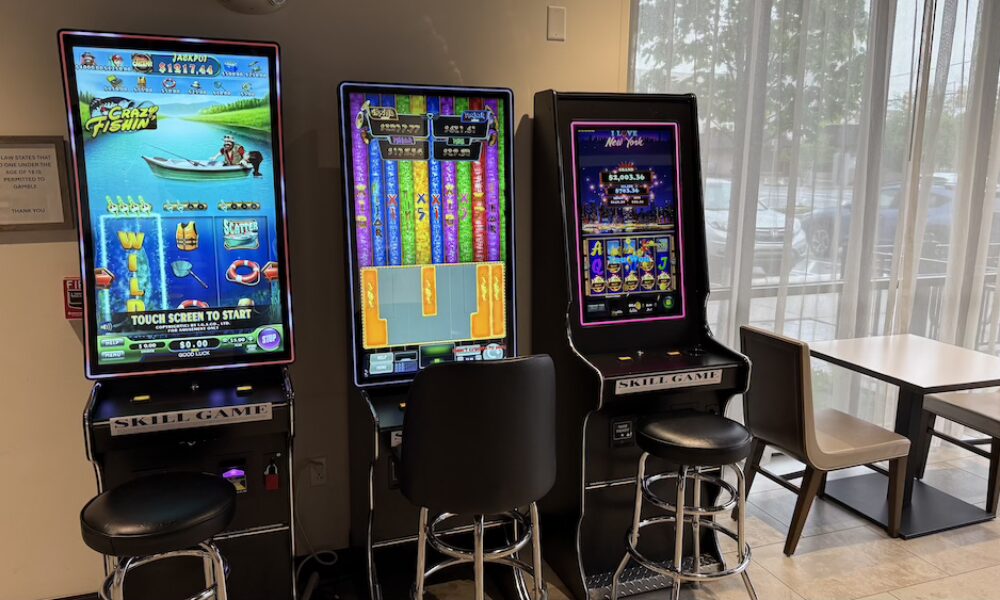

Pennsylvania’s battle over unregulated “skill games” is moving from the courtroom to the legislative floor after a state Supreme Court ruling this week.
In a 4-2 vote, justices determined that skill games indeed meet the legal definition of a slot machine, overturning what the majority opinion called “deeply flawed” lower-court rulings that had allowed skill games “to fall into a legal gray area outside of the reach of both the Gaming Act and the Crimes Code.” However, the court delayed any enforcement of its finding for 120 days, giving the legislature time to address the issue.
The majority opinion called the decision “a straightforward application of existing statutory law,” noting that in 2017, the legislature added “skill slot machine” and “hybrid slot machine” to its overall definition of a slot, making “abundantly clear” that the “skill” element is not legally significant.
American Gaming Association President and CEO Bill Miller applauded the finding, “The Pennsylvania Supreme Court’s ruling makes clear that ‘skill games’ are illegal slot machines under state law,” he said. “This ruling protects Pennsylvania consumers, business owners, and communities from the harms these so-called skill games pose and the public revenue they divert.”
Michael Barley, chief public affairs officer for Pace-O-Matic, a national leader in the development of skill games, said the ruling victimizes more than 10,000 small businesses and fraternal organizations that rely on skill machines for revenue.
“They are now potentially left facing an impossible choice: cease operating these games and lose an important source of revenue or endure a legislative solution that could bring excessive regulation and crippling taxation, which will force them to cease operating these games and lose an important source of revenue,” he said.

Barley encouraged “commonsense” legislation that taxes and regulates skill games fairly, citing proposals in the Pennsylvania House and Senate. “We will continue to work with lawmakers toward a legislative solution for skill games,” he said. “Our No. 1 priority continues to be supporting our small business and nonprofit partners across the commonwealth. Pace-O-Matic will always abide by the rule of law.”
Doug Harbach, communications director for the Pennsylvania Gaming Control Board, said the agency has long requested that it be named the regulator in any legislation for skill games, as it is for all in-person and online casino operations and more than 70 sites with video gaming terminals. “The legislature and governor now have to agree on a law with that and all the other parameters,” such as how many and where such machines are allowed and what tax rate applies. “Should legislation point to us as the regulator, we would have a significant added responsibility, but the scope of that would be determined only after a law is passed,” Harbach said.
A 2025 study by the AGA and The Innovation Group estimated that more than 625,000 unregulated gaming machines, including skill games, are active across the country. The machines generally operate outside regulatory oversight and account for more than $123 billion a year in bets, “often with significantly worse odds for the player than regulated machines,” the report said. It said Pennsylvania has about 67,000 such machines, more than 10 percent of the nationwide total.

At least four bills regarding skill games are in legislative committees. Pace-O-Matics Barley cited two of them, SB 1079 and HB 2213, which would make the state Revenue Department and Lottery Office responsible for regulating skill games and specify that “skill of the player rather than an element of chance is the predominant factor” affecting a game’s outcome. Skill-game players would have to be at least 18 years old, as opposed to the minimum of 21 for casino operations and video gaming terminals. HB 2557 would put the Gaming Control Board in charge of skill-game regulation, set a minimum payback percentage of 85 percent, the same as casino slot machines, and require that players be at least 21. SB 75 would put regulation in the hands of Gaming Control to license and limit skill games to certain liquor-licensed and lottery-licensed establishments, with 18-year-olds able to play.
Gov. Josh Shapiro earlier proposed putting skill games under Gaming Control Board authority and imposing a 52 percent tax on skill-game revenue to generate $2 billion a year for the state. That rate is slightly less than the 55 percent on casino slot revenue.
The Supreme Court ruling came shortly before the June 30 deadline for approving the 2026-27 state budget. The House and Senate reconvene on June 22. The House has approved Shapiro’s budget proposal, but the Senate has yet to act.
One player at a skills-game parlor in suburban Pittsburgh didn’t worry much about the ruling. He had a simple reason for preferring the small parlor to the city’s Rivers Casino and its more than 1,900 machines. “I’m 18,” he said.
