

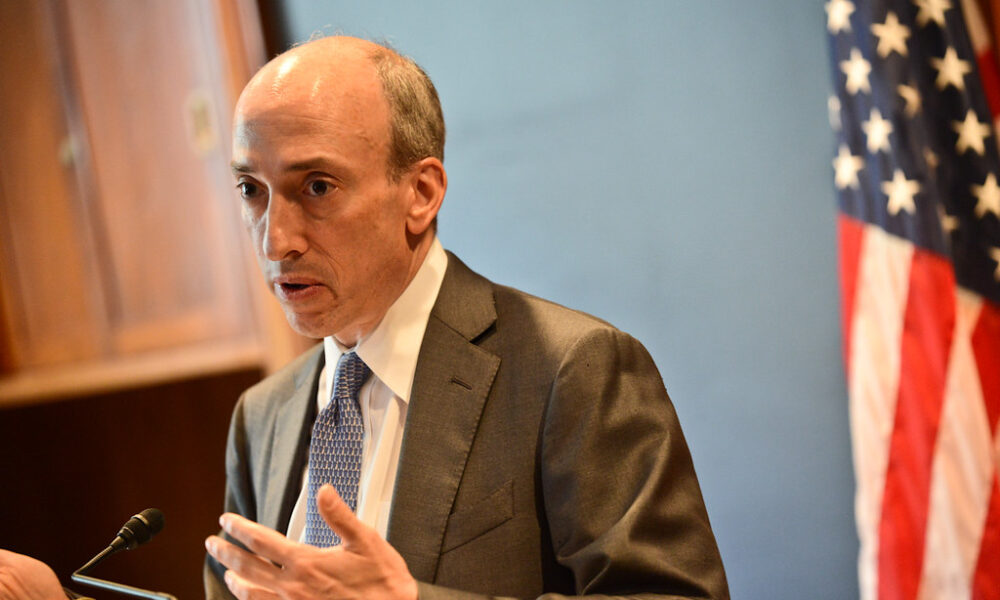

A former chair of the SEC and Commodity Futures Trading Commission told tribal gaming leaders that it’s incomprehensible Congress and then-Senate Majority Leader Harry Reid of Nevada envisioned sports betting when they passed legislation in 2010.
Gary Gensler appeared Wednesday on the New Normal podcast hosted by Jason Giles, CEO of the Indian Gaming Association, and Victor Rocha, the association’s conference chair. The podcast is geared toward educating tribal leaders across the country on issues facing Indian Country, especially prediction markets offering sports betting in all 50 states.
In a recent amicus brief, Gensler challenged the legal foundation underlying the CFTC’s support for prediction markets, arguing that Congress never intended the Dodd-Frank legislation in response to the Great Recession as a way to transform the agency into a nationwide gambling regulator.
Prediction markets have become one of the most contentious issues in gaming and financial regulation. As the CFTC has expanded its support for event contracts, states and tribal governments argue the agency is overriding long-established gaming laws and challenging state and tribal sovereignty. What began as a debate over financial products has evolved into a national fight over federal power, congressional intent, and the authority to regulate gambling in America.
“We had the financial crisis at the center of (Dodd-Frank) and it was this unregulated field called ‘swaps’ – interest-rate swaps and credit-default swaps,” Gensler said. “It wasn’t the only thing that brought down the economy, but millions of Americans lost their jobs and millions lost their homes. It was the most devastating recession since the 1930s. I will tell you I was part of the cleanup crew, went to Congress, and asked for reforms under President Obama. Uniformly, everybody said we have to reverse what was done and bring credit-default and interest-rate swaps and financial derivatives under federal oversight. It wasn’t about sports betting.”
In 2010, Gensler said one of the six pieces of that legislation concerned event contracts associated with potential economic, financial, and commercial consequences or risks. “That’s what will play out in court. No one talking to us at the time thought that sports betting was part of the event contract piece.”
“There are now debates whether the authority to prohibit assassination, war, terrorism, gaming, and contacts involving unlawful acts is somehow a backdoor way of making sports betting swaps,” Gensler said. “It isn’t.”
Gensler mentioned Harry Reid, chair of the Nevada Gaming Commission from 1977 to 1981. Reid specified that any legislation gives the CFTC authority to prohibit gaming contracts. “Harry Reid would have thrown me out of his office if I walked in and said these words on this page mean the CFTC is going to be the federal sports gaming commission.”
Gensler said the Supreme Court has been clear, with an opinion from former Justice Antonin Scalia, that “Congress doesn’t hide elephants in mouse holes.” Looking at the statutory language in Dodd-Frank, he said, “You have to squint really hard to see the words ‘sports betting’ in one prong of swaps around event contracts. The whole argument falls apart and it would be one of the largest elephants in a mouse hole.”

Gensler said context matters. In 2010, only four states had sports betting based on a 1992 law, the Professional and Amateur Sports Protection Act. Nevada was the only state that allowed full-fledged sports betting that’s seen across the country today.
Gensler understands that what’s happening with prediction markets encroaching on states is difficult for tribes whose gaming revenue is being threatened.
“This thing is stark, saying buried in a statute from 16 years ago that unbeknownst to anyone who worked on it at the time that there was this provision taking sovereignty away from the 50 states and sovereignty away from the tribes,” Gensler said. “And that the oversight of sports betting is going to be at this little financial regulator that I was proud to run, overseeing corn, wheat, energy, financial contracts and even contracts related to weather.”

The CFTC isn’t even set up to regulate sports betting, since it deals with an institutional set of financial markets and players, Gensler said. It’s hard to protect retail customers and the 11 states that prohibit sports wagering. Others prohibit sports wager unless you are 21 or older, but prediction markets take bets from those as young as 18, he said.
Rocha questioned why the CFTC is being operated by one member, Chair Michael Selig, when it’s designed to have five commissioners. “The CFTC is down to one commissioner who reports directly to the White House and that’s very different from we’ve had in the last 52 years at that agency and Federal Reserve, Federal Trade Commission, Federal Communications Commission, SEC, and all of these remarkable agencies that have had multiple members going back to the 1800s.”
The Trump Administration argues it controls all of those agencies and the Supreme Court is expected to hand down its ruling on that argument in the next couple of weeks, Gensler said.
Another issue to consider hasn’t popped up on the national radar. Dodd-Frank was implemented in October 2012 and if the argument is that every sports bet is a swap, it means every sports bet made through regulated casinos since then is illegal, Giles said.
Gensler said that’s because the law requires any futures contract must be on a regulated exchange. “That means the last 14 years of sports bets in Vegas and within your tribal casinos were illegal. That’s the absurdity of this position.”
The argument from prediction market operators is that it’s only a swap on their platform and not in a land-based casino, Gensler said. “There’s no definition in the statute or in the courts that is venue-specific.”
Gensler’s illumination of the issue is needed for tribal leaders across the country, Giles said. He mentioned that prediction market operators are constantly running television ads and momentum is on their side. President Trump supports prediction markets and Facebook is getting into the space.
“Are we wrong that this is all a fiction and built on sand, and that this can be undone as fast as they rolled it out over the past 18 months?” Giles asked.
Legalizing nationwide sports betting via prediction markets is an argument for Congress to debate. Gensler said the first sports event contract came two days after Trump was inaugurated in 2025.
“The mid-term elections may shift the mood of Congress around prediction markets,” Gensler said. “We’ll have to see if one or both houses change leadership. Prediction markets suggest right now the House will.”
That just means the Trump administration will focus on the courts, and it eventually will be decided by the Supreme Court in the next year or two. The court will have to decide whether someone “put a fastball by Harry Reid. I think the better argument is that they didn’t.”
