

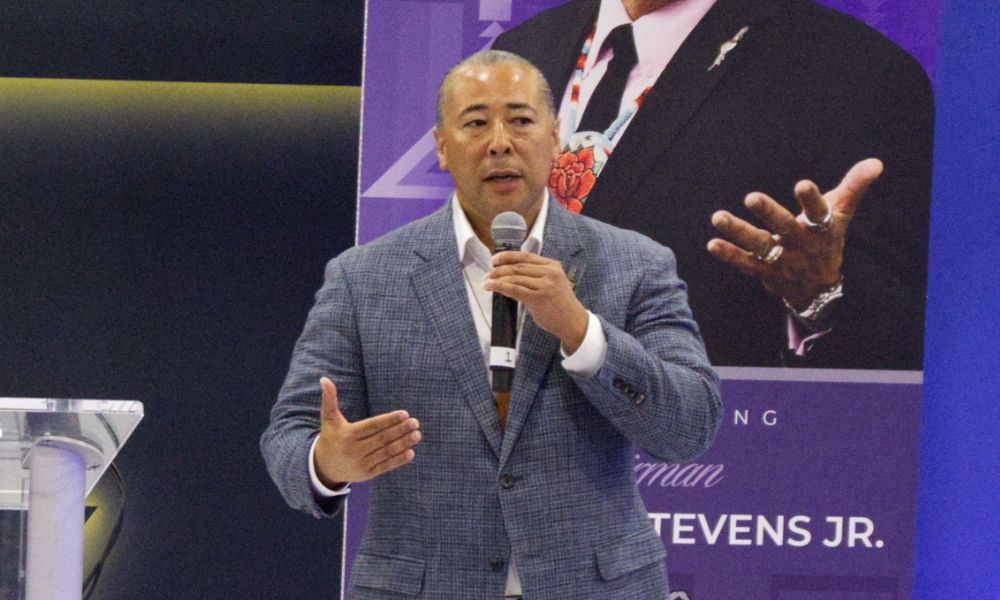

The chairman of the Indian Gaming Association said the federal agency overseeing prediction market operators is spitting in the face of tribes and states with its proposed rules legitimizing sports wagers nationwide.
Chairman David Bean spoke out on IGA’s New Normal webinar following the Commodity Futures Trading Commission’s releasing a document backed by the White House that would legalize sports bets offered nationwide by prediction markets under CFTC regulation rather than states and tribal commissions. States and tribes, which argue the prediction market operators are taking away revenue from casinos and cutting into tax revenue, are fighting them in court.
“I just think it’s the big middle finger to tribes and states,” Bean said. “It’s a continuation of CFTC Chairman (Michael) Selig since he took office. He said he was going to leave it up to the courts, but ever since he got in, he’s definitely working in concert with prediction market operators. I’m disappointed but not surprised. We still have work to do. We’re still pushing that snowball uphill.”

IGA Executive Director Jason Giles said it’s not a surprise that the CFTC has come out with rules trying to legitimize prediction markets.
“It’s a jam job and it’s corrupt,” Giles said. “They blew past three or four different requirements with (Office of Management and Budget) complicity. They needed other agencies’ complicitness in order to jam this rule through in an extremely short timeline with more than 1,500 comments. You’re telling me that in a matter of two to three weeks they looked over 1,500 comments and made any substantive changes to the rule they already had in their back pocket written by the prediction markets.”
Giles said the CFTC had to get the proposed rule through the Office of Internal Regulatory Authority for its economic impact. If it’s declared a major rule, that will require more consultation and justification for the rule.

“Clearly, this is a major rule,” Giles said. “This is affecting billions of dollars. This whole thing tells you they don’t care about being sued. They’re going to violate at least three or four provisions of the Administrative Procedures Act, but they don’t care; they’re already suing up to eight states, plus all the other lawsuits prediction markets are engaged in. It shows you we can’t sit around and take offense. These guys are corrupt to the core, and this kind of rule making is what you get when you have government corruption.”
Giles referred to the situation as “Stalineque. What the dear leader wants, the dear leader gets and you change the rules of the game with very little notice or input, you just to make the dear leader happy,” Giles said. “That’s what Selig is there for. He knows his role. At some point, we have to decide what type of country we want to live in.”
IGA Conference Chair Victor Rocha said the role of the CFTC is there to help farmers place hedges and not oversee sports betting. He accused Selig of using farmers as props when he visits with them. “They are not even pretending anymore,” Rocha said. “The irony is if you go to Polymarket or Kalshi, they have the Democrats taking over Congress.”
Bean has traveled across the country, talking with tribal leaders about the threat of prediction markets. Last week, he participated in the 2026 Tribal Leaders Summit hosted by the University of Arizona Native American Advancement & Tribal Engagement program in Tucson. He spoke to tribal leaders, elected officials, regulators, educators, students, and community advocates from across Indian Country.
“Tribal gaming is not simply an industry. It is an exercise of sovereignty,” Bean told the group. “For nearly four decades, tribal nations have built one of the most highly regulated and successful governmental gaming systems in the world. Any effort that seeks to bypass or undermine that framework is a challenge not only to tribal gaming, but to tribal sovereignty itself.”
Bean said that protecting tribal sovereignty requires ongoing engagement from all tribal nations, regardless of whether they operate gaming facilities. “This issue extends beyond gaming. It’s about defending the authority of tribes to govern their own affairs and ensuring that federal agencies respect the frameworks that Congress and tribal nations have worked together to establish. When one tribe’s sovereignty is challenged, all tribes should take notice.”
During the webinar, Bean said that some tribal leaders are starting to grasp that prediction markets are what he called “illegal online sports betting.” He said opponents of prediction markets now need to focus on the Clarity Act, the proposed cryptocurrency legislation in Congress that serves as a backdoor to prediction market legalization.
“Our focus and attention are going to shift to the Senate and this Clarity Act bill,” Bean said. “We’re going to let the senators know we don’t have a problem with cryptocurrency. The only problem we have is with the prediction markets utilizing the sports betting and casino gaming space.”
Rocha said what’s happening in Washington, D.C., “is a partisan hack” that’s not “good for America and definitely not for tribes and states. This is an erosion of sovereignty – both tribal and state. Now, we can go to Utah and gamble on the steps of the temple on Sunday, while we’re listening to the service, and there’s not a thing they can do about it.”
Giles said no one has grasped the economic impact at the state level. The issue is setting up a constitutional showdown that will be decided by the Supreme Court.
“Unless the Supreme Court does a complete 180, everything they said (in the 2018 PASPA decision paving the way for nationwide sports betting regulated by states) about gambling is that it’s within the remunerated rights left to the states when they overturned the ban on federal sports betting,” Giles said. “The CFTC doesn’t have an argument. Just throw their rules in the pile of nonsense.”
Bean raised concerns about how prediction markets should have to guardrails in place to protect against problem and underage gambling. The good news is that opponents of prediction markets continue to come together to rally against them.

“We’re seeing so many organizations get involved because of what’s at stake,” Bean said. “Tribal facilities and commercial gaming facilities don’t just build up their respective economies, they build up the economies in their communities and neighboring ones. Tribes are some of the largest employers in their respective regions. They generate tax revenue and provide jobs. We have the law on our side. The courts have been ruling in our favor and once you started seeing the tribes get involved, you started seeing the court decisions begin to change and rule against the Polymarkets, Kalshis, and CFTC. We still have a long way to go. We can’t rest on these single victories. As we move forward, these small victories will begin to add up.”
