

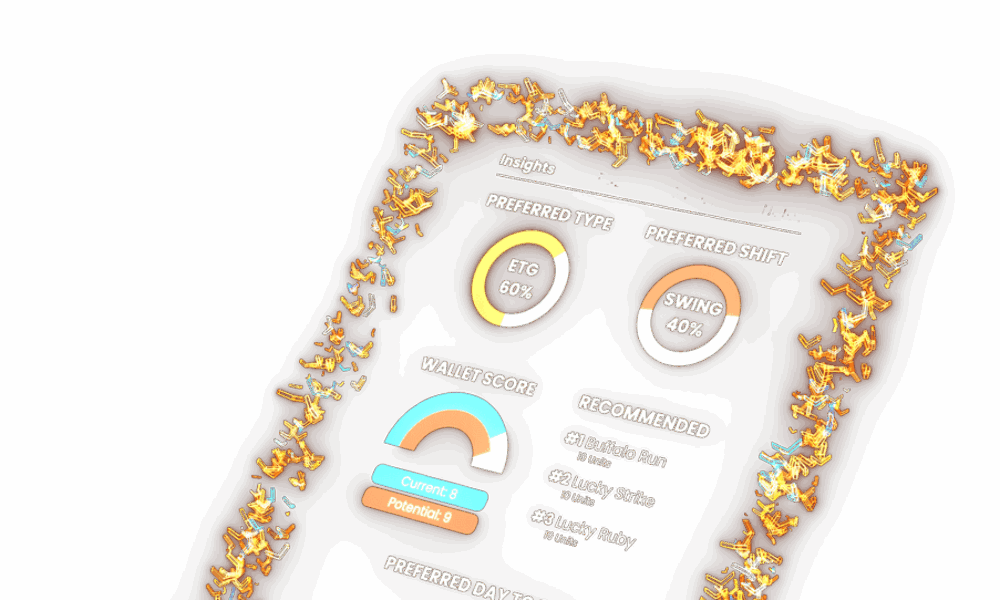

Casino operators have gotten very good at knowing what they should do.
Which players need attention. Which offers are working. Which banks are underperforming. Which games should probably move. There is rarely a shortage of information pointing someone toward the next decision.
Acting on all of that information—consistently and at scale—is another issue.
That came up repeatedly when I sat down with OPTX co-founder and co-CEO Brooke Fiumara, Vice
President of Data Science Steve Bright and Vice President of Product and Client Success Brian Uran
ahead of G2E.
OPTX will be showing Agents, expanded Player Journeys, Virtual Host, enhanced floor mapping and
Project Center this year, with much of the new development focused on taking work that still requires
someone to step in and pushing more of it through the platform.
“Casinos have access to more data than they ever have, but they don’t have more hours in the day, they
don’t have more team members,” Fiumara said. “Actually acting on it is a whole different story.”
The Agent has a job
OPTX Agents is probably the clearest example.
Users will be able to ask an agent to build a campaign, issue a comp, create or assign a task or run a
report inside OPTX.
“We don’t just want AI to tell you what to do,” Fiumara said. “We want to actually help people get it done.”
Some of that creates straightforward time savings. The larger opportunity is what becomes possible when every step no longer requires someone on the team to execute it manually.
Player marketing is an obvious place to start.
OPTX is expanding Player Journeys so players can move through marketing based on individual behavior and lifecycle, using rules set by the operator or AI recommendations.
Fiumara described it as being able to “truly throw the idea of segmentation out the window.”
The goal is not to eliminate strategy or operator control, but to move beyond broad, static segments toward individualized journeys based on each player’s behavior.
Casino marketers have been chasing one-to-one marketing for years. Getting more granular has never
been the hard sell. Doing it across an entire database without creating an operational nightmare has
always been the catch.
OPTX also handles direct mail, email and text, so those journeys can continue through execution.
“If you have to end a player journey at, ‘Well, now I have to go manually pull a list and send a direct mail
piece,’ you don’t really have true automation,” Fiumara said. “You have partial automation that you then
have to manually go do something.”
Your hosts have 500 players
Player development has its own version of the problem.
Bright used the example of a host carrying a book of 300 to 500 players.
“They don’t have time to call 300 to 500 people per day,” he said. “However, they have time to call 10
people per day, and we’re able to identify who those 10 people ought to be.”
OPTX prioritizes those contacts using changes in player behavior, including declining frequency, churn
indicators and deviations from established patterns.
OPTX says its Player Development AI has generated more than $49 million in incremental revenue across more than 110,000 player visits.
Virtual Host can extend that reach by handling routine outreach and reminders, allowing human hosts to concentrate on the players and interactions where the personal relationship matters most.
Fiumara knows there is some skepticism around that idea, particularly in a part of the business where the relationship is the whole point.
“You cannot replace human relationships,” she said. “I don’t think anyone thinks that’s a good idea when it comes to VIP business, but can you scale it more? Can you go maybe a little lower in your database?
Can you make the human host more productive in the right ways? Absolutely.”
For a host team already deciding where a finite number of calls and hours are best spent, having the
system work through more of the book gives them considerably more room to concentrate on the players
where the relationship earns its keep.
About that $250 WPU
On the slot side, OPTX is getting more specific about what happens around a floor change.
Bright said its models now draw on patterns from millions of players, more than 100,000 individual slot
machines and thousands of games to predict performance, player preference and cannibalization.
Operators already account for cannibalization. Fiumara made a point of saying that during our
conversation. OPTX is trying to put a more precise number on it before the decision gets made.
The lease structure can change the answer considerably.
“It’s entirely possible to cannibalize your way out of a profitable modification to your floor,” Bright said.
If play moves from owned games onto leased product, a great performance report on the new bank
doesn’t necessarily settle the economics of the project.
OPTX is building that calculation into its floor recommendations. Bright said the system can identify an
underperforming bank, evaluate a conversion or replacement, estimate cannibalization and provide the
range of lease terms under which the change would still be profitable.
The enhanced floor mapping OPTX is bringing to G2E adds another way to work through those decisions, layering player movement, traffic patterns and performance onto the floor itself. Bright said operators can use it beyond game placement, including looking at ATMs, marketing kiosks and beverage service stations.
Hallelujah, we did it
Uran gave me my favorite example of how quickly a good-looking number can get complicated.
A bank was doing $150 win per unit per day. After a project, it is doing $250.
“Hallelujah, we did it,” he said.
But Uran’s point was that the analysis shouldn’t end with the new WPU.
Project Center can go back 30, 60 or 90 days later and look at how play moved, which players were
gained or lost and how the project performed against the original prediction.
Uran walked through what that could do to our very exciting $250 WPU.
“Here’s the players that have walked out on you. Here’s the new players you’ve attracted. Here’s how the
play has shifted,” he said.
In his example, an additional $100 WPU could translate to roughly $10,000 over 30 days and still leave
the property with a negative project after factoring in revenue pulled from elsewhere on the floor and
$30,000 spent installing the new games.
Uran said the idea is “really giving operators a realistic view of if their projects are moving the needle, and on the front side of that, OPTX recommending projects that we truly believe will move the needle.”
So perhaps we hold the hallelujah until day 90.
What OPTX is bringing to G2E
That $250 bank is a good example of why I found the larger OPTX conversation interesting.
The operator needs more than a report showing that the bank went up. The useful part is being able to
work through what it cost, where the play came from, what happened to the players involved and whether the original decision held up once there was enough time to judge it.
The same thinking runs through much of what OPTX is showing this year. Agents take on pieces of
execution. Player Journeys make individualized marketing easier to run across a full database. Virtual
Host extends the reach of a host team. Floor modeling gets more of the financial implications into the
decision before the games move. Project Center comes back afterward and checks the work.
Fiumara calls this the “next gen of OPTX,” with the company moving further from identifying an
opportunity toward automating what happens after it.
That also gives executives a fairly practical way to evaluate all the AI they’ll see at G2E this year.
There will be no shortage of it.
The more useful conversations will start with what operators can hand over, what their teams can do differently because of it and whether the numbers look as good 90 days later as they did on day one.
That is the next generation of OPTX: not another dashboard simply telling operators what happened, but an intelligent operating platform helping them determine what should happen next—and then helping them make it happen.
