


The core dispute surrounding sports event contracts offered by federally regulated designated contract markets (DCMs) is who gets to regulate the products offered by Kalshi, Polymarket, DraftKings and other prediction market companies.
The industry’s position is they are federally regulated derivatives that are traded on federally regulated exchanges. The Commodity Exchange Act (CEA) gives the Commodity Futures Trading Commission (CFTC) the explicit jurisdiction over the transactions.
So, panelists at the Next Predict Summit in New York made it clear that states shouldn’t be able to apply their gaming laws to ban these contracts, but should the U.S. Supreme Court side with the states, prediction markets are poised to adapt to a changing regulatory environment.
On the flip side, states, tribes and gaming regulators have pushed back, saying that when someone puts money down on a sports event, that’s sports betting and Congress never intended the CEA to take away states’ traditional authority over gambling.
In April, the U.S. Court of Appeals for the Third Circuit sided with Kalshi in its case against New Jersey. The court said sports event contracts qualify as swaps under the CEA, and the CFTC’s exclusive jurisdiction.
The decision blocked New Jersey’s efforts to regulate those contracts as gambling. Then in August, the U.S. Circuit Court of Appeals for the Ninth Circuit went the other way in Kalshi’s case against Nevada, concluding that sports event contracts are likely not swaps.
That was followed last month by a ruling from the U.S. Court of Appeals for the Sixth Circuit that found sports event contracts are swaps, but even if contracts are swaps, state gaming laws would likely not be pre-empted.
A decision on the issue is pending from the U.S. Circuit Court of Appeals for the Fourth District and the Massachusetts Supreme Court.
The New Jersey case has landed at the Supreme Court and Kalshi has until November 9 to file its brief. New Jersey is seeking to have the high court take up the case, while, at the same time, the CFTC has issued a proposed rule to expressly define event contracts, including sports, political, cultural, and weather contracts, as swaps.

So, how do prediction markets operate a national business in the middle of all these court fights?
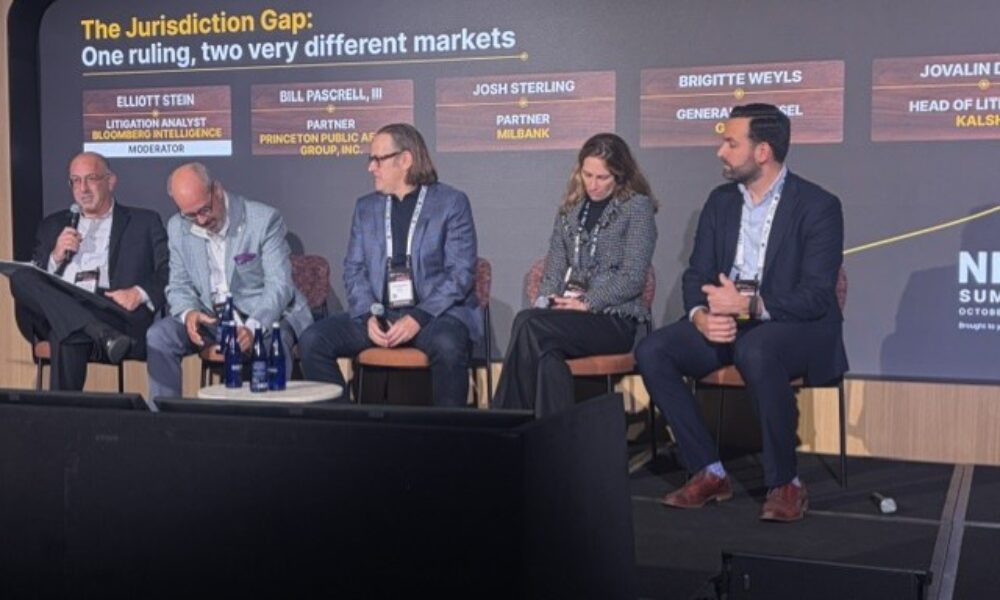
“Well, that question is sort of what’s driving this litigation in the first place,” Javalin Dedaj, head of litigation at Kalshi, said during a panel discussion on Friday titled “The Jurisdiction Gap: One ruling, Two Very Different Markets.”
“Our argument has been from the start that this is trading activity that happens on a designated contract market (and) should be regulated only by the designated federal regulator for the industry, the CFTC,” Dedaj said.

Dedaj explained that it wasn’t an argument they’re “pulling out of thin air,” it’s grounded in the statutory text of the CEA. So being subject to 50 different state regulators is the biggest issue driving this litigation, said Dedaj, adding that Kalshi has complied with all court offers and decision to this point.
Brigitte Weyls, general counsel with Gemini Titan, agreed with Dedaj that there is a federal regulatory landscape for these contracts.
“I think sports event contacts have always been contemplated in the derivatives space,” Weyls said. “If you look back to 2004 when Hedge Street was licensed by the CFTC, which is … now Crypto.com, there’s a commission memo still on the CFTC’s website, and there’s an interesting footnote that says the platform will not offer sports contracts.”
Weyls said these markets have always been around and “they’re here to stay; they’re popular now.”
Weyls and Dedaj were joined on the panel by Bill Pascrell III, partner at Princeton Public Affairs Group, Josh Sterling, a partner at Milbank, and moderator Elliot Stein, litigation analyst with Bloomberg Intelligence.
When asked by Stein how he advises his clients when you have this regulatory and legal uncertainty, Sterling said it depends on the client, but the “message is simple – the goal is to win and that’s what we’re going to do.”
“We’re going to do it because we have the law on our side, and we have it right now. And that’s our position here,” Sterling said.
Prediction market companies could expand into other financial products or develop other offerings even if the Supreme Court rules against them, said Sterling, who is outside counsel to Kalshi and former head of the CFTC’s markets participation division.
“They may have grown beyond (sports) event contracts into other areas that are even more promising for them as a business,” Sterling said.
Weyls noted that exchanges are pursuing securities products and discussing offering single-stock future. Should states prevail in their case, she was confident that these prediction markets continue but might need to be more regionalized to different types of users.
“The markets innovate. They always do,” Weyls said. “There will be new products.”
Dedaj said Kalshi continues to develop new products while it seeks clarity, “but it’s not the end of the road if the Supreme Court rules against the industry.”
In a recent research note, Stein wrote that Kalshi’s September 25 loss in the Sixth Circuit to Ohio and Tennessee makes Supreme Court review more likely, “where we give the edge to Kalshi and its prediction-market peers.”
“We view the prediction markets as having the stronger argument that such contracts can fit the (CEA’s) broad definition of swaps, events associated with potential financial, economic or commercial consequences, as federal trial courts in in Arizona, Illinois, Minnesota, New Jersey and Tennessee have held.
“We expect a SCOTUS decision in late 2027,” Stein wrote.
