

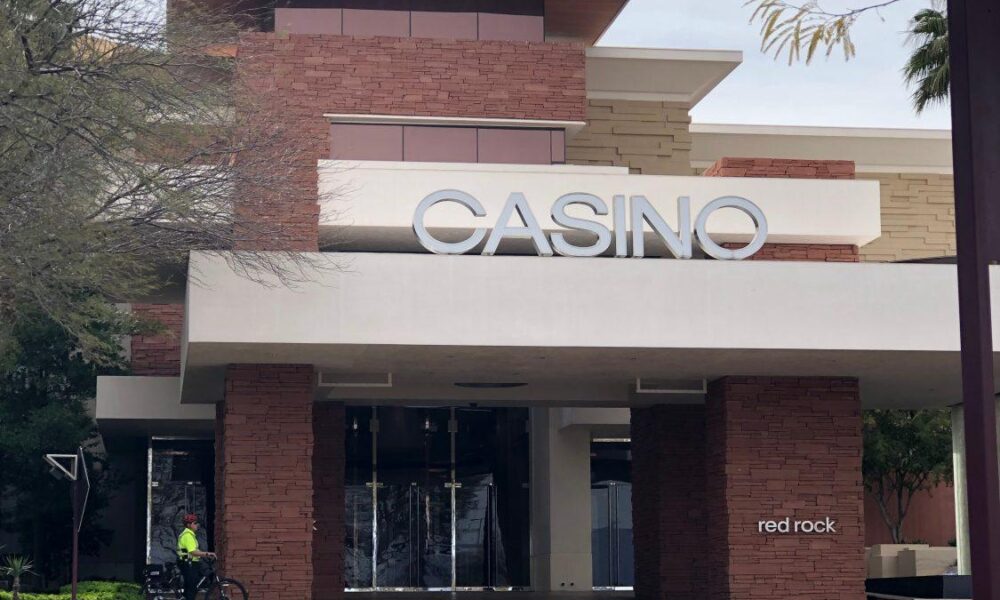

The U.S. Supreme Court has denied an emergency request from Red Rock Casino for a stay of a lower court decision requiring the gaming company to comply with an order from the National Labor Relations Board.
On August 31, the U.S. Court of Appeals for the District of Columbia ruled Red Rock, wholly owned by Station Casinos LLC, recognize and bargain in good faith with the Culinary Union Local 226. The casino must also post notices informing employees of their rights under federal labor law.
On Friday, Chief Justice John Roberts denied Red Rock’s emergency order, filed on August 29, that would have paused the appeals court’s order requiring the casino to bargain with the Culinary Union.

“While Station Casinos will comply with any court order, we continue to object to the National Labor Relations Board decision, which the U.S. Court of Appeals for the District of Columbia affirmed,” a Station Casinos spokesman said in a statement emailed to CDC Gaming.
The NLRB decision overturned a secret-ballot election by Red Rock Casino team members who rejected joining the Culinary Union.
“The decision prevents any company from granting benefits to its employees if it is aware of union interest in unionizing the company’s employees and nullifies the Red Rock team members’ vote to be union-free, all because Station Casinos treated its team members too well,” the spokesman said.
Messages left with the Culinary Union were not returned.
The Las Vegas gaming company has been at odds with the Culinary Union for more than a decade, with the union representatives and Station Casinos employees testifying regularly at Nevada Gaming Control Board meetings.
In 2022, the NLRB ruled that it would be unreasonable to think that a fair election could be conducted at a company property because of their interference. The agency launched its investigation after a failed union vote in December 2019 at Red Rock Casino.
The NLRB’s bargaining order was based on a 1969 Supreme Court Case in N.L.R.B v. Gissel Packing Co. Known as a Gissel Order, it requires an employer to bargain with a union even when the employees had not voted to join that union.
In its 21-page filing with the Supreme Court, Red Rock wrote that it began an improved benefits rollout on November 19, 2019. The company’s decision was “part of a lengthy corporate strategy to restore Station Casinos’ culture and ensure its 10 properties would be the employers of choice for Las Vegas employees.”
Two days later, the union representing employees at seven of Station Casinos’ other properties petitioned to represent certain Red Rock employees.
An election was held a month later and the union undeniably lost, according to the filing submitted by David Dorey, an attorney with Fisher & Phillips in New York, who represented the company.
“Upset at the loss, the union filed unfair labor practices charges and objections, claiming that Red Rock (through Station Casinos) unlawfully and objectionably influenced the outcome of the election by promising, granting, and announcing improved benefits before the vote.
“There was nothing extraordinary or unusual about Station Casinos’ decision to improve benefits for its 14,000 employees across 10 properties, nine of which were not Red Rock,” Dorey wrote.

Despite the enhanced benefits implementation starting before the union sought recognition of any Red Rock employees, the district court found that the timing and rollout of the benefits were intended to deter the union’s organizing effort and ordered Red Rock to recognize and bargain with the union pending completion of the board’s administrative process.
“Station Casinos does not believe it is correct or consistent with the purposed and stated mission of the (NLRB) to punish Station Casinos and its team members for providing best-in-class benefits to team members based on a dubious theory that doing so ‘undermines’ the union,” the spokesman said.
Red Rock complied with interim order and petitioned for review. In June, the D.C. Circuit Court denied the petition and granted enforcement of the Gissel Order. Red Rock then sought a rehearing en banc, which was denied on August 6.
Red Rock then sought a stay of the mandate pending its petition with the Supreme Court for a writ of certiorari, which the D.C. Circuit denied on August 24.
“The company asked the U.S. Supreme Court to pause the mandate, as the decision unfairly overrides the clear, free, and open vote of its team members that overwhelmingly rejected the union,” the spokesman said.
