

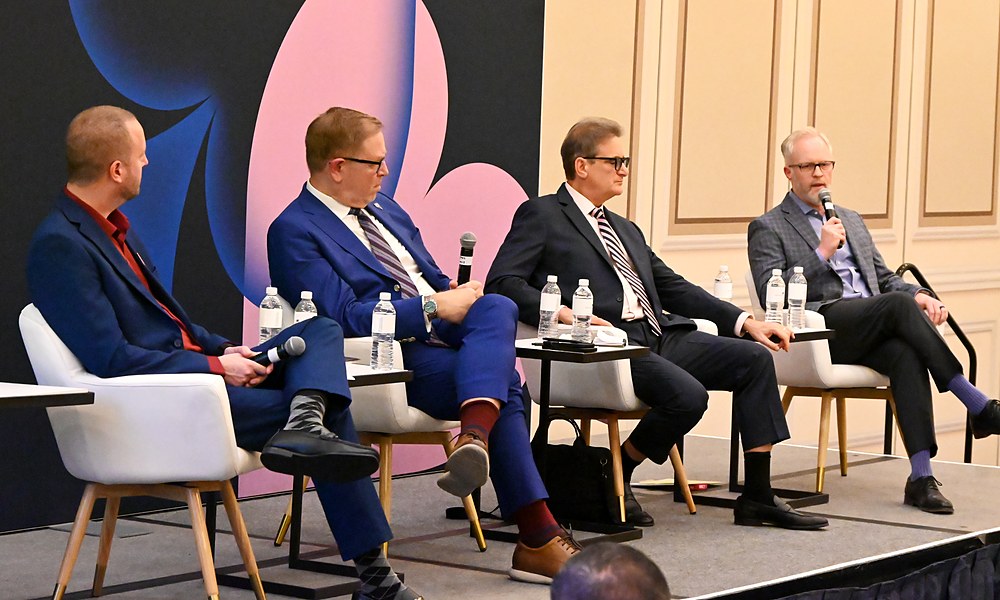

The composition of the panelists assembled for “From Casino Floors to Prediction Markets: Comparing Compliance, Oversight, and Risk” at the Global Gaming Expo (G2E) last week fit certain stereotypes.
Mike Dreitzer, the chairman of the Nevada Gaming Control Board (NGCB), came across as a stern-but-fair university professor. Daniel Wallach, founder of Wallach Legal, was the firebrand raging against the machine. Stephen Martino, senior vice president & chief compliance officer with MGM Resorts International, played the role of a concerned parent.
What they had in common was a determination to staunch the flow of prediction markets.
“They engage in conduct that is against the law, and so we as regulators just have to make sure that if they want to engage in gaming activities in Nevada, that they follow the law,” Dreitzer told attendees gathered in in a conference room at The Venetian Expo in Las Vegas.
“They say that the reason is that that our licensees are afraid to compete,” Dreitzer said. “That’s not true either. Our licensees make the correct choice to be part of a regulated gaming community because they understand the importance of that. They understand that good regulation is the bedrock for everything you see in gaming.”
Wallach, whom moderator Tres York, the vice president government affairs for the American Gaming Association (AGA) introduced as being quoted in every article he’d read about prediction markets, said the recent judicial proceeding against prediction markets are “akin to a tidal wave of rulings that favor the state. 38 out of 43 is not a fluke.”
Wallach thinks Kalshi, Robinhood, and Crypto.com would like the U.S. Circuit Court of Appeals for the the Ninth Circuit in San Francisco case to catch up to the U.S. Circuit Court of Appeals for the Third Circuit in Philadelphia in terms of the time continuum.
“If you remember, the Third Circuit cert petition was filed by New Jersey on September 3, the Ninth Circuit cert petition came about two three weeks later,” Wallach says. “What Robinhood and Crypto.com did was they filed their cert petitions, but Kalshihas asked the U.S. Supreme Court for a 30-day extension on its response to the New Jersey petition in certiorari.
“And I think the ultimate goal here for Kalshi is to ensure that the Third Circuit case does not go up by itself to SCOTUS because historically, looking back over a 20-year time horizon, the Supreme Court is known as a reversal court,” he said.
Wallach noted that looking back over a 20-year track record, the rate of reversal for cases taken up by the Supreme Court is 70%.
“So if you’re Kalshi, if you’re Robinhood, if you’re Crypto.com, it is imperative that they ensure that the Ninth Circuit case, or maybe even the Sixth Circuit (Cincinnati), be taken up at relatively the same time as the Third Circuit case to sort of dilute those percentages.”
From a human aspect, it was hard to argue with Martino’s opposition to prediction markets. As a former regulator, in Maryland and Kansas, he’s adamantly opposed to them.
But as a father, he’s fearful of what might happen to his son, a freshman at the University of Kansas.
“I think about him and the things that I read about the prediction markets and some of those operators and how they are preying on people of that age and the lack of protections that any regulated entity in a regulated market in a regulated gaming environment would have,” Martino said.
Martino added that he was a regulator for 10 years and there were stringent requirements around responsible gaming that prediction markets lack. He also decried Kalshi’s advertising, specifically one that features a young women worried about paying her rent who could win it by placing a “wager” with Kalshi.
“A licensed gaming operator in any jurisdiction in this country that wouldn’t be fined considerably, perhaps out of existence, if they did something like that,” Martino said.
York said during the AGA’s meetings with state attorneys general, they’ve stressed way to fight prediction markets and protect their citizen is to sue in court.
Dreitzer agreed that states banding together has been a very successful strategy. And Nevada has shown how to banish prediction markets from operating.

“We’re very proud of the fact that we are a prediction-free sports state. And we have met the moment with each of five opponents, and at present they are not offering sports betting contracts in Nevada,” Dreitzer said. “It’s also interesting, and I think telling,that Novig and others that have come on, they don’t even try to run to Nevada.
“We’ve been very strong on this,” Dreitzer added. “Why have we been strong? We’ve been strong because again, it’s illegal gambling, and it’s that simple. They try to make it more complex than it is.”
