

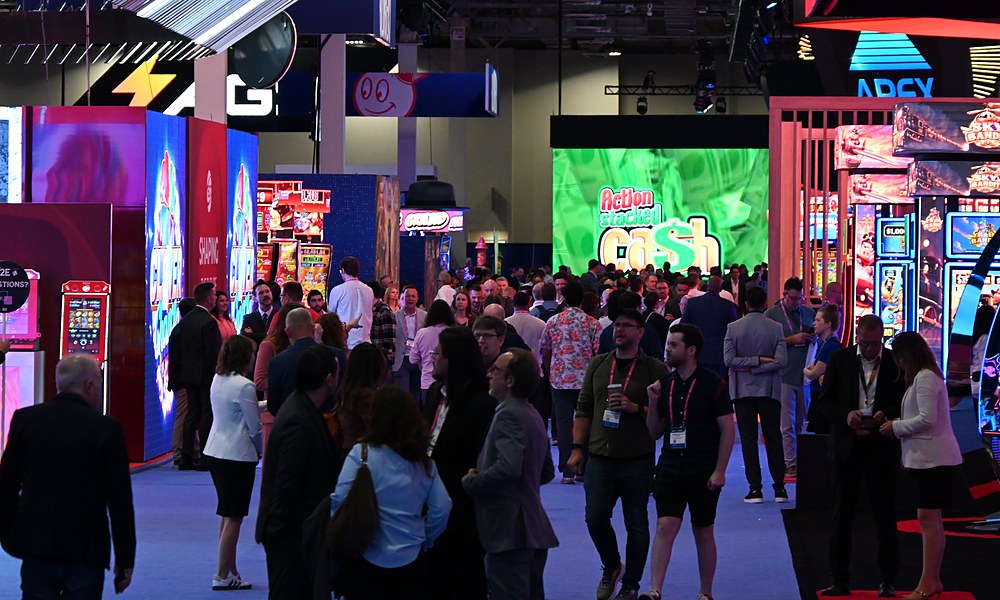

The biggest topic of conversation among attendees at this year’s Global Gaming Expo (G2E) in Las Vegas wasn’t about artificial intelligence, new slot machines, or sports betting integrity, but involved companies that didn’t even attend the annual conference.
Polymarket, Kalshi, and Robinhood are in state and federal courts across the country, trying to block gaming regulators and attorneys generals from enforcing their gaming regulations on their products, specifically sports-event contracts.
State gaming regulators contend prediction market operators are taking sports bets illegally. The Commodity Futures Trading Commission (CFTC) claims exclusive jurisdiction over these derivatives, conflicting with state efforts to treat sports event contracts as gambling.
“This is a defining time for our industry. The state of gaming remains strong, even as we find serious challenges,” Bill Miller, president and CEO of the American Gaming Association (AGA) told attendees during his keynote speech.
Miller said the industry’s battle with prediction markets, which he described as a generational opponent, poses an existential threat. “We also face macroeconomic headwinds beyond our control, both at home and abroad. But resilience is in our industry’s DNA. We faced great tests before — in the aftermath of the great recession, during COVID.”
Each time, Miller told attendees, the industry has responded with innovation and offered world-class products to consumers that propel the industry to new heights. He expected the industry to succeed in its legal fight with prediction markets.
“So while we knock on the front door, a new group of well-funded bad guys have kicked in the back door,” Miller said Tuesday during his speech on the main stage at The Venetian Expo. “They call themselves prediction markets. And their message to states and tribes seems pretty straightforward. Your laws don’t matter. Your regulations don’t matter. The tax structures don’t matter. Your sovereignty doesn’t matter.”
Miller said what makes their approach so remarkable is that they know what they’re doing. Less than two years ago, Kalshi said in federal court that congressional intent was clear: Sports betting should not be regulated with derivatives.
Kalshi’s CEO Tarek Monsour said offering sports bets at the federal level would be illegal. Miller reminded conference attendees that Kalshi alone has done more than $190 billion in sports bets and have paid zero in taxes.

But perhaps most insidious, Miller said, is prediction platforms wanting people to think sports gambling is a form of investment, no different than investing in the stock market.
While gaming industry executives, lawyers, and lobbyists are discussing the impact of sports-event contracts on business and clientele, in Washington, the White House is reviewing two proposals submitted by the CFTC to the Office of Information and Regulatory Affairs. One would classify event contracts as swaps. The other would exclude casino-style gambling products from the federal agency’s jurisdiction.
On Monday, Miller joined four tribal-gaming leaders on the main stage to discuss the threat to the commercial and tribal gaming industries posed by prediction markets.
“These are basically untaxed, unregulated, consumer-predatory organizations that are masquerading themselves as investment vehicles,” David Bean, chairman of the Indian Gaming Association (IGA), said of prediction market companies.
IGA Executive Director Jason Giles, who moderated the discussion, reminded attendees that states have prevailed in 38 out of 43 court decisions, with prediction markets losing 15 consecutive federal court rulings.
Beyond prediction markets
Although prediction markets took up most of the oxygen at the 26th annual conference, other panel discussions centered around protecting sports betting integrity amid wagering scandals, how AI is transforming match-fixing detection, and the slow pace of cashless adoption by casinos.
The AGA estimated some 25,000 attendees from more than 120 countries and multiple Indian tribes attended the conference from September 28 to October 1, which featured some 400 exhibitors presenting new products, slot machines, and table games.
One of the highlights of this year’s conference was a round-table discussion featuring the chief executives of Wynn Resorts, MGM Resorts International, and Caesars Entertainment discussing Las Vegas, mergers and acquisitions, and prediction markets.
“We’re still living through the impact of the pandemic and what we had was a bubble that started post reopening, then went to regional markets, then went to destination markets,” Caesars CEO Tom Reeg told CNBC’s Contessa Brewer, who moderated the event.
IGT, which operates one of the largest spaces on the G2E trade floor, took the opportunity this year to unveil a redesigned company logo, as well as launch its Queen-themed slot machines.
The new game features four content-rich bonuses, six eye-catching jackpots, 10 chart-topping Queen hits including “We are the Champions,” “Bohemian Rhapsody,” and “Don’t Stop Me Now,” and an eclectic mix of photos and videos of all four original band members.
“There is nostalgia that you can bring to the table that the consumer is really resonating with at the moment,” said Fernandez. “I think Queen is the perfect license to bring that to life.”
Another highlight of G2E was a three-day tournament to find the best casino dealer in North America. This year’s tournament was won by “Emily,” a dealer from Mohegan Sun in Connecticut.
Every one of the 50 contestants was introduced only by their first name.
