

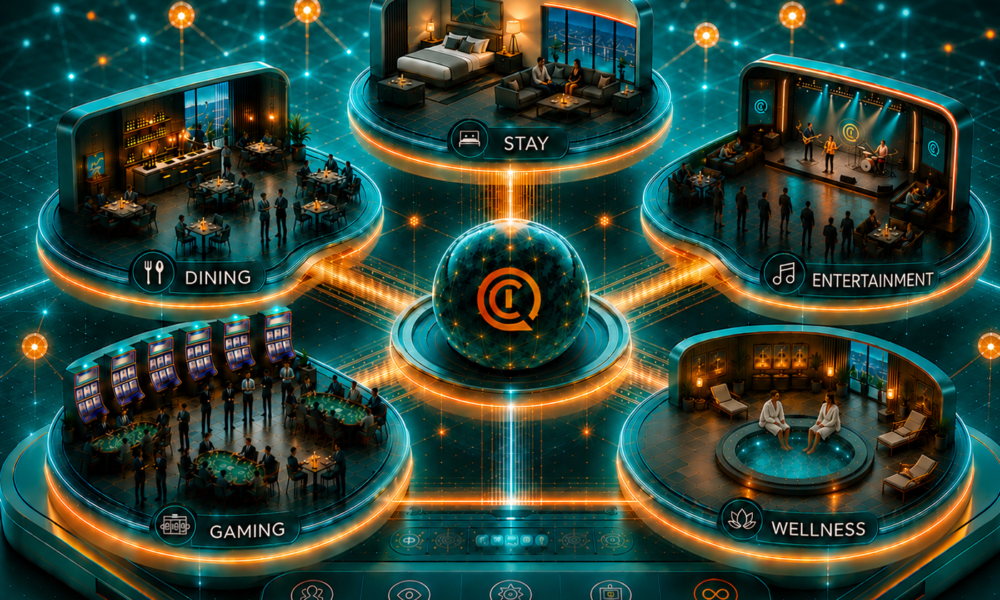

Casino technology pioneer Andrew Cardno calls his company’s latest breakthrough “the boldest, biggest step” he’s been involved with over a career filled with revolutionary developments.
Called QCI Resorts, it’s a unified resort operating platform built for the agentic AI era and capable of acting on data collected from every aspect of a resort operation, from hospitality, hotel, and dining to marketing, loyalty, and finance. Gaming remains a core part of QCI Resorts and is fully connected to the unified operating platform, with gaming systems integrated separately where required by regulations.
“It’s incredibly simple and profoundly different at the same time,” said Cardno, co-founder and chief technology officer of Quick Custom Intelligence (QCI), based in San Diego. “We’re going to bring about the biggest change the industry has ever seen.”
He said the first installation of QCI Resorts will begin soon at Sky City Casino-Hotel in Acoma, N.M., with about two dozen other sites ready to follow. “The response from the industry has been extraordinary, because people know we have to change” to access all the capabilities of artificial intelligence, he added. Operators have traditionally relied on separate systems for their various business segments. QCI Resorts replaces that fragmented approach with a unified operating platform, allowing customers to phase adoption across different areas of the resort based on their operational priorities. Cardno said one overseas operator reported having more than 40 systems, each functioning separately.
QCI Resorts provides a single, real-time operating environment across the resort, unifying hospitality, food and beverage, marketing, loyalty, finance, operations, and gaming while enabling staff through consistent interfaces throughout the property, Cardno said.
Initially, the installation of QCI Resorts will involve one business segment of a property at a time because of the organizational changes inherent in the addition of agentic AI. Training programs and easy-to-use software will help staff adjust, “but it is a transformation,” he said.
One reason Cardno is so confident about the capabilities of QCI Resorts is that a similar system runs QCI itself. Introduced as Jarvis in 2023, that system now handles about 80 percent of QCI’s workflow, including support tickets, financial analysis, and building software technology. Like Jarvis, QCI Resorts is “just one system” that can handle all aspects of a casino resort, even marina and stadium management if requested, Cardno said.
“To say this is extraordinary is completely understated,” he continued. “This is an on-premises solution, and it solves the problem of building the unified infrastructure so you can put an agentic layer in.”
The company will spotlight QCI Resorts at Booth 2440 during the Global Gaming Expo from Sept. 28 to Oct. 1 in Las Vegas. In addition to the exhibit at the company’s main booth, the “QCI Resorts Experience” at Booth 2644 will feature meetings and conversations about the future of resort technology. Additional QCI programming and events will be announced during the lead-up to the conference.
Cardno has been at the forefront of technological changes in casino operations for two decades, from the use of heat maps to improve slot floor layouts and profitability to developing Chatalytics, QCI’s generative AI data activation platform used by resort operators worldwide.
He said the adoption of AI is essential to growth. “I think the casino resort industry is finally going to give guests the experience we’ve always been wanting to give them, and that is going to drive a lot of growth. The growth potential is enormous.”
Cardno said operators hoping to contribute to that growth should ask themselves two questions:
• Is generative AI changing the world?
• Should my operation be part of that?
“There’s no world in which a business can be competitive in the future without being generative,” he said. “You can’t compete with these fantastical capabilities of these machines. People understand that this is a change they can’t miss.”
