


For years, those wanting to bet on sports needed to visit a Las Vegas sportsbook, wager on an illegal offshore site or with their local bookie, but almost nine years ago a U.S. Supreme Court ruling overturned a federal law than banned wagering on games.
On May 14, 2018, the Supreme Court struck down the Professional and Amateur Sports Protection Act (PASPA) in Murphy versus NCAA.
In a 6-3 decision written by justice Samuel Allito, the High Court ruled that PASPA violated the Tenth Amendment’s anti-commandeering clause by prohibiting state legislatures from authorizing or regulating sports betting.
Gambling on sports has surged in the years following the Supreme Court’s ruling, particularly among young men on college campus, who can bet on a game anytime on their mobile phone. That change was the motivation behind a hearing Wednesday in the Rayburn House Office building on Capitol Hill in Washington, D.C.
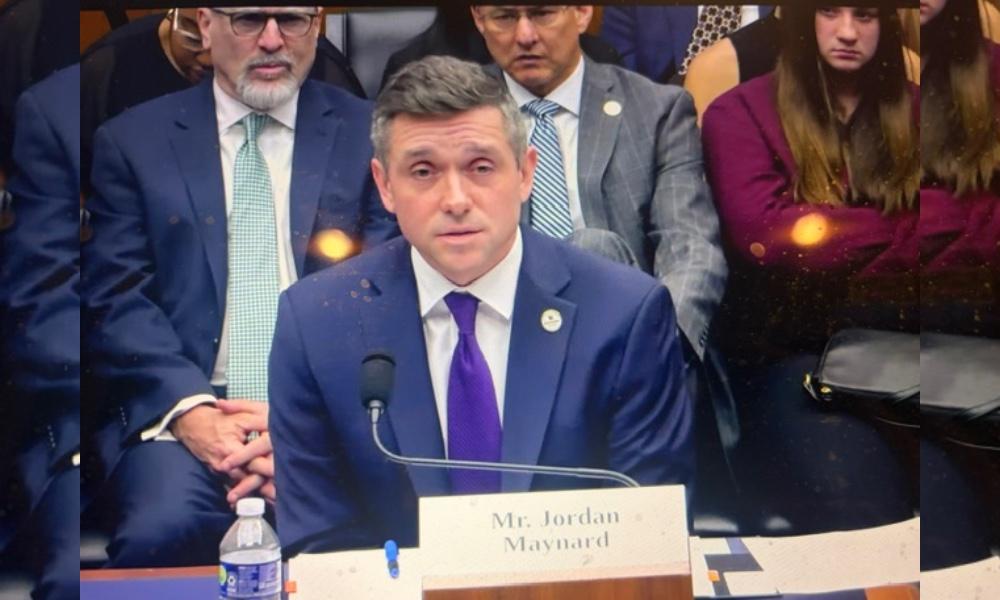
“Seventy-one percent of people in Massachusetts aged 18 to 25 have bet on sports,” Jordan Maynard, chairman of the Massachusetts Gaming Commission (MGC), testified at a congressional hearing on the “Rise of Sports Gambling on College Campuses.”
Maynard also expressed his concern at a Boston University School of Public Health survey that shows among college students who report using sportsbook apps, 34% are under 21. In Massachusetts, the study found that approximately 22% of college-age users are under 21.
“We know the younger someone starts betting, the more likely they are to develop a gambling problem,” Maynard told the House Subcommittee on Higher Education and Workforce Development.
“Gambling is an activity for adults,” Maynard added. “But young people are targeted on virtually every platform.”
In Massachusetts, the legal age to wager on sports is 21. Maynard explained that the MGC requires licensed sports wagering operators to use age verification technologies to prevent underage access.
“This has prevented at least 11,000 accounts from being opened by people under 21,” he said.
Maynard explained that young people still find ways to bet either by using a parent, a sibling, or an older friend’s account, which is known as proxy betting.
“It’s not harmless, it’s illegal,” Maynard said of proxy betting.
In his opening testimony, Maynard explained that Massachusetts state law includes a prohibition on individual collegiate player prop bets and restrictions on wagering on in-state college sports.
“We prioritize enforcement because these rules discourage player harassment and youth betting on campuses,” said Maynard, adding the state prohibits advertisements that target those under 21 and an outright ban on college campuses.
Maynard also addressed the challenges presented by the rapid rise of prediction markets, especially sports event contracts, which he described as “sports wagers by another name.” He also said they avoid state laws, taxes, regulatory requirements, and problem gaming requirements for licensed operators.
“As it stands, prediction markets are illegally offering sports wagering in Massachusetts, Maynard said. “The (Commodity Futures Trading Commission) is not equipped to regulate sports wagering to our standards.”
Maynard expressed his support for Massachusetts Attorney General Andrea Joy Campbell’s lawsuit against Kalshi. The case is currently awaiting a decision from the Massachusetts Supreme Judicial Court.
He said prediction market exchanges make regulation of the markets much more difficult, with two sets of standards “for products that look exactly the same.”
“We get calls at the MGC asking for us to intervene when there are patron disputes for companies we don’t regulate and haven’t applied for a sports betting license in our state,” Maynard told lawmakers.
Ranking subcommittee member Alma Adams, a Democrat from North Carolina, said the CFTC should not be able to use a “loophole” to get around state gambling laws.
“Prediction markets found a way around those rules,” Adams said in her closing remarks. “They call a bet an event contract, and they say that state laws on sports betting don’t apply. The agency that is supposed to be the cop on the beat is the CFTC. But the cop has stepped back and the president’s son has money in the game.”
Adams stressed that they couldn’t ignore that, while saying that students are not a market to be exploited “and their safety should never take a backseat to someone’s investment portfolio.”
The hearing’s witness list also included Dr. Lindsey Mortenson, chief medical health officers and executive director of University Health and Counseling at the University of Michigan, Dr. Daniel Durkin, associate professor at the University of Mississippi, and Cindy Clouner, managing director at the Higher Education Center for Alcohol and Drug Misue Prevention and Recovery at Ohio State University.
All four witnesses agreed elimination of player prop bets would help reduce problem gambling rates among students. Clouner believed federal regulation of prop bets would do more than a state patchwork of regulations.
Prohibiting individual player prop bets on all collegiate events means no gambler will have money on the line solely based on the performance of one student athlete. Massachusetts does allow player prop bets on professional sports, but not college sports, which Maynard said has been successful.
“I would agree, eliminating prop bets especially for college athletes would go a long way forward,” Durkin said. “A lot of students don’t realize that is a behavior that has risks with it and one of thing we need to do with our prevention is teach them that.”
Overall, the conclusions from each of the four witnesses is that many college students don’t seek out help for sports betting addictions or view it as gambling. Others testifying Wednesday believe many students see it as a financial problem, not a behavioral problem.
“We don’t tolerate over-serving of alcohol in bars,” Mortenson said. “We shouldn’t tolerate over-serving of young people on sports betting, and that’s exactly what’s happening right now.”
Mortenson said the “move and break things fast approach of the sports betting industry is causing serious harm,” especially among young people who don’t always recognize that sports betting is gambling.
She other issues include abandoning of basic safety principles and values, problem betting is hard to detect, except by sportsbooks, sports betting is a campus-wide problem, and in terms of research and data the U.S. is far behind other countries.
In his opening statement, Washington state Republican Representative Michael Baumgartner, vice chair of the subcommittee who chaired the two-hour hearing, said nowhere has the “surge” of online betting been more pronounced than on college campuses, expressing concern at the outsized rates of those who gamble.
According to an NCAA survey, 67% of students living on campus had bet on sports, and 16% had shown problem gambling behaviors such as “chasing losses,” or spending more money on bets then they planned, with 6% of students reporting they had lost more than $500 in a single day.
Baumgartner admitted those figures were from 2023 but made it clear he believes they “are likely even higher today.”
“Gambling poses serious risks for everyone, but especially college students,” Baumgartner said. “They exhibit problematic gambling behavior at more than twice the rate of the general population. And the earlier young people start gambling, the greater the odds they will develop a gambling disorder later in life, even years or decades later.”
Baumgartner understood that many colleges already have systems in place to educate students about alcohol and substance use but was concerned that the “same is not yet true for gambling.”
