

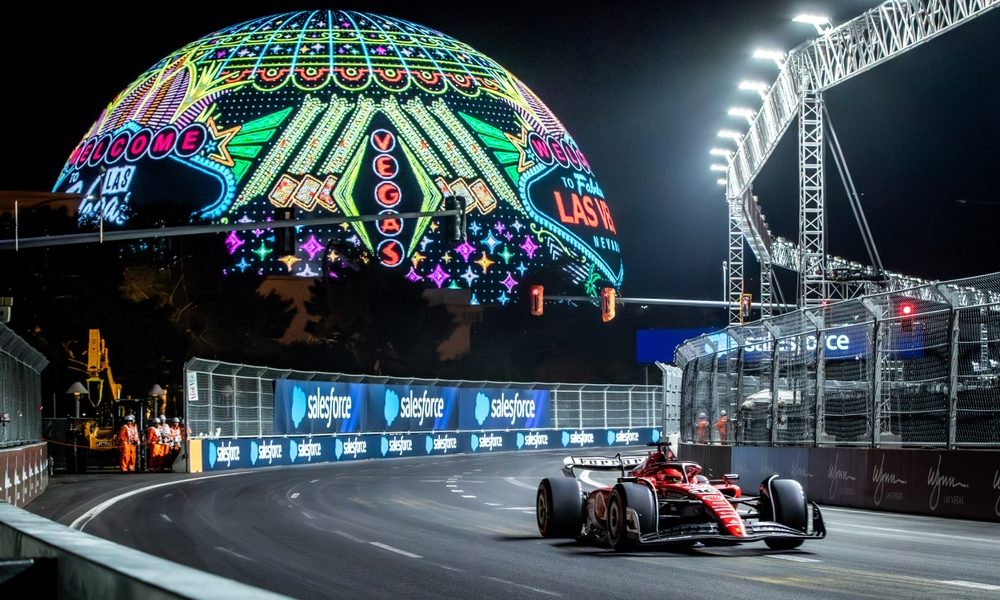

By its fourth year, the Las Vegas Grand Prix has become one of this city’s biggest annual events, so obviously we need to talk about it. I did the heavy lifting for the team this weekend: visiting activations, investigating parties, and enduring temperatures for which my wardrobe was deeply unprepared. You’re welcome.
Two weeks before the race, a friend sent me a color-coded spreadsheet with tabs for each day, dress codes, transportation, and my personal favorite, “backup party.” We were approaching the weekend with the operational discipline of a small airline.
Then the forecast arrived. Rain disrupted Thursday’s opening practice and race-week temperatures flirted with the 40s. I own coats, plural, although most were purchased with the expectation they’d spend their evenings draped over the backs of restaurant chairs. Suddenly, they had jobs. Frankly, they were hired under false pretenses.
We went anyway. There were familiar favorites, from Hello Kitty to Bellagio’s Shoey Bar, but this year’s new experiences showed just how creative brands have become with their F1 partnerships.
The helmet situation is escalating
Bellagio brought back its Shoey Bar, where adults pay to drink from racing shoes. This year’s collectible shoes even contained a capsule of water from the Bellagio fountains. I’m sure someone will eventually explain why this is desirable.
The resort also introduced “The Lid,” a punchbowl cocktail served in a racing helmet, and “The Kit,” a $3,000 caviar service presented in another helmet, complete with cocktails and a personal butler.
Somebody had to propose putting $3,000 worth of hospitality into protective headgear, then calmly explain the margins. I would pay to attend that meeting.
Fontainebleau opened its first Shoey Bar, too. Apparently, we’ve created enough demand for shoe-based beverages to support multiple establishments.
Meanwhile, at the fountains
Marriott Bonvoy turned the Fountains of Bellagio into a custom speedboat course, where Mercedes drivers George Russell and Kimi Antonelli raced against five loyalty members.
The members received access through Marriott Bonvoy Moments, along with Bellagio accommodations and Grand Prix tickets.
Now that’s a loyalty benefit.
There’s something particularly brilliant about taking one of Las Vegas’s most recognizable landmarks, adding two Formula 1 drivers, and letting loyalty members race boats through it.
No other hotel can replicate that exact experience. The property, the partnership, and the location all contributed to something genuinely exclusive.
And the footage practically marketed itself.
An absolutely normal weekend
LEGO put 11 celebrities into functioning brick-built minicars for its inaugural celebrity race. Gordon Ramsay and Hannah Waddingham competed, but DJ FISHER ultimately won. A sentence like that makes considerably more sense after you’ve spent enough time in Las Vegas.
Cadillac, in its first season on the grid, offered scarves designed specifically for the Las Vegas race, which fans could personalize with their initials. Given the weather, I would have accepted practically anything that qualified as another layer.
WHOOP introduced a Performance Lab where visitors tested their grip strength, balance, and reaction times against F1 benchmarks. Pepsi partnered with MGM Resorts on a Flavor Circuit featuring complimentary tastings from local restaurants.
Somewhere between the reflex tests, scarves, and free food, I remembered there was also a car race happening.
The creativity extended across the resorts, too. After the checkered flag, the Backstreet Boys performed the first official F1 afterparty at Sphere. A perfectly reasonable conclusion to a weekend where we’d already been drinking from shoes and racing boats in a fountain.
For casino-resorts, having the race running through the Strip creates opportunities that extend well beyond selling tickets. Restaurants, retail, nightlife and hospitality all get their own opportunities to participate, often through collaborations developed specifically for the weekend.
We love the weird, but who’s paying for all this?
The Las Vegas Convention and Visitors Authority expects approximately $800 million in regional economic impact from this year’s Grand Prix.
The event has generated an estimated $3.2 billion in cumulative economic impact since its 2023 debut, according to the LVCVA. In 2025 alone, it produced approximately $43 million in state and local tax revenue.
Those are significant numbers, although economic impact doesn’t automatically translate into profit for the city. It measures spending and business activity across the region, rather than money remaining after expenses.
The LVCVA has committed $10 million annually in sponsorship support through 2037. Road closures, construction, and disruption to businesses near the circuit also come with costs that deserve consideration.
Still, having a major international sporting event return every November gives the destination something unusual: an annual opportunity for hotels, restaurants, retailers, and entertainment brands to create experiences around a global audience.
The 2026 race sold out, with Max Verstappen winning after 35 lead changes and 352 overtakes. Apparently, the racing itself was pretty entertaining, too.
Four years in, some of the best ideas surrounding the Grand Prix are becoming distinctly Las Vegas. A speedboat race at Bellagio, caviar in a helmet, collectible shoes containing fountain water. There are probably people in other cities trying to understand how any of these proposals survived a marketing meeting.
Here, they’re just part of the weekend.
My friend has already started next year’s spreadsheet. I’ve requested a new column: “Is this indoors?” I’ll happily defend $3,000 caviar served in a racing helmet as a legitimate marketing decision. I’d just prefer to do it with feeling in my toes.
