

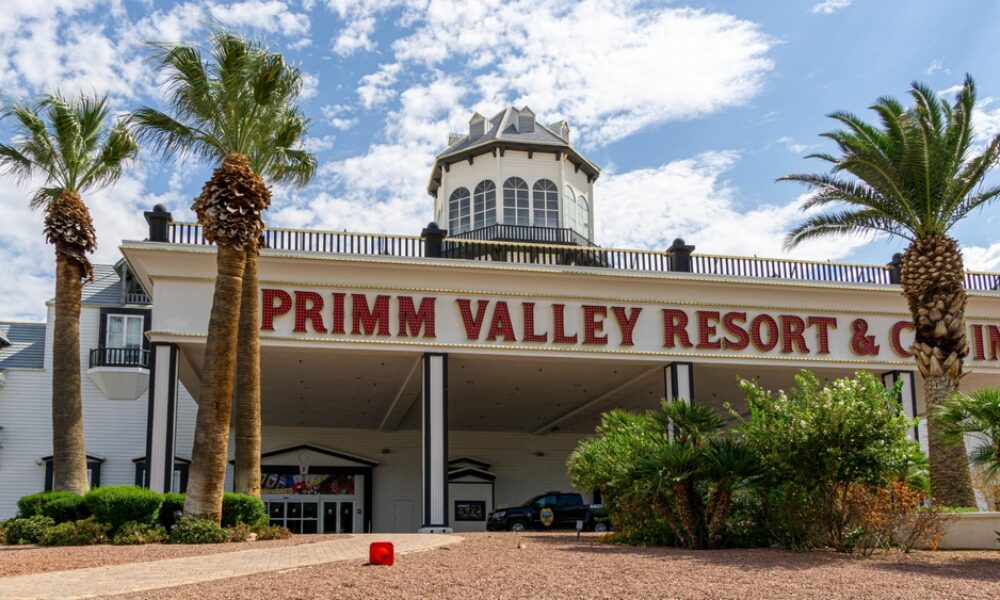

Terrible’s has reopened Primm Resort.
After just 17 days of refurbishing, Primm Valley Casino is doing business under new management. It has 250 hotel rooms, 422 slot machines, a sportsbook and sports bar, a quick-bites eatery, and employs over 300 people. Full-service restaurants are on the way. On July 2, Terrible’s reopened the Primm Center mall, the Chevron and Flying J gas stations, Whiskey Pete’s Travel Store, the Lotto Store, and a Starbucks.
It has been a wild ride. In May, the previous operator, Affinity Interactive, announced that it was closing the last of three properties on the site, along with the other businesses. Affinity said, “There was no commercially rational basis to continue investing in the property or to financially support its continued operations.” Affinity might have been willing to continue, but only with a much-reduced rent. The Primm family and Affinity could not agree on a revised amount. The family did come to an agreement with Terrible’s and the agreement probably includes less rent than Affinity paid.
The story of the businesses and Primm, the town, is a 20th century story. The town was originally called State Line, because it sits on the border between California and Nevada. That location puts the town’s casinos in a perfect position to capture those too eager to make a bet to wait to get to Vegas. And it stands ready for those wanting to make one last bet before entering California.
State Line began its existence in the1920s. Pete MacIntrye saw an opportunity to serve the drivers on the highway and opened a gas station; he later added illegal alcohol to his offerings. The 1920s were an era of expansion in travel. Americans were buying cars and they on whatever roads existed. Enterprising businesspeople set up shop to sell those drivers gasoline, auto supplies and repairs, food, and a resting place. Pete was one of those entrepreneurs.
After the Second World War, there was another explosion of travel. People had jobs, money, cars, and leisure time. Once again, the highways were filled and the roadsides were populated by a new generation of entrepreneurs. Ernie Primm was a member of that second generation of roadside operators. He bought Pete’s place and operated a motel, coffee shop, and slot machines in State Line in the 1950s. Ernie was successful and expanded his operations. His son, Gary, buoyed by the surging business, pushed the envelope.

There was a companion trend to the increase in cars and travel, roadside attractions, such as fruit stands, restaurants, amusement parks, novelty exhibits, motels, gas stations, and a wide variety of retail shops. The businesses that were fortunate enough to have the right location prospered. With that prosperity came expansion and growth. State Line became Primm and Primm grew to three hotel-casinos, an events arena, roller coaster, golf course, spa, Bonnie and Clyde’s car, and mall. Along the way, the property changed hands twice. In the end, it was a victim of its own success.
Like all the roadside attractions around the country, Primm depended on the volume of travel on the highway. The settlement needed drivers on the highway and travelers who wanted what Primm offered. However, economic conditions and people’s interests change. Primm, like other roadside attractions whose births came earlier in the 20th century, suffered from the changes.
For Primm, there two major disruptions, the pandemic and Indian gaming in California.
Indian gaming in California grew dramatically in the 21st century. The tribes clustered around Los Angeles and San Deigo were immensely successful and their casinos grew from small tents and sprung structures into megaresorts. And as the Indian casinos in California grew, they changed the habits of California gamblers. It was no longer necessary to go to Las Vegas and stops at Primm became less meaningful. Then, in 2020, the world was stopped by COVID. People stayed home, putting more pressure on Primm. By the time the country had fully recovered, Primm was in such a weakened condition that Affinity started closing up shop there.
Terrible’s is going to try and bring Primm back. But even the wildest enthusiast cannot expect more than a small piece of what it once was. It was a 1950s’ concept with 1970s, ‘80s and ‘90s fashions tacked on. Las Vegas, Indian casinos, and the rest of the gaming industry have moved on; the roadside attraction is no longer as attractive as it once was.
But here is where the tale takes a twist. In Baker, California, alongside Interstate 15, Jonathan Shinn is setting up shop. Like Pete MacIntre, Shinn wants to service the autos motoring down the highway. Shinn is building an electric-car charging station powered by solar panels. He also has a Cold-War bunker that he would like to convert into a lounge for travelers waiting for their batteries to be charged. Wow! What an idea. But that is how our economy works. Enterprising people see an opportunity and seize it. Shinn is continuing the tradition of Pete MacIntre and Ernie Primm. Like Terrible’s, he is pitching his tent on the side of the road and waving his arms to attract the attention of the passersby.
