

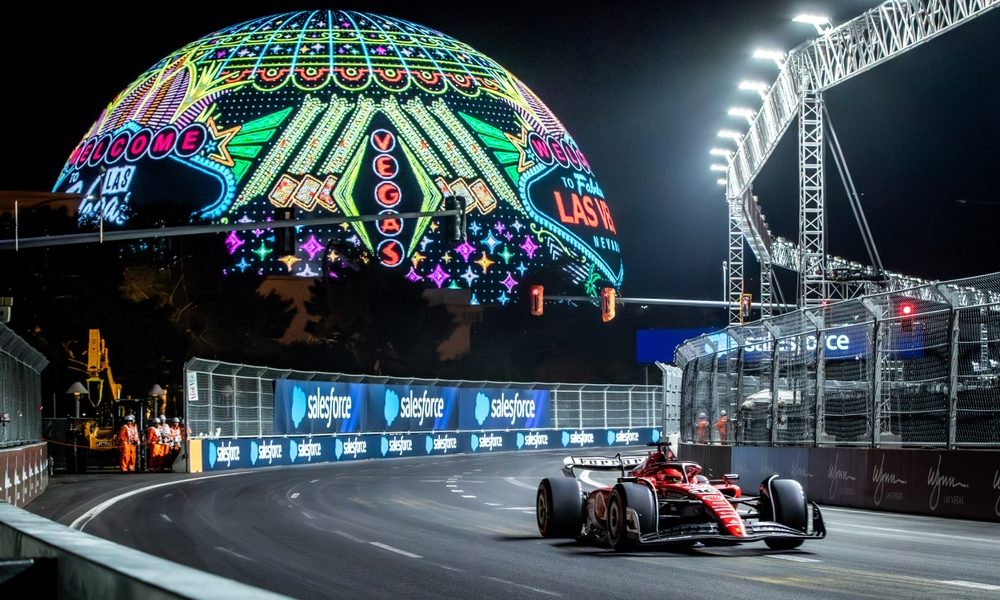

We’re officially at the point in the year when every brand in Las Vegas discovers a deep, previously unexpressed passion for motorsports.
Fashion brands? Racing fans. Jewelry designers? Lifelong enthusiasts. Hello Kitty? Apparently, she’s been following the constructors’ championship.
The Formula 1 Las Vegas Grand Prix returns November 19–21 and the marketing surrounding it is already underway. Now in its fourth year, the event has become an opportunity for brands with very little connection to motorsports to get involved in the spectacle.
And with the number of collaborations being announced, simply putting a checkered flag on an existing product and calling it a limited edition isn’t going to cut it.
Everyone wants a piece of race week
The F1 Hub Presented by American Express opens November 7 at The Venetian, bringing together a collection of brands that sounds a little like someone emptied the contents of a very expensive shopping bag.
New collaborations include jewelry designer Greg Yuna, fashion label Off Season, and Los Angeles-based Etai LA. They’re joining returning partners, including Disney, BAPE, LEGO, the Vegas Golden Knights, and F1 ACADEMY x Hello Kitty & Friends.
Off Season, founded by Kristin Juszczyk and Emma Grede, is bringing racing-inspired apparel, including oversized faux-leather jackets. Greg Yuna is introducing fine jewelry with customizable pieces available through experiences at the F1 Hub and F1 Paddock. BAPE returns with a Las Vegas-exclusive streetwear collection, while The Wild Collective is collaborating with the Vegas Golden Knights on limited-edition jerseys and lifestyle apparel.
And then there’s Hello Kitty, whose collaboration includes an F1 ACADEMY car wrapped in her likeness, complete with an enormous bow.
No notes.
These brands aren’t all selling to the same customer and they certainly aren’t selling the same product. But Formula 1 gives each of them access to a cultural event with an audience interested in considerably more than racing.
For fashion labels, motorsports has become another influence on streetwear and luxury apparel. For collectible brands, a limited-edition collaboration creates an opportunity to reach customers who may have no particular allegiance to a driver or team. For a local sports franchise, it’s a chance to participate in one of the city’s biggest international events.
Each partnership offers a different entry point into the same weekend, without requiring every customer to be a Formula 1 enthusiast.
The Strip has entered the chat
MGM Resorts has announced race-week programming at Bellagio, ARIA, The Cosmopolitan, and Park MGM, scheduled for November 16–22. The lineup includes the return of ARIA’s Carlos Sainz-inspired Smooth Operator Lounge, a Ferrari boutique at Bellagio, a Haas F1 Team car display at The Cosmopolitan, and an interactive Google Play experience at ARIA.
The Auction by Google Play will feature interactive games, customizable model cars and accessories, and opportunities to earn tokens toward a live auction. It’s a clever way for a technology brand to participate in the weekend without pretending it has suddenly developed a lifelong obsession with tire strategy.
The resorts are also rolling out culinary collaborations, visiting bartenders, art installations, fashion pop-ups, and enough specialized merchandise to suggest someone has developed a very detailed spreadsheet about the spending habits of Formula 1 fans.
Together, these activations expand the event beyond the racetrack.
A visitor doesn’t need a grandstand ticket to attend a driver appearance, shop a limited-edition collection, or participate in an experience available for only a few days. That creates additional opportunities to reach travelers who may be in Las Vegas for reasons entirely unrelated to the race.
It also creates a fairly significant problem for marketers.
Everyone is competing for attention during the same week, often targeting overlapping audiences with similar promises of exclusive access, limited availability and once-in-a-lifetime experiences. There’s only so much enthusiasm one person can reasonably allocate to a pop-up.
A racing stripe is not a marketing strategy
Major cultural events create an attractive shortcut for brands looking to reach new audiences. The event has already done much of the work of generating attention, attracting visitors, and establishing relevance. The temptation is to attach a logo, develop some merchandise, and enjoy the association.
But the stronger collaborations give consumers a reason to engage with the brand itself.
A fashion label can introduce a product that reflects its own design identity, while appealing to motorsports fans. A technology company can build an interactive experience around its capabilities. A hospitality brand can create an environment that extends the excitement of the event into its restaurants, lounges, and public spaces. The connection doesn’t have to be obvious. It does need to make sense.
Limited edition isn’t automatically desirable, although marketing departments have certainly been testing that theory.
There’s also a difference between reaching an audience and reaching the right audience. A collaboration can generate considerable attention without necessarily attracting customers who have any long-term interest in the brand. That distinction becomes particularly important when companies are investing in partnerships, merchandise, production, staffing, and promotional campaigns around an event that lasts only a few days.
A successful activation needs a business objective beyond looking good in the recap video.
And what exactly are we measuring?
The challenge with event marketing is that almost everything can be presented as a success.
A crowded activation looks great in photographs. Social media impressions can climb quickly when a recognizable celebrity or driver makes an appearance. Limited-edition merchandise creates urgency and the words “sold out” tend to make everyone in marketing very happy. But those outcomes don’t necessarily answer the same business question.
For a retailer, success might mean merchandise revenue, new customers, or continued demand after the event. For a resort, it could be incremental visitation, restaurant spending, or attracting guests who otherwise wouldn’t have visited. For a consumer brand, the objective may be awareness, earned media or introducing its products to a different audience. Those are different measurements, even when the activations are happening a few blocks apart.
And without a clear objective established before the campaign begins, it becomes remarkably easy to celebrate whichever number looks best afterward.
There’s also the question of how much of that activity would have happened anyway.
Las Vegas is already hosting a major international event. Visitors are already booking rooms, making dinner reservations, and spending money. Determining how much additional business a particular activation generated requires more than counting the people who walked through the door.
The most useful evaluation will separate event-driven demand from demand the brand created itself.
A three-day event with a much longer shelf life
One advantage of these partnerships is that the actual activation is only part of the campaign.
Product announcements, behind-the-scenes content, creator partnerships, media coverage, and social distribution can begin weeks before race weekend and continue well after the final lap. A three-day experience can generate months of material when it’s planned with distribution in mind.
That also means brands need to think beyond the people physically attending. The audience following the event online may be considerably larger than the audience standing in line for an exclusive jacket or photo opportunity.
The challenge is creating something worth sharing in the first place.
As race week approaches, the number of participating brands will only make that competition more intense. Some will produce experiences that become part of the weekend’s conversation. Others will spend a great deal of money to become one more logo in an already-crowded landscape.
And somewhere in all of this, Hello Kitty has an enormous bow on a race car.
Frankly, she’s understood the assignment.
