

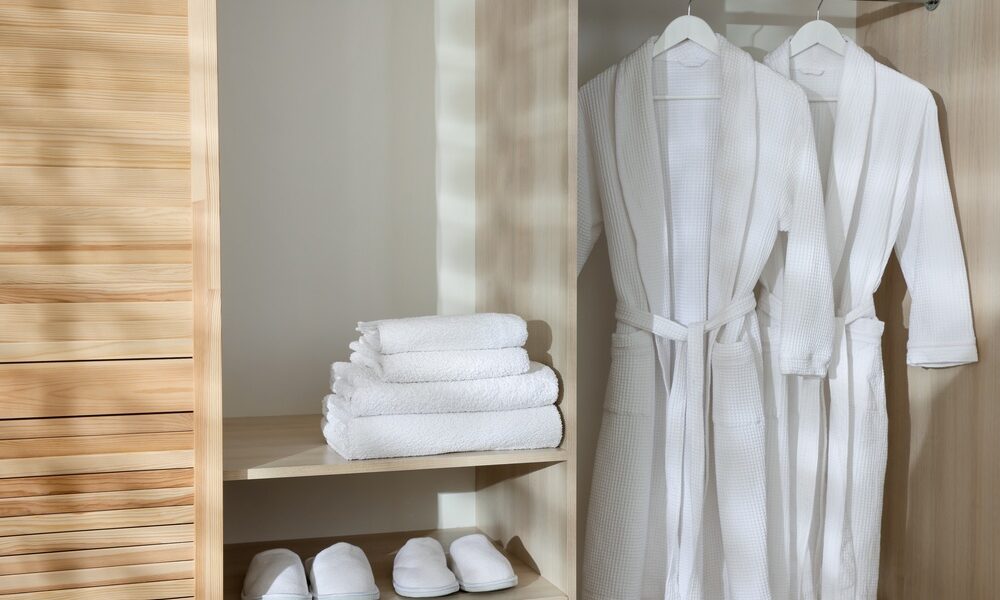

I take the slippers from nice hotels.
Someone told me once that you’re allowed to take them and that aligned perfectly with what I already wanted to believe, so I accepted it as absolute truth and have never looked into it further.
I don’t take the robes. I have boundaries. I also know they’ll charge the room.
The slippers come home with me and become house slippers. I wear them around until it’s time to leave, at which point I switch into normal-person shoes and go function in society.
It’s important to note that I’m fully aware of the quality of said slippers. I could go on Amazon right now and purchase a pair that are objectively better in every measurable way. But that is, I’m afraid, not the point. The point is that I like these. I got them moderately for “free” and a bargain has always had an unreasonable amount of influence over me.
Anyway, back to the plot.
The other morning, I walked into my garage and saw a pair I’d left out there the night before. My feet were bare. The slippers were right there. Nature was healing.
As I started putting them on, I had an intrusive thought: Surely not. Surely this is not the moment one of my worst fears comes true.
There are sensations your body understands before your brain agrees to receive the information.
This was one of them.
I felt a definitive crunch with my right foot.
What happened next was between me and whatever higher power there is.

There was a cockroach in my slipper.
For all intents and purposes, it’s important to note that the exterminator had serviced the house the day before, so the cockroach was already dead.
I know this holds almost no value for you within the context of this story, but it holds enormous emotional value for me. I need this distinction so I can sleep at night.
I could just go back to Deer Valley
Before I decided to resurrect the pair that had recently housed a dead cockroach, I considered my options.
Burn down the garage. Move. Or go back to Deer Valley and get another pair.
Obviously I wouldn’t fly to Utah, book a hotel room, and come home with another pair of slippers.

Obviously.
This is how I found myself mentally reverse-engineering a vacation around replacing a complimentary hotel amenity.
Which, once I got past the obvious cockroach situation, is a fairly remarkable outcome for a complimentary hotel amenity.
What gets to stay after the experience ends?
Marketers spend an enormous amount of time figuring out how to get back in front of people.
Retarget them. Email them. Text them. Get them into the loyalty program. Send the push notification. Follow up after the visit. Please, for the love of God, remember us.
But there is another version of that relationship where the customer voluntarily brings some part of the brand into their regular life.

The research on brand experience is pretty established here. What people see, touch, hear, feel, and do around a brand can influence how they evaluate it later, including satisfaction and loyalty.
And usefulness seems to buy a brand considerably more time.
In a 2026 study of more than 3,400 U.S. consumers, usefulness was the biggest reason people kept branded merchandise. When people got rid of something, the most common reason was just as uncomplicated: They didn’t find it useful.
I appreciate when several thousand people participate in a study only to confirm something our mothers could have told us. If it’s useful, we keep it.
Being kept is a pretty good media strategy
A useful object gets something most marketing doesn’t: time.
It doesn’t need another media buy to show up tomorrow. It doesn’t have to win the auction for your attention again. It can sit in your kitchen, your car, your suitcase, or your closet and continue being associated with wherever it came from.

Separate 2026 research found 78% of U.S. consumers said usefulness was a reason they would keep a promotional product.
This doesn’t mean everyone should order more stuff. We have enough stuff. I’ve been to enough trade shows to know that branded merchandise can very easily complete the opposite journey and go directly from booth to hotel trash can.
What seems more useful to know is what sticks around.
That can be physical, but it doesn’t have to be. A useful calculator. A saved guide. A tool. A feature. A service. Something the customer would miss if you took it away.
Attention is temporary but usefulness has a longer shelf life.
Anyway, I kept them
Ultimately, Deer Valley would have to wait.
I disposed of the trespasser.
I washed the slippers.
I dried the slippers.
I kept the slippers.
I still wear the slippers.
There are probably more sophisticated ways to measure whether something has successfully embedded itself into a customer’s life.
But surviving a dead cockroach feels statistically significant.
