

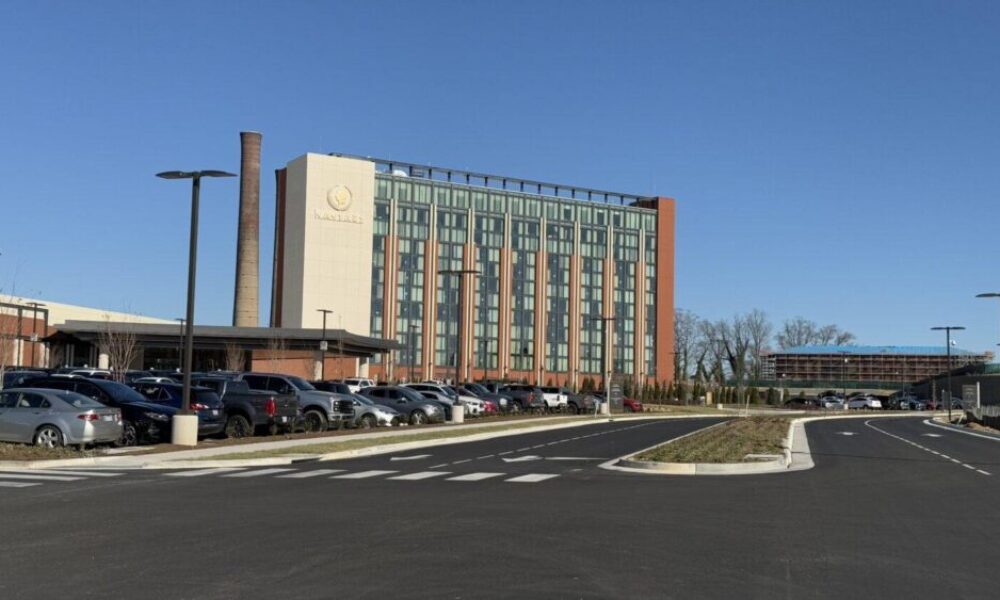

Recently, analysts from Jefferies Equity went on tour to Virginia. Virginia is a growing market, with five casinos, eight mini-casinos with a total of 4,000 historic racing (HHR) machines, and a very healthy mobile sports betting industry. In total, Virginia is generating between $150 million and $200 million in gross gaming revenue monthly. HHR first appeared in 2019, sports betting in 2021, and casinos in 2022. The revenue growth has been steady since. In 2025, casinos generated $969.1 million in gross gaming revenue (GGR). Virginians wagered $7.6 billion on sports, producing $842.9 million in revenue, and historic racing machines generated $480 million in GGR. The state lottery sold $5.7 billion in tickets and held $900 million as proceeds. The total is approximately $3.1 billion.
Wall Street has put Virginia on its radar. Jefferies Equity Research analyst David Katz says the investment, not the revenue, caught his eye. Katz said Boyd Gaming was investing $750 million, The Cordish Companies $1.4 billion, Churchill Downs $3 billion in a series of Rosie’s for its HHR machines, and $1.7 billion spent collectively by Caesars, Rush Street Gaming, and Hard Rock.
Considering that six years ago the state had only a lottery, the growth is very rapid both in terms of revenue and investment. In 2026, most other states have some form of gaming, lotteries, horse racing, sports betting, VLTs, HHR, Indian casinos, and commercial casinos. Lotteries and Indian gaming are on separate tracks; their growth is the result of other factors. Indian gaming is the result of federal legislation that passed in 1988. The legalization of lotteries began in 1963 and now 45 states have a lottery. Over the last 30 years, the growth of lottery sales has been driven by the linked-jackpots Powerball and Mega Millions. The combined sales result in very large jackpots that attract billions of dollars in sales.
The expansion of the other forms of gaming has been ongoing since 1990. It came in separate waves, each different from the others. In the first wave were the riverboats and remote towns. Lawmakers in those years were very concerned about isolating gambling from population centers. To gamble, customers had to travel long distances to remote locations; in the case of riverboats, the amount of time and money they could spend was limited by law.
However, with the expansion into more states, attitudes and motivation changed. Lawmakers became more concerned with tax revenue than harm. In the next wave, big cities were seen as ideal locations. Today, Chicago, Detroit, Philadelphia, Baltimore, Boston, New Orleans, and New York City have casinos. And as prejudice against legalized gambling decreased further, the states with riverboats began to allow the casinos to move to land, abandoning the boats, limits, and requirements that were seen as critical in the early 1990s. In the same vein, allowing slot machines to slip away from casinos and locate in taverns, bars, restaurants, and social clubs gained favor. Again, those changes were primarily driven by the need for tax revenue.
The final form of gambling to sweep the country has been legalized sports betting. In 2018, the Supreme Court ruled that sports betting was not subject to federal control, opening the door to what has become a monster industry. In 2025, bettors in the United States wagered $166 billion on sporting events; the GGR was nearly $17 billion.
Clearly, the Old Dominion is in good company. Excluding Utahans and Hawaiins, no one in the United States is very far from a casino. The casinos and Rosie’s in Virginia offer just that, a close-to-home place to gamble. Wall Street may just be discovering the state, but Caesars, Boyd, Hard Rock, and Churchill Downs have had their eyes on it for the last six years. Now, whether those operations will all make a profit and generate a fair return on investment is another question. Like many other states, Virginia is getting close to a saturation point.
How many is too many? That is the question that operators in many states will be trying to answer over the next decade and not just in Virginia. In Atlantic City, Illinois, New York, Pennsylvania, New Hampshire, and even Oklahoma and California and their tribal casinos, that is going to be a very real concern.
In the meantime, pour yourself a glass of champagne and drink up. The party is in full swing.
