

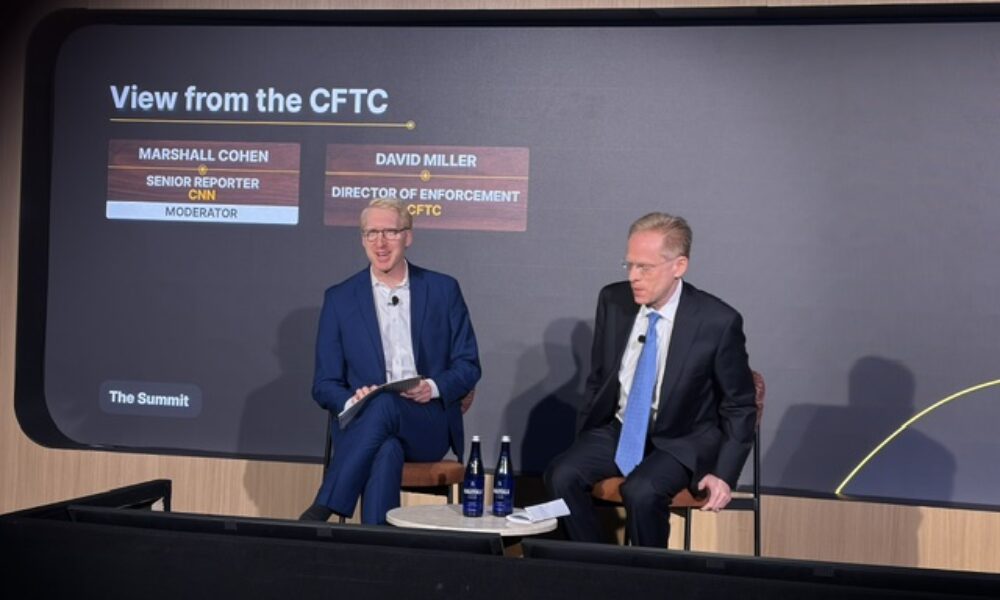

David Miller, director of enforcement with the Commodity Futures Trading Commission (CFTC), has made it clear that insider trading in prediction markets is an enforcement priority at the agency.
“I’ve said publicly that our priority at the Division of Enforcement is policing fraud, abuse, and manipulation,” said Miller, who was appointed earlier this year by CFTC Chairman Michael Selig.
Prior to his appointment, Miller said, “There was a lot of confusion as to whether or not insider trading and market manipulation rules and laws applied to prediction markets.”
In April, the CFTC brought its first insider-trading case against Army Master Sgt. Gannon Ken Van Dyke, alleging he used confidential information about the capture operation of former Venezuelan President Nicolas Maduro to earn more than $400,000 on Polymarket.
Van Dyke, who helped plan and execute the raid to capture Maduro, has pleaded not guilty to charges that include unlawful use of confidential governmental information for personal gain. He is free on bond, with his federal criminal trial scheduled to begin on December 7.
“We’ve been bringing insider trading cases for over a decade, but this was the first one with prediction markets,” Miller said last week at the Next Predict Summit in New York.

On February 25, the CFTC’s Division of Enforcement issued an advisory stating that the belief that insider-trading laws do not apply to event contracts and prediction markets is incorrect.
The Van Dyke case was followed by another case in May, where the CFTC and U.S. Department of Justice filed parallel civil and criminal charges against Google software engineer Michael Spagnuolo.
Spagnuolo was charged with insider trading on Polymarket using confidential corporate data. The complaints allege he risked $2.75 million across multiple contracts and generated roughly $1.2 million in profits.

Miller said both cases are still pending, with both men denying wrongdoing.
When asked by CNN senior reporter Marshall Cohen if Maduro could have traded on his own capture without necessarily violating federal insider-trading laws, Miller said the trade might have broken an exchange’s rules or federal law.
“That doesn’t mean you’re breaking federal law,” said Miller, adding that insider-trading law applies to the commodities and derivatives markets.
“Now, what people don’t get is that insider trading, basically, is about a breach of duty,” he added. “You have material nonpublic information, you have a duty to shareholders, not to trade against them.”
With the November 3 midterms approaching, Cohen said there have already been scandals involving political candidates “betting on their own races” on prediction markets and being punished by prediction markets for doing so.
Cohen knew that Miller couldn’t discuss specific investigations, but “big picture, is the agency investigating any midterm related activity for potential manipulation or insider trading?
“Well, I’m not going to go specific on the midterms, but I will say that we do investigate and have investigated and may have open investigations about some candidates who have placed trades on contracts that are based on their own elections,” Miller said.
