

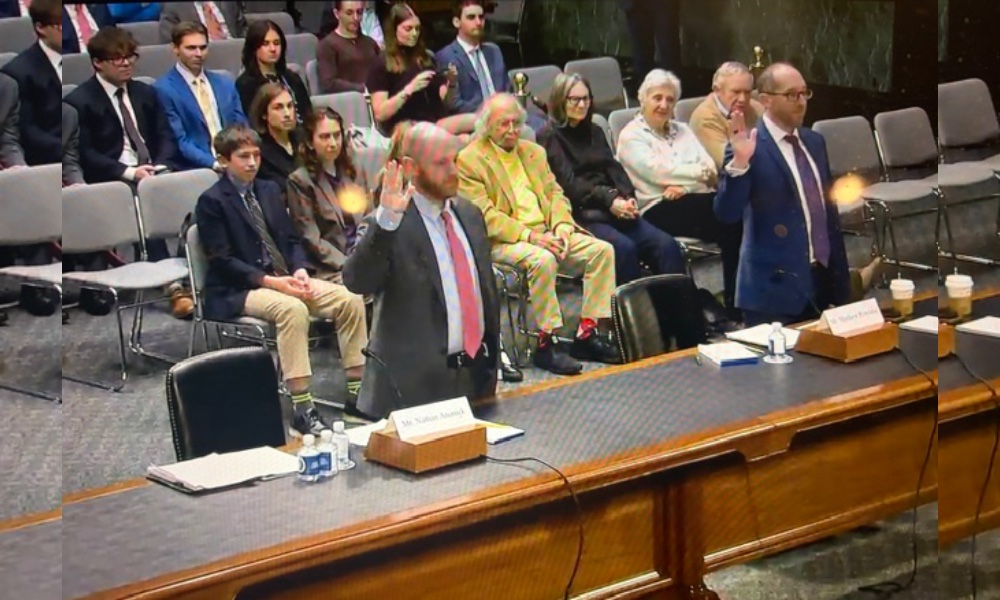

President Donald Trump’s bipartisan choices for the Commodity Futures Trading Commission (CFTC) were asked by members of a Senate committee Tuesday whether sports-event contracts should be regulated by the federal agency or remain subject to state gaming regulations.
Neither of the picks, Nathan Anonick nor Matthew Rowland, provided clear answers to senators’ questions on the topic, even as Democratic Senator Adam Schiff of California expressed concerns that Anonick, a Republican nominee, would fall in line with CFTC chairman Michael Selig’s position that the contracts are federally regulated.
Schiff believed Selig may have “blatantly decided” him more than any other nominees.
During Selig’s nominee hearing in November 2025, he pledged to “follow the courts” regarding sports-event contract regulations and described himself as a “blank slate” when it came to his opinion on regulatory control of the markets.
Schiff asked both Rowland and Anonick the same question he asked Selig during his hearing. Is a sports-event contract on Thursday night’s NFL game between the Indianapolis Colts and Houston Texans the same as a sports bet?
Anonick said the question is complex, noting that federal courts have disagreed on the answer.
“I appreciate the practical argument,” he said. “I just say it’s legally complex.”
Both Anonick and Rowland told the committee they would fully support a U.S. Supreme Court ruling on the issue.
Democratic Minnesota Senator Amy Klobucher, ranking member of the Senate Committee on Agriculture, Nutrition, and Forestry, reminded Rowland that the CFTC has taken the position that states are preempted from regulated sports-event contracts.
Klobucher asked Rowland what independent obligation the CFTC has to examine whether a contract falls within the statute restriction on event contracts related to gaming, war, terrorism, assassination, or certain other activities that may be against the public interest?
Or even in violation of state, tribal, or federal law.
“I do think that the framework that’s set out in the special rule in the Section 5CC, 5C really does direct the agency to think about the public interest,” Rowland said. “I know the commission under chair Selig has undertaken a rulemaking on this issue.”
Section 5CC, 5C of the Commodity Exchange Act (CEA) is the primary federal statute governing how regulated exchanges and clearinghouses list new derivative contracts and adopt rules under CFTC oversight.
Rowland stressed that it was important as part of the rulemaking process, which is still ongoing, and which he said he hopes to participate in if confirmed, that “we think long and hard about balancing the public interest against the kind of economic usefulness of these contracts.”
On October 9, the CFTC published a notice of proposed rulemaking to explicitly define “swap” to cover event contracts, such as sports or politics, framing them as commodity derivatives squarely within the agency’s jurisdiction under the CEA.
“I also think there is likely to be a (U.S.) Supreme Court decision within the next term or the one after, and, of course, we would be bound the court’s decision on that,” he added.
Democratic Senator Tina Smith of Minnesota touched on Klobucher’s line of questioning on prediction markets, noting that last May, Minnesota passed the first-in-the-nation ban on prediction markets, only to have a federal judge issue a temporary injunction blocking the ban.
Smith noted that Selig sued Minnesota, along with 11 other Republican- and Democratic-led states, including Arkansas. She also criticized prediction markets for making sports-event contracts available on sovereign tribal lands, when even Congress has long recognized their exclusive rights to regulate gaming on their lands.
Smith then asked both Rowland and Anonick whether she was correct that the Supreme Court’ decision in May 2018 to overturn the Professional and Amateur Sports Protection Act (PASPA) returned power to the states to legalize sports betting.
“Do I have that correct?” Smith asked.
“That’s my understanding of what the court said,” Rowland said.
Anonick responded that he believed that was correct, saying he was “not an expert on that case, but I believe so.”
Smith then asked if the Indian Gaming Regulatory Act (IGRA) granted tribes the authority to regulate gaming within their reservations, with both nominees saying it was their understanding that IGRA regulated tribal gaming.
“I actually think the law is quite clear, that jurisdiction over sports betting rests in the hand of the states and tribes,” Smith said. “Yet prediction markets continue to operate, I believe in violation of these state and tribal laws.”
Smith said prediction markets claim they are offering event contracts, which are regulated by the CFTC, and that these contracts are not, in fact, sports wagers. So she said, “I want to understand where you see this.”
“CFTC regulations clearly prohibit event contracts related to gaming from being offered. I think that’s correct,” the senator said. “Is that your understanding?”
Rowland said he knew that’s how Regulation 40.11 is written.
“Well, senator, my understanding of the CEA is CFTC has discretion to determine a contract is against the public interest if it meets the enumerated factors, one of which is gaming,” Anonick said.
Smith responded by asking if there was any practical difference between a sports wager and a sports-event contract? “It seems to me that if it walks like a bet and quacks like a bet, it in in fact a bet,” the senator said.
Rowland noted that court rulings have held both ways on this issue, but as a matter of pure practicality, he understand that the argument Smith was making goes to the heart of the legal issue.
“It’s hard for me to comment on active litigation that the CFTC is engaged in, but I’m certainly very sympathetic to the concerns that the states and tribes have raised and would kind of want to work with them further, if I was confirmed, on that.”
Anonick agreed with Rowland, saying it was a complex legal issue, such that federal courts have disagreed on that issue.
“So from a legal perspective, I wouldn’t want to tip the scales on that, but I appreciate your practical examples and I agree with my friend Matt, in that I’ve heard from the tribes as well,” Anonick said. “It’s a very charged emotional issue and I appreciate how sensitive it is.”
Smith told both nominees that she raised the issue because it’s a core legal tenant laid out in IGRA, as well as the rights of states to regulate sports betting.
“I think it is unambiguous that a prohibition on gaming applies to these event contracts … which are a bet in any other name,” Smith said.
Chairman John Boozman, a Republican from Arkansas, concluded the hearing by thanking both Rowland and Anonick for appearing before the committee. Members of the committee did not vote on either nominee, with Boozman noting that “the record will remain open for two business days.”
Rowland, a Democrat, was nominated for the remainder of a term expiring April 13, 2028, while Anonick, a Republican, was nominated for a term expiring June 19, 2031. If both are approved by the Senate to serve on the CFTC, it would bring the commission’s total number to three, leaving two seats still vacant.
