

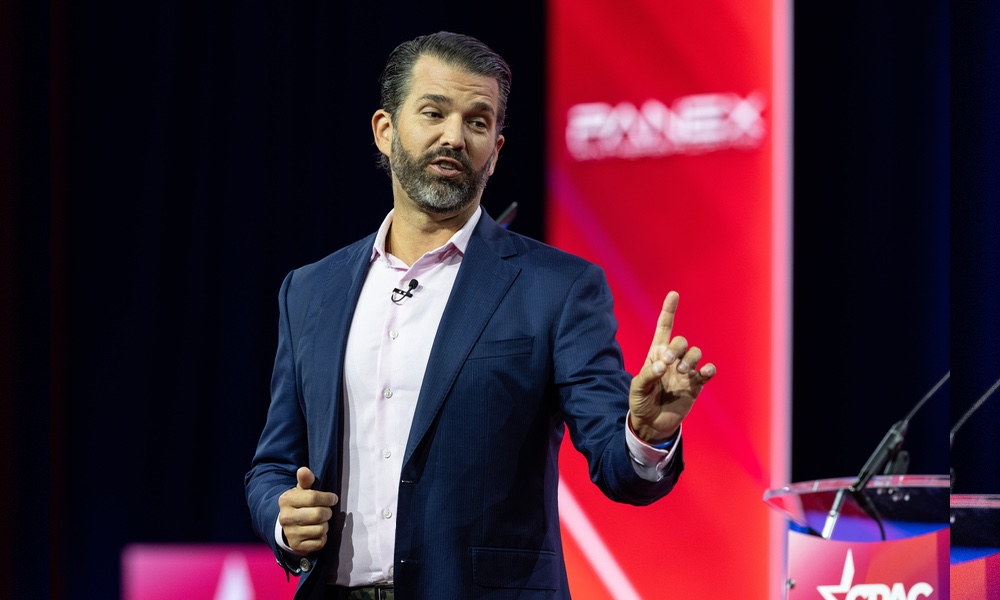

Donald Trump Jr. is stepping down from his role as an advisor to Kalshi, less than two weeks after Democrats took control of Congress in the midterm elections.
The decision comes as Democrats in both the House and Senate are expected to scrutinize President Trump’s family ties to crypto and prediction market companies, Bloomberg reported.
Trump Jr. has been an advisor to Kalshi and Polymarket since 2025. The Financial Times reported that his stake in Kalshi was worth $300,000 in January 2025.
His firm, 1789 Capital, invested $200 million in Polymarket before adding another $300 million over the summer. A Kalshi spokesperson attributed the change to the Polymarket investment.
“We have mutually agreed to end Don’s advisory role after his firm’s significant investment in a competitor this past summer,” the spokesperson told Bloomberg. “We are grateful for his contributions in helping us market Kalshi to more customers.”
The decision to part ways with Trump Jr. comes after Nevada Democratic Senator Catherine Cortez Masto criticized Commodity Futures Trading Commission Chairman Michael Selig for serving the Trump family’s interests, writing that the “move to undermine tribal and state sovereignty is intended to create profits for the president’s family.”
“That should outrage all of us,” Masto wrote.
Novig appeals ruling that denies injunction in New York
Novig has filed a notice of appeal to the U.S. Court of Appeals for the Second Circuit, after a federal judge in Manhattan denied its request for a preliminary injunction against New York gaming regulators and the attorney general.
The ruling enabled the state to enforce its gaming laws against the prediction market operator. In the ruling, the federal judge found Novig’s sports-event contracts are essentially bets on sports and not financial derivatives, or swaps, protected by federal law.
In a 35-page ruling, U.S. District Court Southern District of New York Judge Colleen McMahon denied Novig’s request for a preliminary injunction against New York Attorney General Letita James and state gaming regulators. McMahon also rejected the company’s argument that federal law preempts state gaming regulations.
She questioned the Commodity Futures Trading Commission’s (CFTC) updated position on sports-event contracts. McMahon highlighted the CFTC in its Notice of Proposed Rulemaking released in October, saying they failed to explain the distinction between sports-event contracts and traditional sports bets.
McMahon wrote that the CFTC’s Interim Final Rule codified its longstanding position that casino-style gambling products are not swaps and do not fall within the CFTC’s jurisdiction.
“The CFTC did not identify any differences between sports-related event contracts and sports wagering contracts, such that one would qualify as a ‘swap’ while the other would not,” McMahon wrote.
McMahon noted that the Interim Final Rule does, however, “make it perfectly clear the CFTC has historically taken a hands-off position with respect to contracts wagering on the outcome, score, or other details of sporting events.”
Novig began offering sports-related event contracts to customers in New York in August. Ludlow Exchange LLC, the parent company of Novig, received designation as a contract market from the CFTC in June.
The New York State Gaming Commission considers the activity to be sports betting, which is prohibited in the state without a gaming license.
The company had argued that federal commodities law preempts state regulation of its sports-event contracts and that the CFTC has exclusive jurisdiction over contracts, because they qualify as event swaps under the Commodity Exchange Act (CEA).
“Congress drafted the CEA to regulate financial activity, like hedging against corn futures, not consumers betting on Thursday Night Football,” she wrote. “The CEA’s text must be read accordingly.”
McMahon also criticized the CFTC’s emergency order telling Kalshi to continue to operate in New York even if a state court rules otherwise. She wrote that it “smacks of a collusive effort between a regulator and regulated to generate a claim for conflict preemption.”
McMahon also dismissed Novig’s argument that state licensing would conflict with federal requirements, noting that the company could obtain gambling licenses, as it previously did in Colorado, and implement geofencing.
Novig originally obtained its first sports betting license in Colorado in late 2023 in partnership with Full House Resorts before pivoting to its current exchange model and being regulated by the CFTC.
In other developments:
- The White House has sent bipartisan nominations for commissioners on the CFTC to the Senate for approval. Matthew Rowlan, a Democrat, was nominated for the role of commissioner at the CFTC for the remainder of a term expiring in 2028. Nathan Anonick, a Republican, was also nominated for a role as a commissioner at the CFTC for a term that is due to end in 2031. “I congratulate them on their nominations and look forward to working with each of them upon their confirmation by the U.S. Senate,” said CFTC Chairman Michael Selig.
- Missouri officials have agreed to pursue criminal, civil, or administrative enforcement against Kalshi until a ruling in the federal lawsuit or a qualifying dismissal of the state’s counterclaims. Meanwhile, Kalshi withdrew its temporary restraining order request but will seek a preliminary injunction. On Wednesday, Missouri officials made it clear they intend to pursue their licensing and tax claims through counterclaims in federal, rather than state, court.
- Ro Khanna, a Democratic congressman representing California, has called for sports-event contracts to be banned. Khanna believes “prediction markets are sports betting disguised as financial trading,” which flout state and tribal gaming laws, siphon state tax revenues, fuel addiction, and expose young Americans to public health risks, while evading state consumer safeguards. “Congress must ban them.”
- In barely over a year, Kalshi has added 23 million app downloads, compared to 33 million for DraftKings and FanDuel, according to a report authored by Citizens analyst Jordan Bender. “Kalshi’s level of customer acquisition is unprecedented for the sports industry,” Bender wrote. “If the current rate is sustainable through the end of the NFL season, we would expect customer acquisition to triple, over the prior year, for the next month and double as we progress later into the season.”
- Polymarket is facing a probe by the CFTC into whether it violated a 2022 enforcement agreement, according to Reuters. Under the deal, the company had committed to blocking U.S. users from accessing its main offshore platform. Polymarket is based in New York and operates an offshore entity registered in Panama.
