

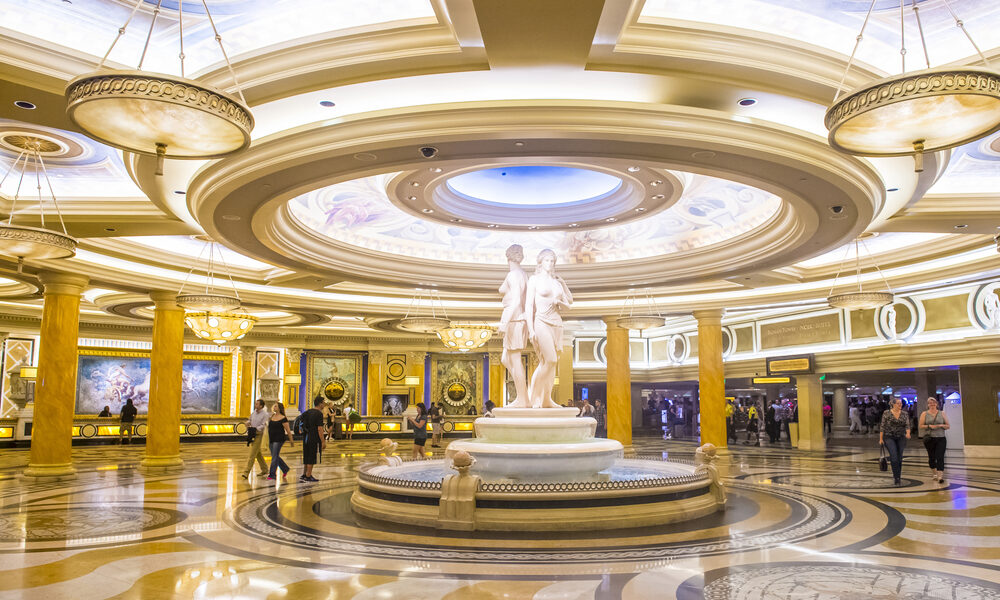

The CEO of Caesars Entertainment said Tuesday there’s “no crisis” on the Las Vegas Strip, which he claims is holding up “quite well,” and that the fourth quarter improvement – a top-four result in the company’s history – is continuing into the first quarter, auguring well for 2026.
CEO Tom Reeg said Caesars is coming off a soft summer in Las Vegas because of a decline in leisure travel. It remains soft but is not as pronounced as it was over the summer. Group business helped fill in the fourth quarter, and Reeg expects that to offset leisure travel in the first quarter. Group business picks up even more in the second quarter, and he said he feels good about the rest of the year. The one unknown is how leisure travel will be during the summer, considering that was the issue in 2025.
What’s happening in Las Vegas with a 7.5% decline in visitation in 2025 is a “normal economic cycle activity in leisure,” Reeg said. Drive-in traffic from California was down in 2025 as people stayed closer to home, and visitation from Canada was down.
In the last three months of 2025, Las Vegas saw 92% occupancy versus 96.5% a year ago, and the average daily room rate decreased 9%.
“F1 was a strong event for us. The Super Bowl despite what you read on social media was an extremely strong event for us,” Reeg added. “Keep in mind we were 92% occupied during the quarter for 20,000 rooms and if you look back over the history of Caesars in Vegas this was probably the third or fourth best fourth quarter of all time. There’s really no crisis happening in Vegas. It’s normal cyclicality that will play itself out.”
Reeg said complaints about Las Vegas prices are a focus of social media, but that has nothing to do with what is taking place on the Strip.
“Center Strip is holding up quite well,” Reeg said. “The mix of what’s available – the options you have here are unsurpassed. The fact that we were at 92% instead of 96% – we are going to work to get back to 96%. There’s nothing unusual happening here, and I expect it to recover as time goes by, and we’re already seeing that happen over the fourth quarter and into the first quarter.”
It’s also a staffing challenge because occupancy can fall to the 80s% one week, then surge to full occupancy the next week, Reeg said.
“The way I characterized the business in Vegas is peak events and peak weekends and conferences – the city and all of our properties are doing quite well,” Reeg said. “It’s the shoulder periods when there is not a big event or a big conference where demand is challenging and from an operating perspective that’s a unique challenge for us and all of us in the market.”
President and Chief Operating Officer Anthony Carano said company-wide net revenues rose 4% and adjusted earnings were up 2% in the fourth quarter. Margins were in the mid-40s.
Carano said the company continues to see improving trends in Las Vegas throughout the year driven by stabilizing leisure trends and a strong group and convention calendar.
“During the fourth quarter we benefited from a strong event calendar, which produced a record F1 event for Caesars, a strong New Year’s Eve and 17% group and convention room-night mix during the quarter,” Carano said.
Carano said regional properties saw a decline in adjusted earnings because of poor weather in December, but sees improvement in 2026 based on strong group showings in Reno, completion of a $200 million Lake Tahoe master plan renovation, hosting events around the World Cup, and continued returns on investment on changes in marketing. Harrah’s Oklahoma will open April 9th.
Reeg addressed prediction markets and their impact on legalized casinos’ sports betting bottom lines by saying they don’t know what will happen in the courts and in Congress to deal with the issue. Caesars digital handle grew in the fourth quarter and continues to grow, and they are not seeing any impact in regulated markets so far.
“This [prediction markets] is clearly gambling and will take a couple of years to wind its way through the courts,” Reeg said. “You will have a patchwork of states where they are not allowed and states where they are allowed. In the current regulatory environment, you shouldn’t expect us to be participating in prediction markets. Some of our most valuable assets are our gaming licenses in the states where we operate. It has been made clear to us that if we pursue that avenue some of our bricks and mortar licenses could be at risk. You shouldn’t expect us to do that. Notwithstanding, if there becomes clarity that there is a legal path for prediction markets that satisfies regulators on the brick and mortar side we will find a way to participate. I will tell you unequivocally that we view this as gambling that should (not be legal). We will let that play out through the courts.”


