

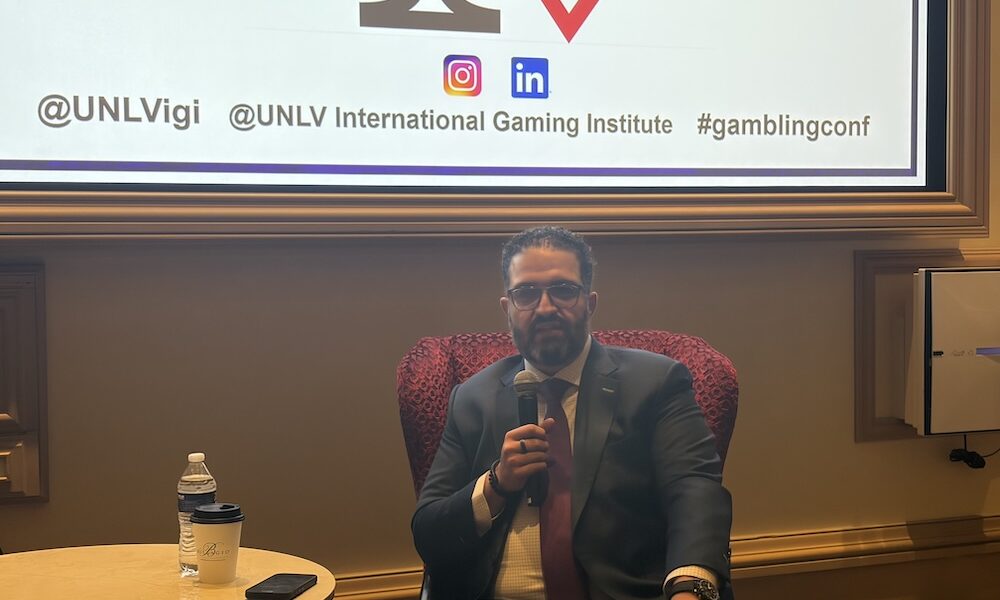

Las Vegas Strip casinos are under the watchful eye of Nevada gaming regulators after slew of anti-money-laundering and other violations led to a combined $32 million in fines. Wynn Resort’s Omar Khoury, for one, welcomes the oversight and wants to protect the industry’s reputation.
Khoury has served as Wynn’s chief global compliance officer for nearly two years, overseeing compliance in the U.S., Macau, and the UK, and will do so in the United Arab Emirates when the company’s casino opens there in 2027.
In 2025, three Strip casinos were punished for AML violations for dealing with illegal bookmakers. Caesars paid $7.8 million, MGM $8.5 million, and Resorts World paid $10.5 million. Wynn Resorts avoided involvement with those bookmakers, but was fined $5.5 million for unregistered international money transfers. As part of that case in September 2024, Wynn forfeited $130 million to the Department of Justice after a 10-year investigation.

Khoury came to Wynn from Everi, where he served as vice president of regulatory compliance for five years. Prior to that, he spent 15 years at MGM Resorts International, starting in internal audit and eventually becoming senior vice president of corporate compliance.
In April, Nevada regulators approved AML regulations to hold industry executives accountable, including reviewing and approving individuals whose primary responsibility is oversight of the casino’s AML program, along with employees within player development. That licensing requirement holds people like Khoury responsible for any AML violations and could result in having their license stripped.
Khoury spoke about his job at the International Conference on Gambling & Risk Taking, where he was interviewed by Anika Howard, president and CEO of Wondr Nation.
“One of the biggest myths I experience in my role as compliance officer is that I’m going to say no,” Khoury said. “I’m not here to tell you no. I’m also not here to tell you yes all the time. When a compliance officer turns into a yes person, they lose the independence that makes them valuable. We’re on the same team. Compliance, CEO, and C-Suite, we all have the same objective. We’re trying to move the boat in the same direction. If someone in operations wants a no, but doesn’t have the courage to say no, they’ll say, ‘Go ask compliance,’ counting on the no department. They’re surprised sometimes when we’re able to work through it and say yes.
“No to me means a law, statute, or regulation stops us from doing it from a reputational standpoint. It all goes back to a risk-based approach. I don’t make business decisions. I help influence them, but the main objective is compliance. I still have to maintain independence by not making business decisions (like whether to issue credit to someone).”
A lot has changed in the industry over the years and compliance now has a seat at the table, Khoury said. In the past, the philosophy was do it now and ask for forgiveness later; compliance will figure it out when they talk to the Gaming Control Board, while having full deniability.
“That has changed. We have to be at the table at the onset,” Khoury said. “It’s easier to say something when I’m involved and we stay throughout and get a good product at the end. Having a seat at the table shows how much we’ve evolved and the respect compliance is given at the C-Suite level.”
Any friction that develops within a company is healthy, though he said most in the industry want to avoid being at odds with their CEOs, general counsel, and other executives.
Khoury reports to Wynn’s Compliance Committee, appointed by the Board of Directors. The general counsel serves as a sounding board.
“I don’t feel pressured by anybody ever in my role, because I have the ultimate say,” Khoury said. “The CEO understands that when it comes to banning a patron and responsible gaming, that I have the authority to put someone on an involuntary self-limit. We take that out of the hands of operations and it’s solely my decision. I can ban a patron here, in Macau, and the UK. That’s come a long way. A lot of the decisions in the last 10 to 15 years that have resulted in enforcement action throughout the land have come because compliance felt pressure to make a decision a certain way. To me, the minute your compliance officer starts feeling that, it’s time to go. You should have the authority to make a decision and not be questioned on it. “
In May, a Wynn executive told a group of Nevada accountants that a player who lost $26 million was banned. That happened because of the current environment.
Khoury welcomes the new regulations enacted by Nevada regulators over AML, which were needed to create consistency and a level playing field across Strip properties and throughout Nevada
Khoury also believes marketing has a place in compliance decisions. “Marketing asks asking why you made the decision to ban a player who immediately goes to the casino down the road. Articles have said that marketing shouldn’t be involved in these decisions, I think they should. I want our head of marketing and CEO asking why you banned (that person). There is a process behind what we do in compliance and how we get to our decisions.
“Obviously, when it comes to AML, our license, and our reputation, I’m not willing to take a gamble on some things,” Khoury said. “I want that friction with marketing and the CEO. It helps to have a candid conversation with your CEO and C-Suite. Sometimes they are tough conversations. Sometimes we don’t agree. We agree to disagree, but at the end of the day, I have that authority.”
Khoury noted that Nevada regulators understand the importance of their relationship with operators. Casinos across the state had a seat at the table over the last six months to craft the new compliance regulations.

“Other regulatory bodies make changes without consulting the operators,” Khoury said. “Nevada is big on doing that. The Board has done a good job of reaching out and wanting to understand things. Frankly, where we started and has come a long way. A lot of good things are in place. Transparency with your regulators is critical.
“Back in the day, it was like, ‘Do we need to tell gaming about that?’ Now, we just pick up the phone, call Gaming, and say, ‘Here’s where we’re at, this is my thought process, is there any information you’re willing to give me – maybe on a particular patron or particular activity we are looking to do on property. We have an open dialogue I tell people all the time that regulators aren’t scary. They want to do the right thing. We are all on the same team. Our job is to protect not only our reputation, but the industry. We love what we do and love the industry we are in and want to protect it.”
Khoury talked about the role artificial intelligence is playing in compliance and responsible gaming, creating efficiencies in gathering data. “It’s an enabler. It doesn’t replace human judgment. Someone has to review that information and make decisions.”
One use for AI is detecting counterfeit documents, Khoury said. When conducting research, it helps with checking someone’s source of wealth to make sure the money they are bringing to the property is legitimate. In that case, they will ask for tax returns. AI can red flag documents as potentially fake that the human eye can’t catch. It can also offer advice on next steps. AI has been used for responsible gaming.
Khoury said his AML team takes its responsible-gaming role seriously. When a player is wagering $50 and all of a sudden accelerates to $1,500 a hand, that’s a red flag. The two issues are combined, he said.
“People are doing bad things, because they have problem gaming, and we’re seeing that from an AML perspective. Sometimes it’s very hard to approach somebody, especially in the States. The UK does it a lot better. They have an affordability check and tell someone this is their limit. In the U.S., it’s how dare you tell me I have a problem. It does get a bit challenging. Our industry is very reactive and I think AI will help us get proactive in that area.”
