

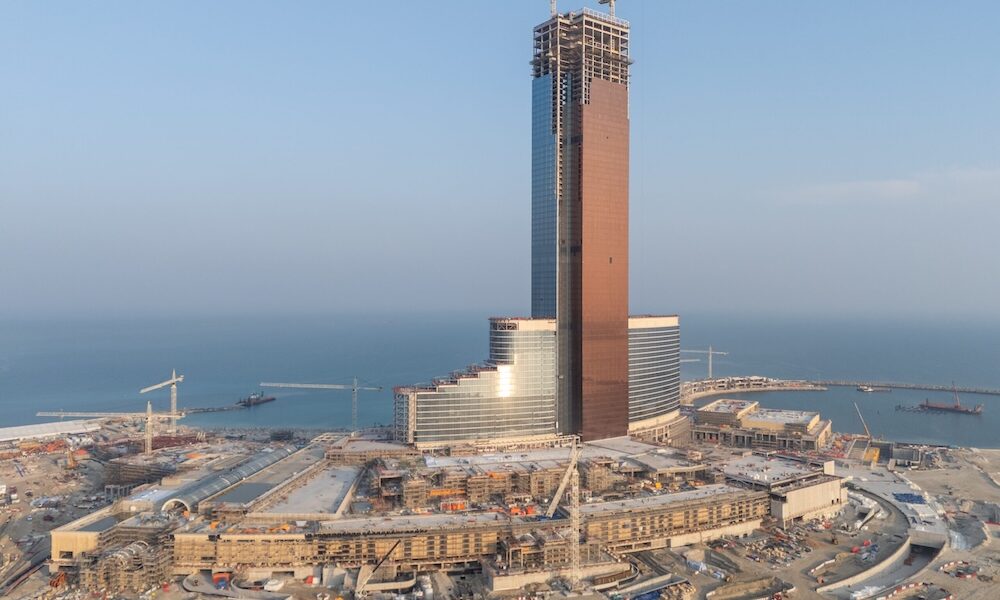

Wynn Resorts announced that the opening of its $5 billion-plus Wynn Al Marjan Island casino resort in the United Arab Emirates has been pushed back to September 2027 from the spring. In addition, its costs have increased by $600 million, half of which is attributed to the regional conflict in the Persian Gulf.
Wynn CEO Craig Billings made the announcement Tuesday during the operator’s second-quarter earnings call. In May during the first-quarter call, Billings said the project faced “a modest delay” due to the ongoing conflict between the U.S. and Iran, without giving a rescheduled opening date.
“As development of Wynn Al Marjan Island progresses, regional conflict-related disruptions initially impacted global supply chains and continued to impact the shifting insurance markets,” Billings said. “This has required certain materials and equipment to be resourced, rerouted, or expedited to ensure the project’s construction timeline.”
There were other disruptions associated with the movement of staff, consultants and other non-recurring issues, Billings added.
“These disruptions have impacted the timing and cost of the project,” Billings said. “On the timing, we now expect the project to open its doors to the public in September 2027. With respect to budget, we’re increasing the total project by approximately $600 million. Of that, half is directly attributed to disruptions from the regional conflict – material cost increases, shipping cost increases, and the pre-opening and capitalized interest costs associated with the extended construction timeline. The remaining portion reflects remeasurement, trade coordination, and other costs you expect on a project of this scale and duration, independent of anything happening in the region.”
Billings, who went to the UAE in June, said construction is progressing rapidly. In addition, pre-opening hiring and operations planning are advancing.
“What we’re building is one-of-a-kind and the quality of work is truly extraordinary,” Billings said. “We continue to believe this will be the most exciting resort opening globally in over a decade and remain as committed to and confident in the UAE as ever.”
In response to a question from a Wall Street analyst, Billings said the military intensity against the UAE has eased even as the broader conflict has played out.
“This country absorbs pressure and keeps functioning, rather than gets knocked off course by it,” Billings said. “I’m not going to tell you there’s no risk, but when we underwrote the project, we didn’t underwrite a region with zero geopolitical risk. We underwrote a country with the demonstrated ability to manage through it.”

Consumer supply chains are normal and the Dubai Airport has grown flight capacity over the last couple of months, Billings said.
“Day-to-day life is pretty normal. You’re talking about an opening that’s well over a year out and if the conflict is persisting at that point, we have bigger problems from the perspective of the energy market.”
September marks the beginning of the peak tourism season in the UAE, Billings said.
“When this property opens, we expect a pretty robust locals or regional pipeline. We also expect a healthy global pipeline. The real question as we fast forward to September 2027 is which of those customer funnels are we addressing in the near term and which over time. It’s fair to say for the core gaming product, demand should exceed supply. It’s just a question of where it’s going to come from. That changes where you spend marketing dollars and focus your hosts and their attention. But it doesn’t change the core of what you’re opening. We have a lot of levers to pull there and it’s a question of which lever we pull based on the state of play.”
In other markets, Billings highlighted that Las Vegas, where it caters to the luxury customer base, delivered $215 million in adjusted earnings during the second quarter with strength in May.
“We saw impressive increases in both drop and handle, driving a 5% total increase in casino revenue,” Billings said. “We were also pleased to grow revenue per room by 3% and retail-lease revenue was up 8% during the quarter. More recently, the business has seen solid volumes and increases in both slot revenues and revenue per room. We experienced unusually low hold in the month of July.

“Looking ahead, we remain positive about the business in Las Vegas,” Billings said. “We’re currently on track for another strong F1 week and pacing ahead of last year for our transient leisure business for that event. On the group and convention side, we saw the forward-booking pace accelerate as July progressed and the business looks strong heading into the fourth quarter and 2027.”
As for Boston, Billings said Encore Boston’s Harbor generated $56 million in adjusted earnings, with the second quarter setting records for Q2 revenue per room and hotel revenue. Slots remained strong, with revenue up 1%. “More recently, demand in Boston has remained healthy, with slot revenue running slightly ahead of last year.”
In Macau, Billings said Wynn delivered solid results during the quarter with $306 million in normalized VIP adjusted earnings with unfavorable VIP hold negatively impacting the operator by nearly $9 million.

“Volumes were up nicely in the quarter, with mass drop up 5%,” Billings said. “So far in the third quarter, rolling volumes and mass drop were down slightly year-on-year as we absorbed a well-publicized impact from the World Cup, along with usual seasonality. We saw drop pick up in the back half of July as the region entered the summer holiday season and those improving trends continued into early August.”
In Macau, Billings expects to start construction on Enclave, a 432-all-suite hotel before the end of 2026. They will also begin construction in the coming weeks on their long-planned event center and theater at Wynn Palace, with completion in 2028. The Enclave is expected to open in 2029.
“Taken together, these projects reflect a clear and confident investment in the future of the Macau market and our effort to support its diversification efforts,” Billings said.
