

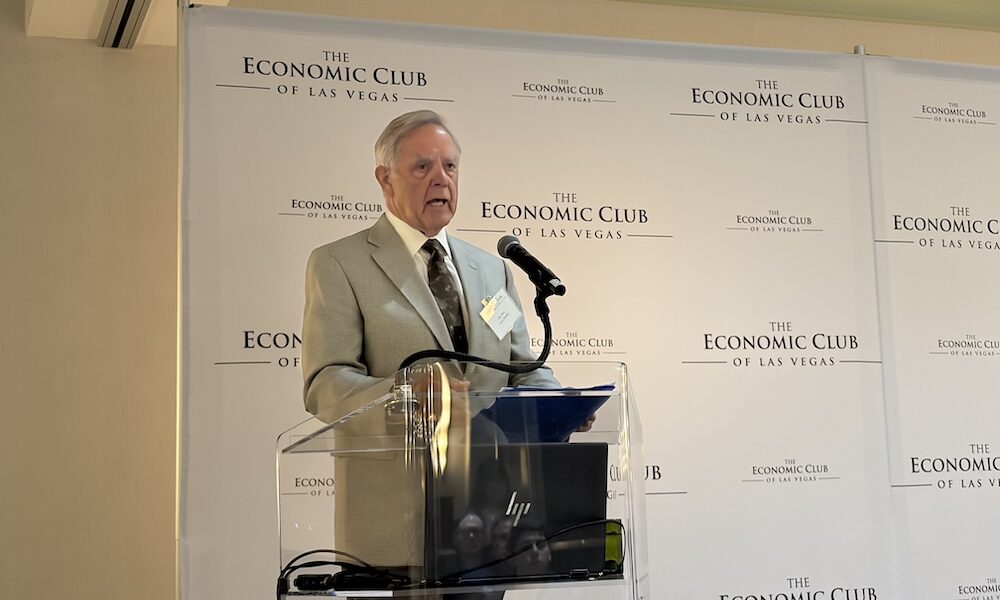

While optimistic about the city’s future as a global vacation destination beyond gaming, the board chair of Wynn Resorts said a big threat to Las Vegas has been the sale of casino properties and subsequent leasebacks that can potentially hinder reinvestment crucial for attracting guests from around the world.
Phil Satre addressed the OpCo PropCo model that has been deployed on the Strip by MGM Resorts International, Caesars Entertainment, and others following his address to the Economic Club of Las Vegas this past week. He noted that the separation of ownership, the physical assets from the operation, is still being evaluated and has its upsides and potential downsides for Las Vegas.
“If you have a softening of revenue for whatever it might be — COVID, tariffs, or whatever impacts value — and suddenly revenue streams are declining, you don’t have any choice but to pay the rent first,” Satre said. “It has to be done that way. If you don’t, then it’s a far bigger problem. What that might create is an environment where the guest no longer sees the value, anymore, because either the prices go up or the capital improvements (go down).”
Satre was asked about the recent announcement of billionaire casino owner Tilman Fertitta’s bid to take over Caesars and an offer by Barry Diller’s People Inc. to buy MGM. He said he doesn’t think that’s bad for Las Vegas.
“I think in both of those cases, the financial capacity is there to reinvest in the assets,” Satre said. “I’m more worried about the inability to invest, because of the rent payments. That has a potentially significant impact on competitiveness. That investment is critical, in my view. At the Wynn, we have to make sure the guest sees that we’re trying to stay special, adding events and amenities.”
Satre said Las Vegas’ focus on non-gaming attractions, such as Allegiant Stadium and the A’s $2 billion Major League Baseball stadium, has had the “biggest single long-term impact” on the city. He noted that gaming in the 1970s was 90% of revenue, while it’s only 35% today.

“This is one of the healthiest evolutions for the industry. People have lots of other opportunities to gamble online or on their telephones. So we need a better set of competitive characteristics and Las Vegas has done it very well.”
Satre said Las Vegas can now compete all over the world, because it’s now a destination where people find the city fun and exciting. He cited Sphere for what he called immersive and incredible shows. “I get excited by the fact we’re hosting F1. This city is doing some exciting things and bringing in a customer that we wouldn’t have seen otherwise.”
Satre addressed a question about Las Vegas being overpriced. He suggested the city will reach a point where prices can’t continue to escalate, but there’s also an increase in the capacity of people who can afford to come to Las Vegas.
“We have to charge more, because of investment, but if we didn’t invest, we’d lose out to other venues throughout the world. If we’re careful and combine investment with special experiences, we’re competing more with non-gaming types of attractions. I think we’re now getting to the point where we can compete, even if visitors have no interest in gambling.”
Satre said that doesn’t mean there aren’t challenges for the gaming industry, citing competition from online gaming and prediction markets. But he also included more casinos throughout the country.
“People say, why would I spend the money to travel to a casino destination? In northern California and Reno, we see that right now. Why would you drive over Donner Pass in a snowstorm to get to a casino in Reno when you can stop at any number of Indian gaming casinos along the Interstate 80 corridor?

“My home city of Reno hasn’t figured that out. We haven’t invested the kind of capital to make that happen. We still have the opportunity and I’m hopeful that will happen, but the mix in Reno looks more like the old mix in Las Vegas in terms of gaming and non-gaming revenue.”
Satre, the former CEO of Harrah’s Entertainment, praised one of the biggest changes in the industry over the decades: Leadership has become more diverse, welcoming women and people of color.
He also showed the audience photos and outlined the opulence at Wynn Al Marjan, the $5 billion resort under construction scheduled to open in 2027. “We’re going to have a market all to ourselves for a significant period of time.” Wynn’s 30 acres across Las Vegas Boulevard from its two resort properties will someday be developed, Satre added.

The emergence of artificial intelligence will help the industry know its customers better and how to market to them, Satre said. That way the customer can have a clear picture of what their experience could be like.
“AI can help us staff more appropriately to meet the potential highs and lows in business levels,” Satre said. “That should have a positive impact on financial performance. It’s not about depriving that customer of experiences but having that service adjustable based on what we learned from AI. I think you can fine-tune customization.”
