


If the idea of shared goals and policies isn’t enough reason for commercial and Native American gaming to work together, there’s the economics: The most recent numbers show commercial casinos garnered $38.5 billion in revenue; Indian casinos aren’t far behind, at almost $30 billion.
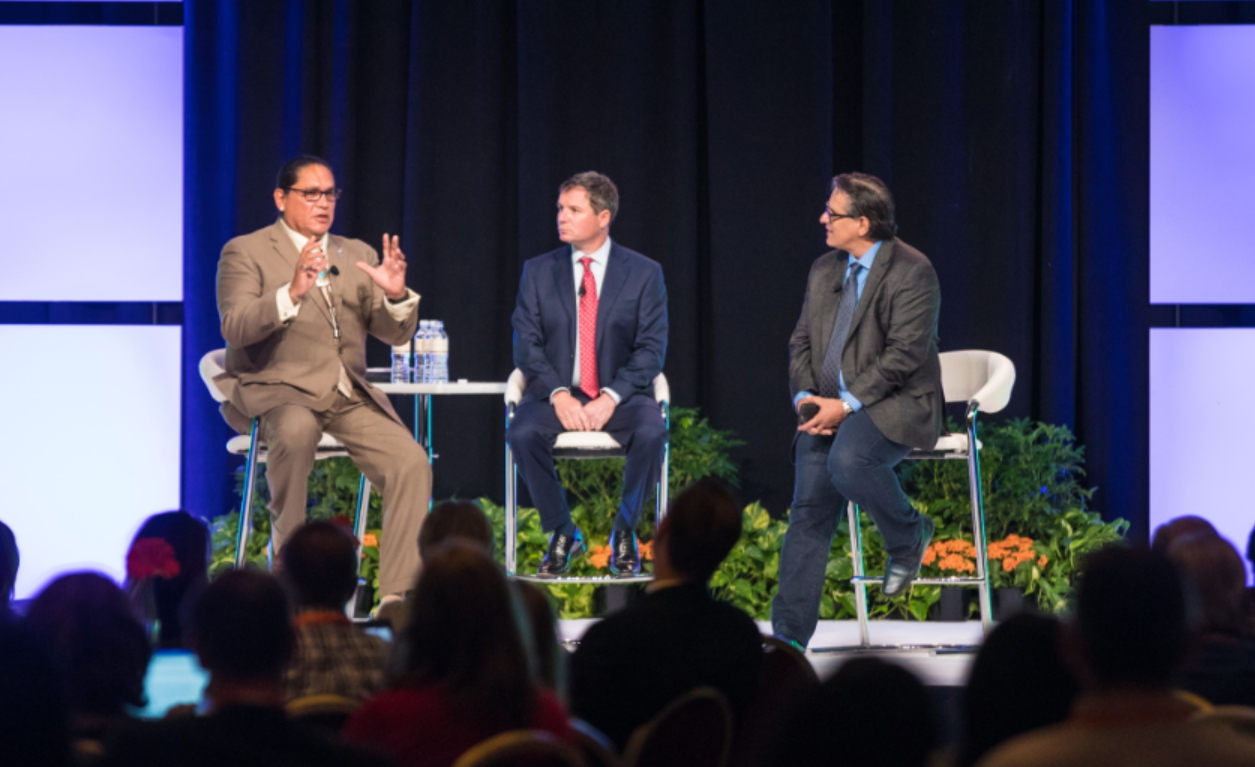
Tuesday morning, the American Gaming Association (AGA) President Geoff Freeman and the National Indian Gaming Association (NIGA) Chairman Ernest Stevens Jr. spelled out their common goals, especially when it comes to working with the government to form policy.
 Notable objectives are fighting off attempts by the Internal Revenue Service to lower the minimum reportable payout from $1,200 to $600 and using casinos’ tracking programs to report individuals’ revenues.
“I’ll take this point and be blunt,” Freeman said, as the two delivered the day’s keynotes at G2E in Las Vegas. “There are differences between us. But you have to get over it. There are also differences just within commercial gaming entities. There are differences within every industry.”
The AGA represents the casino industry as a whole. The NIGA represents about 200 tribes.
Stevens noted that tribal involvement in the AGA is still in infancy, with seven tribes joining the group (although three are notable, representing the Mohegan Sun, Foxwoods and the Seminole Tribe of Florida).
“We made a very consequential decision, and we’re not uniting for the sake of uniting. We’re uniting because it’s important to our future,” Stevens said.
Freeman added, “I don’t see a divide between tribal gaming and commercial gaming, and our customers don’t see a difference. It’s casino gaming to them.”
Stevens also notes that tribal gaming itself will not change with the partnership. Native American casinos still will negotiate compacts with states.

“Our rights have not changed,” he said. “We are tribal government gaming. What we’re doing is building our communities and our rights to engage as governments.”
He added that tribal gaming has come a long way, with the 30th anniversary of the 1987 California v. Cabazon Band of Mission Indians decision approaching. That U.S. Supreme Court ruling declared that tribes can offer the forms of gambling that a state currently offers.
“We’ve made it through all kinds of obstacles,” Stevens said. “We’re right on the heels of the overall industry and we’re a major force. And when you’re a major force, unity is vital.”

Freeman said tribes and commercial casinos also have common interests in legalizing sports gambling (also read: AGA President optimistic about sports gambling) and anti-money laundering compliance.
Said Stevens, on sports gambling: “Certainly there’s a whole lot of money going someplace.”
Moderator Victor Rocha, owner of Pechanga.net, noted that the leaders bonded when Freeman flew to Wisconsin to visit Stevens, and the two learned they were both Green Bay Packers fans.
“So we have the Green Bay Packers to thank for helping our industry,” he joked.
The pair of leaders also stressed that merely communicating issues is a step forward for the relationship.
“We certainly have issues on my end and he has issues on his end,” Freeman said. “But we pick up the phone and talk to each other.”
