

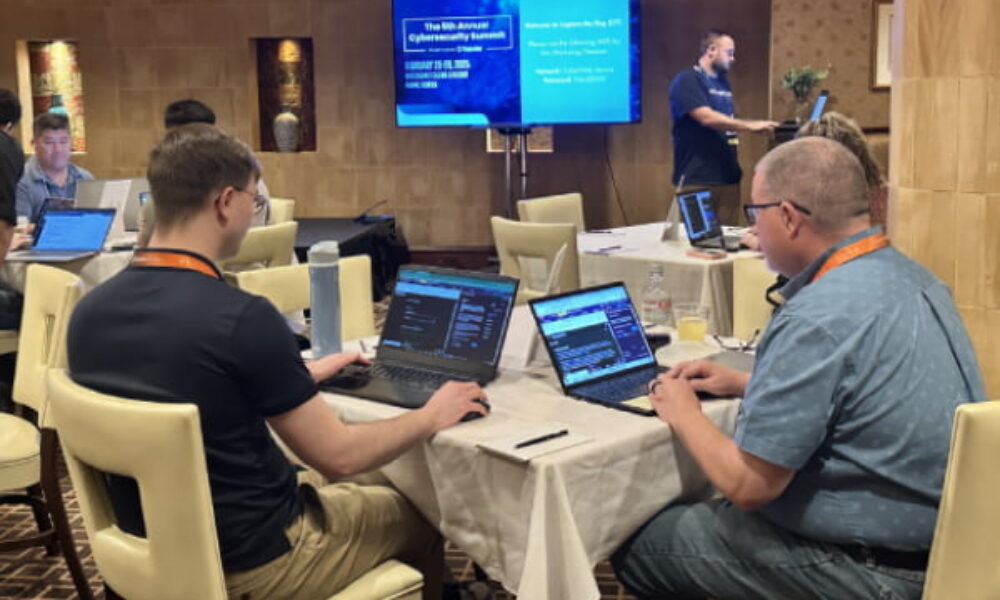

The National Tribal Cyber Challenge October 20-21 featured tribal technology and security professionals testing their defenses, collaborating with peers, and strengthening cybersecurity readiness.
Hosted virtually through World Wide Technology’s Cyber Range, the immersive Capture the Flag event, Disarm Me: Hack, Decrypt, Disable, challenged participants to act as ethical hackers, investigate a hostile environment, uncover vulnerabilities and work through realistic attack scenarios.
More than half of the challenge participants were from California tribes, bringing the challenge participation to more than 60 technology professionals who work at tribes or tribal enterprises. This was TribalHub’s first virtual edition of the Cyber Challenge, as the organization has previously hosted in-person challenges at past TribalNets and Cybersecurity Summits.
WWT Associate Business Development Manager Daniel Hartnagel emphasized the value of experiential learning for the TribalHub Community, the largest community of technology-minded leaders from tribes across the country.
“At WWT, we believe people learn security best by doing it,” Hartnagel said in a statement “The Cyber Range lets us put real tools and realistic scenarios in front of people in a safe environment, so participants build skills they can bring straight back to their teams.”
To support players of all skill levels, the Red team tools learning path, the Initiation demo CTF, live proctors, and in-game hints ensured accessibility. While players competed individually for leaderboard spots, the event centered on community learning and collaboration, allowing participants to share insights and discuss approaches as they progressed through the challenges at their own pace.
Competitors used a wide range of tools and techniques, from Nmap and John the Ripper to Metasploit and Ghidra, demonstrating problem-solving across diverse skill levels.
Valley View Casino & Hotel Senior Systems Engineer Jason Omo said the experience helped him advance his cybersecurity knowledge.
“It was an exciting experience,” Omo said. “The most rewarding part was when I got the right answer. I am currently studying for the CEH v13 exam, and this helped a lot. I (enjoyed) getting to experience working with others to reach a goal.”
“Several players worked through the night, and four completed every one of the 21 challenges, which says a lot about the effort this group put in,” Hartnagel said.
In the Division A category, Yuhaaviatam of San Manuel Nation, led by Angel Garcia of team Crypto Zeroday, claimed the top spot with 385 points.
The Chickasaw Nation’s Global Gaming Solutions posted the fastest overall completion time by Ashish Pathuri of Rapid Sentinel.
Rounding out the division’s top finishes were Sycuan Casino Resort’s Kailani Del Rio of Locked Watchtower and Yuhaaviatam of San Manuel Nation’s Bryan Baker of Daring Sandbox, both with 375 points.
Valley View Casino and Hotel, led by Cristian Soriano of Team Lucid Passkey, took first place in the Division B category with 215 points. Table Mountain Casino Resort, led by Kyle Shubin of Team Delta Barricade, secured second place with 195 points, followed by Habematolel Pomo of Upper Lake, led by Austin Malicay of Team Hardy Cipher in third with 135 points.
Team Prompt Moat’s Cristian Soriano and Justin Hill earned “First Blood” honors (the first participants to complete the first challenge), while Ashish Pathuri and Angel Garcia captured First to Finish recognition.
Garcia, a senior security analyst with Yuhaaviatam of San Manuel Nation, said navigating the CTF challenges in the Cyber Range felt intuitive and engaging, letting him focus on problem-solving rather than learning the environment.
“One feature that stood out was the bot assistant, which provided timely clues that helped guide me toward the next stage of an exploit without taking away the challenge of discovery,” Garcia said. “What I found most rewarding was the opportunity to work with a variety of tools from the Kali Linux toolkit and gain a deeper appreciation for the tool’s capabilities. Connecting each tool’s purpose to practical attack and defense scenarios turned the experience from simply completing challenges into a meaningful learning opportunity.”
Garcia said Red team-style challenges give Blue teamers a powerful way to sharpen their defensive instincts by exploring real-world exploitation techniques from an attacker’s perspective.
Stepping into an adversary’s mindset, defenders gained a clearer understanding of how malicious activity unfolds across a network. Retracing these attack paths in a production environment lets security teams rigorously test logging and monitoring controls and uncover critical visibility gaps, Garcia said, noting that evaluating whether current telemetry would have caught each stage of the compromise guides targeted improvements in event progression, ultimately strengthening detection engineering and ensuring threats are neutralized before escalating into major security incidents.
“While I did not have many opportunities to collaborate with participants outside my organization, working alongside a peer who also took part in the CTF added a valuable team dimension to the experience,” Garcia said. “We traded approaches, built on the clues provided, and drew from our own experience with Kali to work through challenges from different angles. That exchange reinforced how much stronger learning becomes when people share ideas and techniques. I’m looking forward to future events where I can broaden those connections, learn from more perspectives and engage more deeply with cybersecurity peers across Indian Country.”
Bryan Baker of Yuhaaviatam of San Manuel Nation earned the Night Owl Award for working until 12:56 a.m. C.T. Angel Garcia, alongside Justin Hill, secured Early Bird honors for submitting flags before 7:10 a.m. C.T.
Hartnagel said that virtual formats successfully remove barriers like travel and cost, enabling continuous, shared learning communities.
“We hope participants walked away with more confidence and practical skills, and a better sense of how attackers think so they can defend more effectively,” Hartnagel said. “We would love to keep building on this with TribalHub.”
“Thanks (everyone) for participating, and again, a big thanks to WWT for working with us on launching this and working towards some more stuff in the future,” said TribalHub Chief Operating Officer & Director of Operations Shannon Bouschor. “Love the interest. Love the involvement. Congrats to everybody for taking a couple of days and adding some more work to your plate that hopefully was interesting, valuable, and fun.”
