


Slot manufacturers continue to move away from branded games of television shows and other content to in-house themes, games that are more volatile, and simpler.
The discussion “Casino Game Design: New Trends and the Player Experience” was part of a session the UNLV International Gaming Institute held in collaboration with the Global Gaming Expo at the 19th Conference on Gambling & Risk Taking held at Bellagio in Las Vegas.
The session examined recent innovations in slot machine design, focusing on how changes in hardware, game mechanics, and audiovisual presentation have reshaped player engagement and product performance. It also considered the growing influence of mobile gaming, highlighting points of convergence and divergence with land-based slots and the implications for future research and development.
Daniel Sahl, director of the UNLV Center for Gaming Innovation, moderated the program that featured Anika Howard, president & CEO of Wondr Nation, a digital entity of Mashantucket Pequot Tribal Nation, which owns Foxwoods in Connecticut; and Brett Vela, vice president of product management with Bluberi.
“Fifteen years ago, if you walked the floor at G2E, you saw a lot of branded themes,” Sahl said. “Movies, TV shows, and games like the Brady Bunch and Back to the Future. That type of branding has been on the decline. Some really solid brands are still popular with players, but most manufacturers have focused on more in-house content development and branding characters and trademarks.”
Howard said branded themes are on the decline, because licensed content will get people in the seat to start, it won’t necessarily keep them there. It’s about the game mechanics and other experiences, she noted. “Suppliers are seeing they can get to that level of engagement with the players without necessarily being a licensed product.”

Vela said it’s no longer as simple as making a western theme and throwing a cowboy on the screen. Themes have become so immersive and intentional that every symbol matters.
“We do a lot of player focus testing and put games early in development in front of players,” Vela said. “You better believe that if that game has an element that doesn’t make sense or fit in that theme package, the players call that out instantly. More than ever, it’s not about art for the sake of art. It has to be a fully immersive package with audio, lighting, and everything else.”
The panel agreed that the biggest game changer in design changes has been hold and spin and that’s evolved to cash-on-reel slots, Vela said. More than 40% of the games on the market have those mechanics and that will continue to grow.
“We have a limited amount of time to teach players about game mechanics,” Vela said. “Hold-and-spin and cash-on-reels are very simple mechanics. You land the ball and you get the ball. Cash-on-reels has changed that a little, because you also have to get a catalyst. It’s a lot easier to educate players on the base game and what that catalyst is and how to get those cash-on-reels. Cash-on-reels and hold-and-spin are at this beautiful crossroads of simplicity. On the other side are these complex bonuses and the amount of variety you get from hold-and-spin.”
Howard said hold-and-spin is a “perfect blend between old and new.” Nearly every operator has hold-and-spin on their casino floors, because it’s a “near universal cross-demographic mechanic, which she said is rare in this industry.
“You don’t find something that has all those elements,” Howard said. “When you think about it, hold-and-spin descends from mechanical reels and you add all this near-miss psychology borrowed from social gaming. It’s familiar and easy to understand, because you don’t have much time to teach a new player how to play. It’s part of a ritual they’re accustomed to that makes it easier for them to grasp and enjoy. It feels familiar, even though there are so many things going on.”
Sahl said hold-and-spin stands out in that the core game runs seamlessly, while a separate game works together well.
“Simplicity today matters most and it has always mattered,” Vela added. “There’s no shortage of innovation and ideas throughout our game developers, but getting those into a package that’s quickly understood really matters. Games today are becoming so much more complex than ever before, and it hard to explain that to players. If the game is too complicated, they may not want to play.”
Casino commercials today show that slot players haven’t changed much over the years in how they enjoy the games. They lean in, press buttons, and have a sense of excitement, Howard said. “The buttons got bigger and curvier, but a lot of the player’s core experience is the same.”

Adding to that experience is sound that has become more important than ever. A fully immersive sound package to go with the theme adds a different layer to the experience for the players, Vela said.
The panel was asked by an audience member about game volatility and what impact that has on players who can lose their bankroll sooner.
Vela said some players are looking for a more volatile experience, and the industry is following that lead. “Players vote with their wallet and they’re playing these more volatile games.”

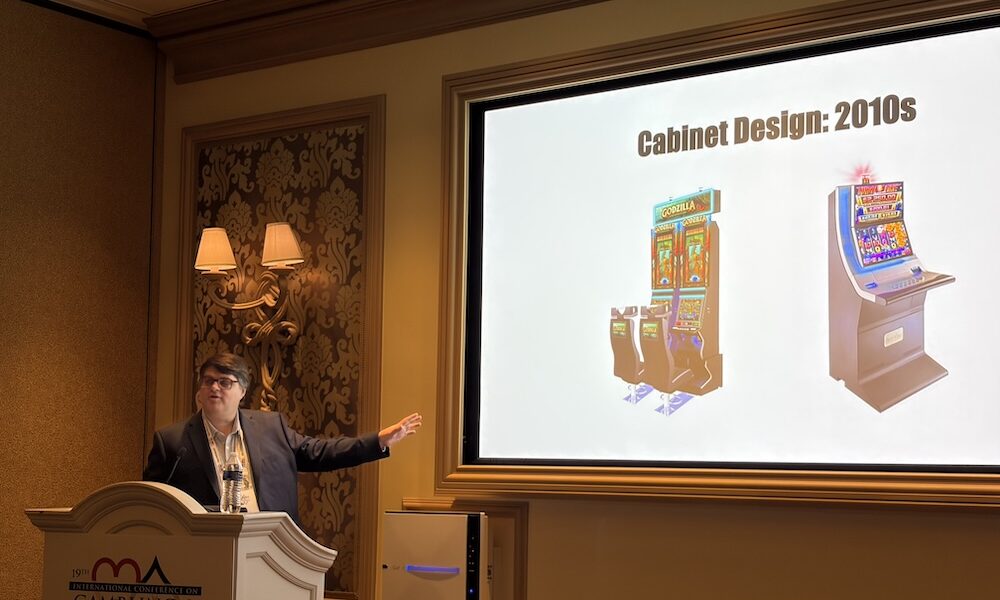
Sahl said 15 years ago marked the beginning of the current era of slant-based slot design with an emphasis on bigger and bolder —brighter colors, dynamic screens, high-quality graphics, and multi-screen cabinets with different elements of the game action.
“One of the things I find interesting when I think about mobile gaming is how we’ve got these new game themes emerging that are designed for these very large screens, and it’s clear when you look at how these games are designed that these artists and designers are taking full advantage of the space,” Sahl said. “When we try to transfer that to mobile gaming, sometimes those translations work and sometimes they can be challenging to do.”
One of the trends they’re seeing in mobile and online gaming is divergence in the type of content and gaming experiences being offered from more traditional land- based, Sahl noted.
“There are regulated operators looking at types of (online designs) that offer players more control of volatility and more control over how much risk they’re willing to take,” Sahl said. “These games are very basic and down to the bare bones for gaming experience on the winning and losing outcomes, which is a divergence from land based.”
During the discussion, the panel talked about what hasn’t worked in the slot industry in recent years.
Vela said his company changed the bash button from plastic to silicon to create a luxurious feel. Players liked it, but casinos are harsh environments and players are tough on games and chemical cleaners can wear down silicon.
Howard said with skill-based gaming in its initial iteration, the industry expected a lot and was on the bandwagon. But for a slot player, the ritual is about the risk taking and anticipation and skill-based games broke that dynamic.
“You have this pattern that people were expecting,” Howard said. “We were trying to go after a new audience, but we didn’t understand the audience we were trying to capture and isolating the audience we had.”
Howard also cited virtual reality slots were about immersing players in the experience, but customers want ritualized play instead.
Sahl agreed, saying people play a video game for one type of experience and gambling game for a different one.
The industry was “way more innovative” a decade ago than it is today, Vela said. He cited IGT leading the way with 4D and multi-layer displays and other “fantastic innovations” that pushed the industry.
“They came out and did well, but players went back to what they wanted their original experience to be,” Vela said. “Players are very loyal and like what they like.”
When it comes to responsible gaming, Howard said when it comes to slots, it has traditionally been an afterthought, but it should be an upfront part of the core experience rather than relegated to footnote.
“I couldn’t agree more,” Vela said. “It has to be front-and-center when you develop a game. We’re trying to do a better job of transparency. With our focus group, we put games in front of players to make sure they understand what’s happening and why they’re winning what they’re winning. As the technology continues to advance, we would all love to see more responsible gaming incorporated into the land-based side as well. It is a hard road to get there. It’s complicated. A lot of cabinets are 20 years old with different regulations out there. As technology advances, we’ll get a solution that works for the land-based side as well.”
