



(Author’s note: If you think you know everything about persistence machines and their threat to operators, you might be surprised by reading the just-released “Breaking the Slot Code,” a book we review this month. You’ll find there’s still a lot to learn. On the other hand, if you’re scratching your head about how and why talk about these games keeps coming up in every meeting, stick with me here.)
Walk the hallways at any gaming conference these days (G2E, IGA, ICE, you name it) and sooner or later somebody’s going to corner you about “persistence” slot machines. It might be the GM from a tribal property in Florida, or a slot director from Nebraska. Doesn’t matter. They all want to know the same two things: “What exactly is a persistence machine – are they good or bad? And what the heck do I do about them?”
Fair questions, both. Let’s start at the beginning.
Back to basics
Every “standard” slot machine you’ve ever played operates on one iron-clad principle: each outcome is completely independent of the one before it. Hit a jackpot on spin number one? You could absolutely hit another one on spin number two. Or you could lose the next hundred in a row. The machine doesn’t know, and it doesn’t care. Given enough handle pulls (statistically the industry uses 10 million), the game performs exactly as programmed. Most machines today are set to return somewhere between 88% and 98% of what’s wagered, leaving the house with a 12% to 2% edge.
That’s the standard model. Predictable. Regulated. And governed only by Luck.
But then there’s another whole category of machines; what the industry calls “variable state” games. And these are anything but standard, which is exactly the problem.
In a variable state game, things change as you play. Specifically, they get better. The prize can grow. The odds can improve. Or, in the most aggressive versions, both happen at once. The longer you “persist” in your play, the more the game rewards you for it. Hence the name.
If you’ve ever watched a kid rack up extra lives and power-ups at Dave & Buster’s or on the video games at the mall arcade, you already understand the concept perfectly. Persistence slots are built on the exact same philosophy; just with real money on the line.
A simple example (bear with me)
I’m going to use dice, because it’s easy to understand this basic game.
Imagine my contest with one, six-sided die. Players bet $1.05 for a chance. Roll a one through five, they lose. Roll a six, and they’ll collect $6. Do the math and you’ve got a 95% payback (5% for the House). Not a bad game and solidly in our favor.
Now start tweaking it.
Bump the jackpot to $7 and suddenly our edge disappears entirely. The player’s payback hits 110% and the casino is now writing checks instead of cashing them.
Or leave the jackpot alone and change the die itself. Add a second “six” (two ways to win instead of one) and the player’s payback shoots to 147.5%. We aren’t just losing; we’re hemorrhaging.
Those are static changes. Now make it variable:
Growing Jackpots. What if that $6 prize climbed by a nickel every time someone rolled without hitting after the first six losing rolls? Six more rolls without a winner and the jackpot sits at $6.30. That’s already break-even. Keep going and the game tips entirely in the player’s favor. Any experienced gambler paying attention would never walk away and would soon win. But the casino has already made its expected profit

Improving Odds. Or flip the script on the die itself. Again, after six losing rolls, for every ten consecutive losing rolls, one more number converts to a “six.” Now imagine a counter on the screen displaying that number openly. Would you leave that game showing “8” rolls without a win”? Of course not. Neither would anyone else.
That’s an overly simplified version of what’s happening right now on casino slot floors everywhere.
So why do we have them?
That’s the question I get every time I talk about this. And the answer is pretty simple: players absolutely love them.

More importantly (and this is what can make a slot director go bipolar), these games are extraordinarily profitable before they ever reach that player-positive tipping point. The revenue they generate on the way to that positive state is consistent, predictable, and is generally near the top of your floor metrics. Your analysts and the finance team are not complaining. But strangely, your everyday players are starting to … even though they generally like the games. Discontent is starting to grow.
The problem isn’t the game. It is one group of players that has figured out how to exploit them.
Advantage players: The slot vultures
My colleague Michael Shackleford (aka The Wizard of Odds) has a term for these folks in his latest book: “Slot Vultures.” I love it, because it’s exactly right. They are also known as advantage players (APs).
Real vultures don’t make the kill. They circle patiently and swoop in the moment someone else has done all the hard work. Slot vultures operate identically. They never (I mean never ever) play a persistence machine in a neutral or negative state. They watch and wait until a regular guest has unknowingly built the game into a player-positive condition, then they slide in and collect.
It’s not illegal. Let me be clear about that. But it is deeply corrosive to your floor, for one very practical reason: every spin the slot vulture takes in a positive state is a spin your loyal guests don’t get. And those most profitable players seldom see a win on those machines despite playing them regularly. Worse, they may stop coming back.
That’s the real damage. Not the math. Their disappointment and the erosion of loyalty.
A brief history of the hustle
This isn’t new. But there are more opportunities for APs today than at any time in the past. The first wave came decades ago with linked progressive jackpots on video poker and video keno banks. Teams of advantage players would monitor these meters obsessively and wait until the jackpot climbed high enough that the expected value (EV) tipped their direction. Then they’d plant someone in every seat on the link, effectively blocking out all other guests, until the jackpot hit. It was a virtually guaranteed profit for them (and ironically the casino too).
Those high meters drove traffic? The floor was buzzing. But the team never touched those games when the meters were low, which meant regular guests were grinding through the worst possible conditions (low meters) just to help the teams take the glory and the money.
This was one of the first indicators of the damage persistence machines could do.
Must hit by
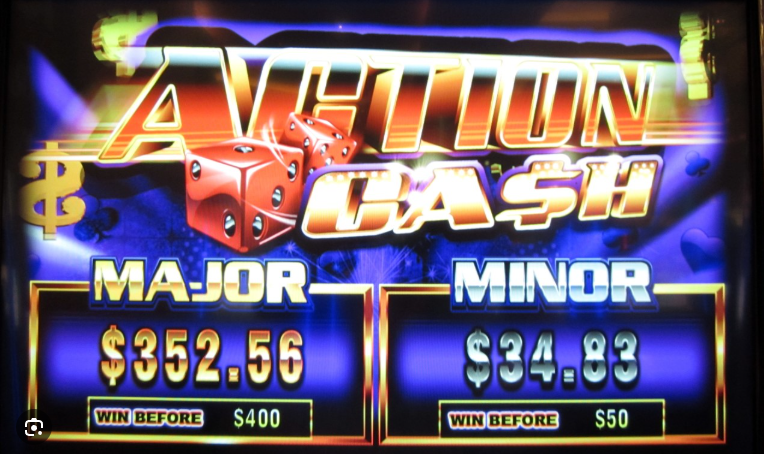
Then came the “Must Hit By” progressives. These mystery jackpots had a floor and a ceiling, guaranteed to hit somewhere between those values (e.g. -$200 and $400 as shown). When a meter like this climbed to $385 or $390, the vultures descended. Some of the more aggressive ones would even make themselves unpleasant to force regular players off high-value machines. It got ugly.
The new generation
Those two progressive problems have been with us for years. What’s different now, as mentioned, is the sheer scale of the persistence video game category. There are dozens of titles on the market with growing symbols, expanding reels, countdown timers, bonus meters, bubble bursts, and coin accumulations. The visual complexity is remarkable. The vulnerability, for those who know what to look for, is even more remarkable.
These persistence game “mechanics” actually surfaced briefly back in the 1980s. One memorable reel spinner/video combo from IGT was “Diamond Mine.” The abuse from AP hustlers doomed it quickly, and it quietly disappeared. But with the video slot evolution of the 2000s and beyond, this concept came roaring back. IGT’s “Hexbreaker” was one of the early titles that showed the industry what true persistence could look like in a modern video format. Today, every major manufacturer has entries in this space. Aristocrat has produced some of the most popular titles on our floors which feature persistence.

The list of games that can be systematically beaten by a knowledgeable advantage player now includes some of your highest-earning titles: from “Scarab” and “Buffalo Ascension,” to “Rich Little Piggies” and the very new “Lightning 10 Year Storm.” You get the idea. For the specifics on how each individual game can be exploited, there are dedicated websites and books that spell it out in detail (including the excellent title reviewed this month).
The fake-out: Perceived persistence
Here’s where it can get clever. Manufacturers, fully aware of the player popularity and the operator heat around true persistence games, have engineered a new category: games that feel like persistence, but aren’t. They are called “perceived persistence.” My personal favorite example is the “Bao Zhu Zhao Fu” series (aka the Firecracker games) from Aristocrat.

It is a great game. Watch a player on one of these machines. As they spin, individual strings of firecrackers on the screen begin to sparkle and one or two at a time climb from the bottom up. When those sparkles are nearly at the top of a string, players are convinced a bonus is imminent. They’re glued to their seats. They will seldom leave that machine.
Indeed. Those sparkles probably do reflect how long it’s been since that particular bonus was last triggered. But (and this is critical), they do not guarantee that the bonus is about to be triggered.
Think about flipping a coin that has come up heads five straight times. Your gut screams that a tail is overdue. Your gut is wrong. The odds on the next flip, and every flip after, is still 50/50. Each outcome is independent.
The same principle applies to the firecrackers. Their sparkles tell you something about the past. They tell you nothing about the future.
Advantage players know this. That’s precisely why they don’t touch these games. There’s no true edge for them to exploit. But your guest doesn’t know it, and that’s what keeps them engaged and on their stools. Balloons pop. Pigs get fat. Bubbles burst. The game mechanics and graphics change, but the psychology is identical. Thankfully, most players also love perceived persistence games.
(Operator tip: you need to know which of your games fall into which category. Query the manufacturers. Monitor the chatter online. Read everything you can. The list of true persistence vs. perceived persistence titles is not static — it changes as new games are released and as advantage players “break their code.”)
What can you actually do?
This is where I have to be honest with you: there’s no clear answer. Not yet.
Sophisticated AI analytic tools can now flag advantage players who are only engaging games in favorable states and winning at rates that defy normal distribution. With the right tools, you can identify them. But then what?
Cut their comps? They’ll just play without a card. Toss them? They’ll come back in a hat and sunglasses. I’m not exaggerating, it happens. If you are very aggressive, it may help, but not that much.
The nuclear option is to pull all persistence games off your floor entirely. A handful of operators have tried it. But they’ve also given a competitive advantage to every property within driving distance that still carries those titles. Many average players will go find them somewhere else if they can.
The honest answer today is that your best tools are information and analytics. Know which games on your floor carry true persistence mechanics and are hurting regular play. Monitor the data. Are you being hurt by APs? Watch for the patterns. And hope, as I do, that manufacturers continue pushing the perceived persistence model rather than the true persistence model, because it gives you “player engagement” without the vulnerability.
Until then, keep your eyes open and your analytics dashboard open.
Good luck out there.
# # #
Reading List
- Breaking the Slot Code – Beat the Machines Through Advantage Play
- Million Dollar Slots
- Advantageous Slot Machines
- Robbing the One-Armed Bandits
Websites
