


The roots of today’s multi-billion-dollar tribal gaming industry can be traced to a two-county region just west of Green Bay, Wisconsin, where the Oneida Tribe’s reservation is located.
In 1976, two women, Sandra Brehmer and Alma Webster, started a bingo game. Little did they know that someday that game, held in a gymnasium using single cards and corn or chips to cover spaces, would turn into a tribal gaming industry worth more than $46 billion in 2025.
“When you open these little bingo halls and you’re getting money … it brings the tribes closer to the American dream,” Victor Rocha, conference chairman at the Indian Gaming Association, said. “Bingo was that first crack in the door that day.”
Bingo on the Oneida reservation started slowly. Attendance began with 50 players or fewer. But attendance grew quickly to double that and “steadily grew to setting the entire gymnasium floor with tables and chairs and a sound system and eventually electronic boards on the walls. Pretty soon, jackpots grew to $100,” say Taryn E. Webster, CEO of Oneida Casino Hotel, and Jessalyn Harvath, assistant general manager, who jointly answered questions via email.
Bingo spread across the country as tribes sought ways to pay for basic services. The game turned into a way to pay for those necessities.
But the games were often contested.
“The local jurisdictions opposed and threatened to shut us down, but we persisted and battled in the courts and eventually won,” said Webster and Harvath.
Oneida Indians of Wisconsin v. State of Wisconsin in 1981 proved to be the turning point. The decision, in part, read: “But as the Supreme Court has emphasized repeatedly, [t]he Indian sovereignty doctrine is relevant, then, not because it provides a definitive resolution of the issues in this suit, but because it provides a backdrop against which the applicable treaties and federal statutes must be read.”
The Oneida Tribe triumphed and attempts to ban tribal bingo in Wisconsin were shut down.
Similar legislative battles were playing out in other areas of the country as tribal bingo, long the domain of Catholic churches and fire halls, began to spread. The Seminole Tribe of Florida began to offer bingo in 1979. It was simultaneously a necessity and a success.
“Like many Indian tribes, the Seminoles were seeking new sources of revenue to provide important needed services for our tribal members,” said Seminole Tribe Chairman Marcellus B. Osceola Jr. “Health care, education, housing, senior services, and other needs were on the list and it was our hope that bingo games could help to fund them.”
But the state of Florida fought tribal bingo. In Seminole Tribe v. Butterworth, named after a sheriff from Broward County, Robert Butterworth, the state attempted to shut down or limit bingo games. There were concerns that bingo games could be infiltrated by organized crime and that there would be regulatory issues if the state was excluded from the games.

The Seminole Tribe, however, had an ace up its sleeve.
In 1953, Public Law 280 transferred criminal jurisdiction over Indian country from the federal government to states, including Florida. Superficially, that seemed to give Butterworth a straightforward argument: Florida law applied on the reservation and the state capped bingo prizes and Seminole bingo games that exceeded the cap.
But Public Law 280 granted states criminal jurisdiction and limited civil authority. It did not make states the regulators of Indian country. Courts recognized that, reading it as a transfer of regulatory power that would effectively eliminate tribal self-government by statute.
The Seminole Tribe prevailed in the Butterworth case and bingo and, eventually, gaming flourished.
Responses from the public, according to Osceola, were immediately favorable. High-stakes bingo games offered Floridians an opportunity to gamble that was only otherwise available at horse racing and dog tracks.
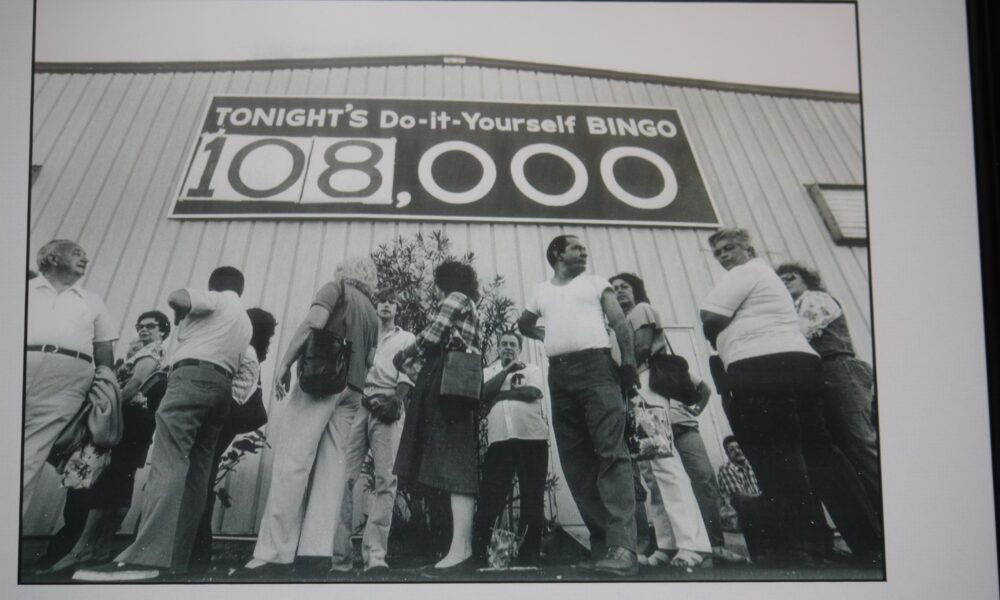
“The first high-stakes bingo games were an immediate success, with long lines of guests out the door of a huge warehouse,” Osceola says. “Jackpots of more than $100,000 were advertised on a large sign visible to passersby on nearby highways.
“Unlimited bingo proved to be a winning formula that not only brought in meaningful revenue,” Osceola adds, “but also established the legal precedent for what would become the Indian gaming industry throughout the country, which has grown to $46.2 billion in gross gaming revenue for fiscal year 2025.”
In California, the introduction of bingo was almost an immediate success, according to Charles Martin, chairman of the Morongo Band of Mission Indians.
Martin said there was no doubt the tribe had found something lucrative. Buses were coming to Cabazon, where Morongo is located, from across the Inland Empire region, which includes Riverside and San Bernardino counties, and eventually Los Angeles.
“We started drawing large crowds immediately, because our prizes were so high,” Charles Martin said. “We weren’t doing $250 games. We were doing $300, $400, whatever the market was at the time.”
The state of California noticed, with former Republican Governor Pete Wilson especially vocal in his opposition to tribal bingo.
“We were getting threats of shutting us down, bringing in marshals to arrest tribal leaders,” said Morongo Chairman Emeritus Robert Martin. “It was a real sensitive time at Morongo, but we had good advice, a good legal team.

“With Pete Wilson and his conservative base, they just felt it was important to try to stop us. But at the same time, they started the lotto here in California,” Robert Martin added. “So their argument against public policy kind of fell on deaf ears at that point.”
That set the stage for California v. Cabazon Band of Indians, where the state sought to apply to the tribes its statute governing the operation of bingo games. Riverside County also sought to apply its ordinance regulating bingo, as well as its ordinance banning the playing of draw poker and other card games.
Robert Martin felt the pressure. He was lobbying for Morongo when another tribal leader got on an elevator with his entourage.

Recognizing Martin, he said, “What you all are doing in California is going to affect us across the country. “And,” Martin continued, “he said all the issues we’ve had with tribal sovereignty are at stake. If you all fail, they can put us back 50 years. He took the time to let me know that his tribe was looking at us from across the country,” Robert Martin said.
The U.S. Supreme Court eventually ruled in favor of the Morongo and Cabazon tribes, writing that because enforcement of OCCA (Organized Crime Control Act of 1970) is an exercise of federal, rather than state, authority, there is no danger of state encroachment on Indian tribal sovereignty.
Charles Martin says that decision reverberates today. When he was elected chairman in 1982, many of the roads on tribal grounds weren’t paved. Security was non-existent and phone calls to the local sheriff sometimes took hours to get a response. Jobs were scarce, as was healthcare.

“Today, we have over 2,500 people working for us,” says Robert Martin. “We affect the local community to around $3 billion. This is what we’ve done.”
