

Artificial intelligence will threaten jobs in the Las Vegas casino industry while helping with sports betting integrity, but it won’t dampen visitation to the resort city, according to a group of panelists.
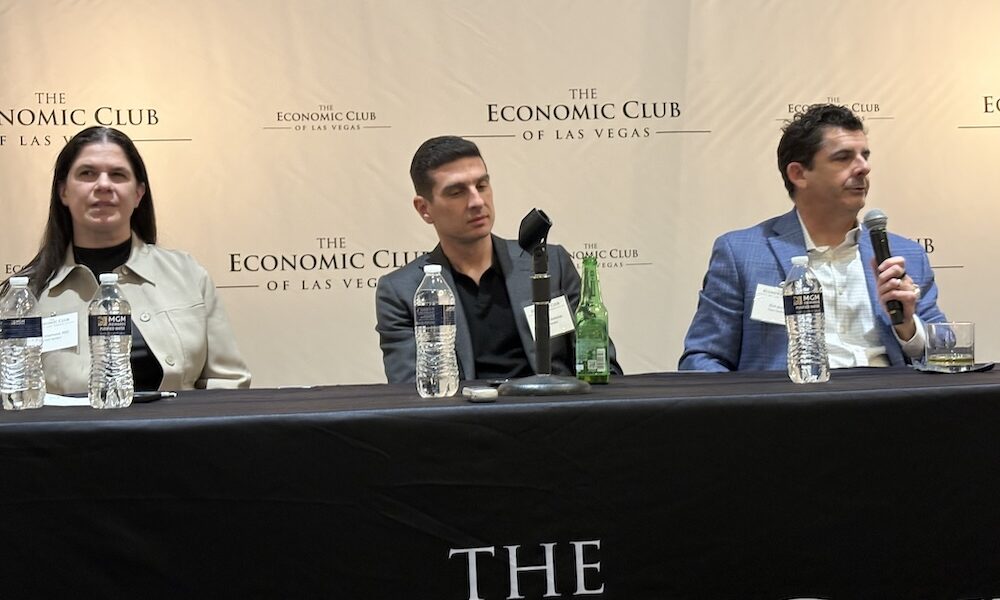
The “Challenges and Opportunities of AI in Las Vegas” was a focal point during a seminar at Park MGM hosted by The Economic Club of Las Vegas. The panelists included Brett Abarbanel, executive director of the UNLV International Gaming Institute; Dr. Kasra Ghaharian, director of research at the UNLV International Gaming Institute; and Rick Arpin, managing director of KPMG in Las Vegas, who focuses on the casino industry.
Abarbanel said a lot of questions have been raised about sports integrity after high-profile cases involving the major sports leagues. These have included arrests and allegations of tanking of prop bets. College basketball is also dealing with a point-shaving scandal.
“How do we maintain the integrity of the game when we put something like sports – this bastion of society and microcosm of how we reflect ourselves and purity of things in a place like Las Vegas? Of course we would immediately corrupt it. That’s what all of these assumptions were. A lot of work went into convincing the WNBA, NHL, NFL, MLB, and soon to be several others to come and have their sports organizations here in Las Vegas.”
With the proliferation of sports betting since the Supreme Court allowed it in 2018, Abarbanel said AI will play a key role in the fight for integrity in sports. So much data can be put into an algorithm that assesses it. AI can assess betting patterns in the U.S. and around the world and find suspicious activity that can be investigated further.
“AI is an extremely adept tool that can be used in that entire process,” Abarbanel said. “We’re not at the point where we can dump it all into (AI) and ask if this person is fixing the game. AI is not quite good enough to replace an entire cadre of sports integrity experts (along with law enforcement investigations when laws are broken) that exist throughout the world.”

Arpin said AI isn’t overhyped. There’s a lot of potential and some of it is being realized now. He called it “transformational technology” akin to the internet and smartphones. It’s an accumulation of other technologies over the last 50 to 60 years and has advanced significantly over the last two to three years.
“It doesn’t do everything and it is not perfect,” Arpin said. “But we are seeing real results. I would not put myself on the side that says, it’s just another metaverse, and I’m going to hunker down and ignore it. That is a big risk as an individual, as a team, and as a company.”
In gaming where he has spent his career, Arpin, a former senior vice president at MGM Resorts International, said the industry doesn’t think “boldly enough.” In the front-of-the-house operations at casino-hotels, executives think they need someone to answer the phones for the personal touch to make the difference.
“It’s not the personal touch that makes a difference, but getting their phone answered within 10 minutes and getting the problem resolved or the room booked,” Arpin said. “AI is very good for things like that.”
For back-of-the-house operations, a lot of people shuffle paper to generate revenue for financial reporting systems. AI is good for that, along with software development and coding.
“In our industry, we’re never creative enough about looking for opportunities to be more efficient and more effective and make more revenue,” Arpin said. “We get stuck in our traditions. AI is breaking through our traditions. It is breaking through in a lot of industries right now, and it will break through in our industry. The question is who is going to lead that.”
Ghaharian said AI will be an interesting dynamic for slot machine designers. It can can do that well and it will get even better.
“As the cost of creating a game approaches zero, interesting things can happen to the workforce,” Ghaharian said. “People talk about upscaling. AI can do more cumbersome tasks, so you can upscale your workforce to be more creative and productive. The workforce impact is a real thing, and the industry is going to have to tackle that and figure out a way to address it.”
Abarbanel said Las Vegas has many video game manufacturers and looking at trends globally shows massive layoffs in that industry. Five years ago, it cost $150 million to $250 million to produce big-time games and bringing that cost closer to zero will be meaningful to the workforce of software developers and artists.
A game-development center at UNLV started 13 years ago by pairing artists with engineers to create amazing games. Today, it’s a three-hour class that meets once a week and creates a game using AI in one class setting — with time to spare so they can all play it, Abarbanel said.
“This isn’t looking into the future to see how it’s going to affect the workforce,” Abarbanel said. “It’s on us right now and will have a meaningful impact on industries that are important to this city – service, game development, and operators as well.”
One of the best uses of AI is doing paperwork, Abarbanel said. It will maintain compliance and flag when something is wrong, important for operators that have properties across the country and globally.
Arpin said live entertainment is the safest job when it comes to AI advancements and one of the jobs in the future is managing AI. What a lot of people think about AI today is how it can replace staff. The problem with that thinking is that staff members become the next managers, he noted.
“I don’t have an answer for it, but if you look at hiring out of MBA schools for big consulting firms, it has slowed to a halt,” Arpin said. “Who is going to do our work when we retire because no one is going to have the human intellect to be able to interpret all the stuff AI is doing?”
While people answering phones are already being replaced, Aprin said in most cases, AI in casinos serves as a helper to humans, rather than cutting into the workforce.
“We need less call center agents and maybe less people doing accounting, but we still need people,” Arpin said. “AI is going to help them be more productive and effective and get better answers. If you understand and use these tools, you will have a job. The ones who bury their heads in the sand won’t have a job.”
Ghaharian said UNLV did a study for the Massachusetts Gaming Commission on AI use in the gaming sector. It shows it’s good for back-of-house operational efficiencies, data mining and predictive analytics, and compliance and risk management dealing with AML and consumer protection. In addition, it’s for creating user experiences with engaging content.
“You can create games almost instantaneously and there will be interesting things on the horizon when generative video becomes real time,” Ghaharian said. “It can generate new content as you are playing it.”
Arpin addressed a question on why customers would want to come to analog Las Vegas as the world becomes more digital in the future.
“I go back to live entertainment,” Arpin said. “This has been studied quite extensively. There’s a reason why it has thrived regardless of some of the trends in the last 20 to 30 years. It is the reason why sports is one of the last live television experiences that is sought after. Whether it’s Las Vegas or other casinos and resorts, tourist destinations will continue to thrive. Humans like to gather and like inter-human experiences.
“I know some of you have teenagers who are on their headphones and devices all day and some of you have 25-year-olds working for you who grew up in a generation of text messaging and you ask why don’t they just come talk to you,” Arpin said. “I understand all of that. Some of those 25-year-olds are now 30-year-olds going jeez, this COVID thing sucked and want to be back in the office with people and learn from interpersonal experience. Other than COVID when you couldn’t go to a resort, we’re still thriving (in Las Vegas). I know the last six months in Vegas, there have been a lot of other factors going on. It’s not AI driving that. People want to gather and want interpersonal human experiences, and that’s not going to change.”
That means they might gather in a casino stadium with a 50-person roulette game instead of individual tables. Casinos may need fewer dealers, but they will still need people on the floor and bringing drinks, Arpin added.
“Is getting a drink from a robot as fun as getting it from a person? As far as I can tell, it’s no and not for the foreseeable future,” Arpin said. “Maybe that changes. Las Vegas, just like it has reinvented itself dozens of times in 80 years, will reinvent itself as needed. People said, ‘Oh my God, tribal casinos and what is Vegas going to do? Oh my God, Macau and what is Vegas going to do? We’ve always responded and other tourist destinations have responded with better and more human experiences.”
Ghaharian said what AI can do that impacts Las Vegas visitation is make the business more efficient and give properties the ability to pass those savings onto the customer. That will help attract more people to Las Vegas and help offset the slowdown in visitation in 2025.

