

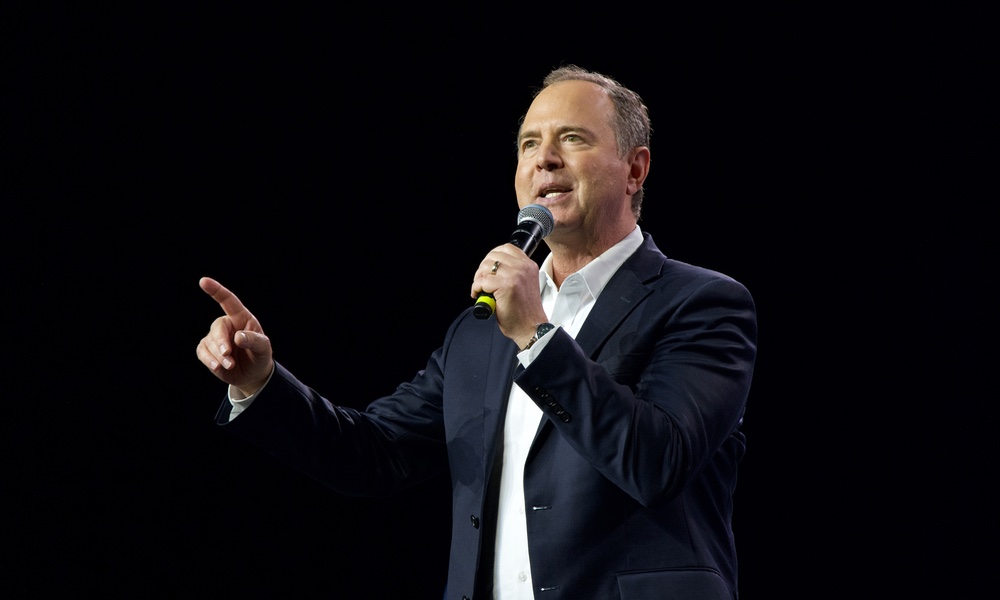

Senator Adam Schiff, a Democrat from California, and eight other Senate Democrats sent a letter Monday to Commodity Futures Trading Commission (CFTC) Chairman Michael Selig seeking to reverse the agency’s efforts to assert its regulatory authority over prediction markets.
In their letter, the senators expressed their opposition to the CFTC’s November 5 interpretation that orders designated contract markets (DCMs) to end geofencing of certain event-contract markets.
Selig’s order effectively requires prediction markets to offer contacts in all 50 states and on all tribal lands. The senators accused the CFTC of encouraging prediction markets to offer prohibited contracts in contempt of numerous court orders to the contrary.
“Your unilateral decision directly conflicts with active court orders, undermines state and tribal law, and must be reversed,” the senators wrote. Currently, court orders are active in California, Michigan, Nevada, and Washington that require prediction market firms to geofence the state or tribal reservations, blocking access to their sports event products.
Joining Schiff are all senators representing California, Michigan, Nevada, and Washington, Senators Catherine Cortez Masto (Nev.), Jacky Rosen (Nev.), Maria Cantwell (Wash.), Patty Murray (Wash.), Elissa Slotkin (Mich.), Gary Peters (Mich.) and Alex Padilla (Calif.), as well as the Ranking Member of the Senate Agriculture Committee Amy Klobuchar (Minn.).
“Numerous courts have held that sports-event contracts are not swaps and instead are indistinguishable from sports bets subject to state and tribal gaming laws,” the senators wrote. “The commission now appears to be encouraging prediction markets to offer prohibited contracts in contempt of these court orders during active litigation.”
The senators expressed their concern that the CFTC’s action came just hours after the U.S. Court of Appeals for the Ninth Circuit issued a ruling in Blue Lake Rancheria v. Kakshi requiring the company to geofence around tribal lands.
The court unanimously ruled that Kalshi’s sports-event contracts qualify as unauthorized Class III gaming under the Indian Gaming Regulatory Act (IGRA) when used on tribal lands. The court found that Blue Lake Rancheria and Chicken Ranch of Me-Wuk Indians were likely to be successful in proving Kalshi and Polymarket operated without a valid gaming compact.
“This interpretation raises concerns that the commission may be coordinating with platforms engaged in litigation and encouraging them to violate state and tribal gaming laws,” the senators wrote. “The commission must withdraw the interpretation or freeze all efforts to implement until litigation is resolved.”
The senators requested that the CFTC preserve all records and communication relating to the topics addressed in this letter from January 1, 2025, to the present and continue preserving existing and future materials on an ongoing basis.
In their letter, the senators set a November 23 for the CFTC to confirm that they are preserving all records related to this congressional inquiry.
Selig made it clear during an interview with CNBC that the agency will take the fight up to the U.S. Supreme Court, “if this is where it’s going.”
“Our view on the statute is that we have exclusive jurisdiction over these markets, and I will not allow for states to bring lawsuits against our exchanges, claiming that they are unlicensed gambling,” Selig said.
Selig also took issue with states bringing criminal charges and essentially trying to lock up founders and CEOs of these companies that “are offering lawful products under a federal regime.”
He was referring to Utah Attorney General Derek Brown’s decision to file 14 criminal charges, including 13 felonies, against Kalshi co-founders Tarek Mansour and Luana Lopes Lara. Brown asserted that Kalshi continues to operate illegally in violation of state anti-gambling laws.
“Now, there might be some technical fights, somebody says it’s gambling, somebody says it’s a derivative, but that’s not something that should be at the risk of going to jail,” Selig said.
