

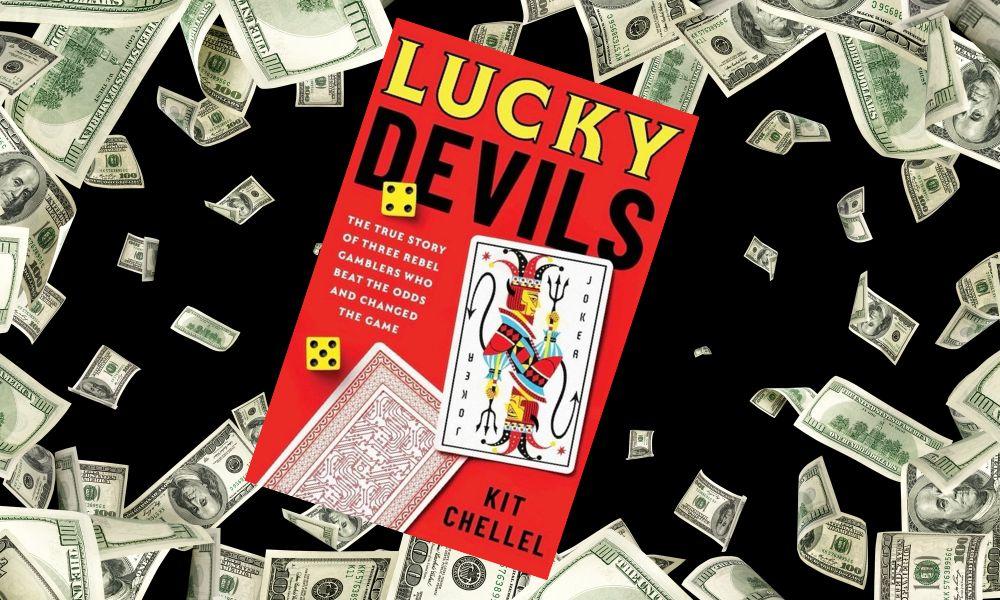

Kit Chellel admits there were moments during the reporting of his book Lucky Devils: The True Story of Three Gamblers Who Beat the Odds and Changed the Game (Atria Books) when he pinched himself. Was this really his life?
“I ended up driving across most of the western United States in one day in a convertible Mustang – don’t ask, it was the car I had,” Chellel says during an interview with CDC Gaming.
Chellel was looking for Rob Reitzen, one of three gamblers profiled in Lucky Devils. Reitzen agreed to talk, but he was in Oregon.
“I just got in the car that I’d rented and I just drove, 1,000 miles to go see him, zooming through the desert, driving through Tahoe and Reno,” says Chellel, a reporter at Bloomberg and Businessweek. “It was an amazing, amazing experience.”
The pursuit of Reitzen, and then Bill Bentner and Bill Nelson, took the author across the United States and to Europe. He interviews friends and colleagues of the trio to paint a picture of these advantage gamblers who decided, in the 1970s, that sitting at a desk for eight hours a day wasn’t for them.
They wanted action and excitement and sought to exploit flaws in casino systems through card counting and other mathematical calculations using the then emerging technology of computers.
“It’s kind of a strange career choice,” Chellel said. “To be an advantage gambler, to do this with math, you’ve got to be smart, you’ve got to be numerate, you’ve got to be able to manage money. Why this? I think the answer is that they wanted to avoid a conventional life.”
Bentner, a Pittsburgh native, was the key to the book. After working at odd jobs, including at a Las Vegas 7-11 for $3 per hour, Bentner – who initially resisted being interviewed – designed a computer system that made him millions of dollars wagering on Hong Kong horse racing.
“You can learn a lot from the way he runs his betting business, from the way he thinks about probability and numbers,” Chellel says, noting that Bentner is a philanthropist in his hometown who gives away millions of dollars. “I think there’s lessons in there. That’s why I was fascinated with him, and that’s why I thought it was worth writing a book about him and his peers.”
Nelson had a more mercurial career, grinding away counting cards at blackjack, then focusing on developing a system to beat roulette.
Nelson, Chellel says, had a fierce independent streak that didn’t allow him to work at traditional jobs, and created a mistrust of gambling markets.
“He’s seen the most predatory aspect of the gambling market. If you spend a lifetime trying to make money from casinos and betting operations, they do try quite hard to stop that happening,” Chellel says. “They become your adversary. I don’t know any professional gambler who has any love for casinos, and he’s no different But he’s watched the industry change over the past 5-10 years, and he’s not happy about it.”

Reitzen was closest to the image of a gambler the general public has created. Loud, at times garish and a prankster, he’s dyslexic and made enough money to live in the Hollywood Hills, but lost it all.
“(Reitzen) has a particular kind of intelligence that allows him to navigate this stuff,” Chellel said. “I think what they all do is they all have an ability to switch off that part of your brain, the emotional fuel part of the brain, the bit that delivers a dopamine hit when you win a bet, that makes you feel good about yourself when something goes your way. They all are ice cold when it comes to that stuff. They use when it comes to betting.
“They use the other part of their brain, the deeply logical, rational part of the brain, to the point where an individual bet for them is irrelevant. You win one hand of poker, it’s nothing to these guys.”

While they were gamblers who sometimes got banned from casinos, Bentner, Nelson, and Reitzen didn’t see anything wrong with what they did. They saw themselves as being honorable and avatars of fair gambling.
“The ethos of this community is that they are the good guys. They are like Robin Hood,” Chellel says. “The casino, the gambling industry is the big bad money bags, and they are the scrappy outsiders trying to take some money back. You can have a long argument about whether that’s true or not, but certainly the justification for them is that all they’re doing is math here. If the casino game or a betting game is to be fair, you should be able to play it well, right? You should be able to allow winners to win, and they argue the fundamental unfairness is that as soon as you start winning inside a casino, you’re liable to get kicked out, or they’ll accuse you of cheating.”
