

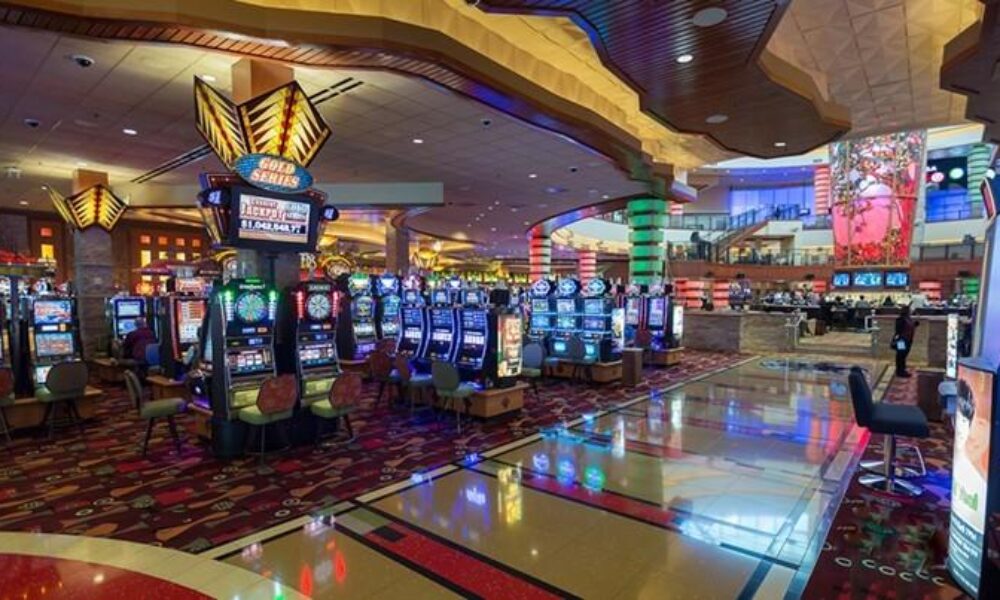

A few years ago, Peter Arceo was approached by a cage supervisor complaining that the music in the casino at 3 a.m. when she started her shift was too loud.
The woman told Arceo, Yaamava’ Resort & Casino chief gaming officer, her fellow workers were coming in, half asleep and didn’t like the “level 10” music.
Arceo appreciated the woman’s comment, but said the music wasn’t for her. Look at our guests, he told her.
“Why are they here at three in the morning?” Arceo wanted to know. “Have you ever asked that question? What are they doing? Well, maybe it’s because their day ends at two. Or maybe it starts at five, and they just want a place to go and spend some time before they start their workday.
“Think about when you get off work. What do you do? You go to a sports bar. You go meet your friends for cocktails or something. Are you ready to go to sleep?’”
The music that’s played in casinos is constant, a soundtrack for slot, table game, and other casino visitors. It’s a steady hum of mostly pop, rock, and country songs, but ask anyone to name a few tunes heard after a casino visit and most likely they’d be at a loss.
Yet, if there was no music, it would be akin to walking into a place of worship or a funeral home.
“People definitely notice if there’s nothing, because if you walk into a business or a space and there’s no music, it’s very uncomfortable,” says Nathan Green, CEO of New Level Radio, which provides custom music, messaging, and on property audio experiences for over 60 casino properties.
Green co-founded New Level Radio nearly 20 years ago and since then has witnessed myriad changes in the gaming industry. The one constant, however, is music — always there, always present, if a bit unnoticed. But the music emanating from a casino’s sound system is different on a Monday morning compared to a Saturday night.
“You need to really curate the music to who’s in the space,” Green says. “Most importantly, just from a kind of progression standpoint and a flow of music, it’s really important, in our opinion, to increase the beats per minute as the day goes on.
“In early morning, obviously, we don’t want to play any snoring kind of sleepy music,” Green added. “We definitely want it to be engaging, but the energy, the tempo, and the beats per minute will be lower than they would be on Friday night at ten o’clock.”
Another consideration is the location of a casino. Green says a New Orleans locale will play music that differs from a casino in Denver.
“We have kind of a curated offering based on where you are,” Green says. “It’s not just an afterthought, the music, because you have to incorporate the specificity of the location. If you’re in New Orleans, there’s different styles of music that you can play for that demographic. If you do that in Colorado, people are going to say, ‘What is this? I’ve never heard of this style.’ It’s critical to dovetail the music to where these properties are.”
To set the right tone for Yaamava, Arceo created the Vibe team, a group that, in addition to music, also controls the lights and partially the air temperature.
The Vibe team first walked around during the day, swing, and graveyard shifts to understand where the volume level needed to be. They made adjustments, then worked on the playlist.
Arceo’s philosophy mandates a playlist that consists of songs from the 2000s onward. He bases this on the Hard Rock Casino in Las Vegas in the 1990s and its reliance on modern hip music.
The Hard Rock became known as the place to be for young patrons, but Arceo says older players also gravitated to it. He remembers hearing music from the 1970s through the 1990s.
So why, Arceo asks, are some casino playlists still using music from the ’70s and ’80s?
“That would be like in the mid-90s playing ’40s, ’50s, and ’60s music. That doesn’t make sense. People fall in love with it and they play their favorite songs from their childhood. Fine, but that’s not what we’re doing here. What we’re doing here is trying to create an environment that’s fun and exciting.
“Some people don’t like it and they go, ‘It’s too loud.’ Fine, this is not the vibe for you. But for those who want that, they’re going to find it at our casinos.”
Troy Wyatt disagrees that music must be current. The founder and CEO of the Seattle Entertainment Group, a Native-owned talent-booking and event-production company, he’s worked with acts ranging from Alice Cooper to Andreas Bocelli.
“It’s usually kind of a red flag to me, because it speaks to limitations and guardrails that they put in front of themselves,” Wyatt says of those who limit the types of music played in a casino. “It depends, or it’s a clarifying question, because if you look at your database and say, ‘Yeah, all of our ages or all of our birthdays for the 100,000 players we’ve got in the database, everyone was born in 1941 or whatever.’ You’re like, ‘Okay, well, maybe we need to bring in Frankie Avalon.’”
The music Wyatt books for casinos includes artists such as Slaughter, Bret Michaels, and the Band Perry. Legacy rap artists, such as Ice Cube and Flo Rida, also do well.
Booking bands can also make economic sense, even if casinos lose money on their shows. Food and beverage and other incidentals add up, as opposed to corporate events where often all that’s needed is a microphone and a podium.
“If you ask me as an operator, would you rather do 100 concerts a year or 100 private events? As it relates to profitability, 100 private events,” Wyatt says. “But as it relates to a marketing capacity, it would be 100 concerts.”
He adds that live shows, whether music, comedy, or variety, are an opportunity to reach a new demographic, whether or not they lose money.
“But what did you get to do? You got to market the restaurant, you got to feed your guests, you got to treat them well and give them a reason to come back,” Wyatt says. “There’s really not this old school or one school of thought that we need to make money on every single concert and every at restaurant.
“In some shows, you exceed sales, but some you fall flat, and some you might lose money, but the goal is to understand why you’re doing it all,” Wyatt adds. “It’s to reward your current demographic or acquire a potential new player, and that second category is kind of the catch-all.”
What’s most important is the tried-and-true gaming adage: Know your customer. Green says that the vibe at the Cosmopolitan in Las Vegas is very eclectic and fits the space.
People tell Green they want the same soundscape. He responds, “You’re not the Cosmo, your average age is 71, and you’re going to alienate your crowd.”
It’s most important to play music that fits a casino’s players.
“In gaming, what’s beautiful is that there actually is a lot of demographic information that the properties have, so when we get that information, it makes our jobs a lot easier from a curation standpoint,” Green says.
