


Alberta officially opened its regulated online sports betting and iGaming market almost three months ago, becoming Canada’s second province after Ontario to open a competitive, multi-operator commercial model.
Prior to its launch on July 13, some 70% of Alberta’s iGaming previously took place on unregulated offshore gray-market websites. On the first day, 22 operators launched, including Play Alberta.
Within the first six weeks, that figure increased to 31 licensed operators and there are more joining every week, according to a provincial minister. Until the market’s launch, Play Alberta had been the only regulated online option in the province.

“When they started Play Alberta, the unfortunate part was they were only able to capture 30% of the market,” said Dale Nally, minister of Service Alberta and Red Tape Reduction with the Government of Alberta.
“We were committed to dealing with the illicit market and the best way to deal with the illicit market is to have an open, healthy regulated market,” Nally said. “So that was a no brainer for us. We wanted to open our market.”
Nally said they were very clear operators, inviting them across the line into a regulated market but they must “embrace player safety, player responsibility.”
“I was thrilled there was no light between us as government and the responsible operators,” Nally added. “They want customers for life. That’s the difference between the responsible operators and the illicit market.”
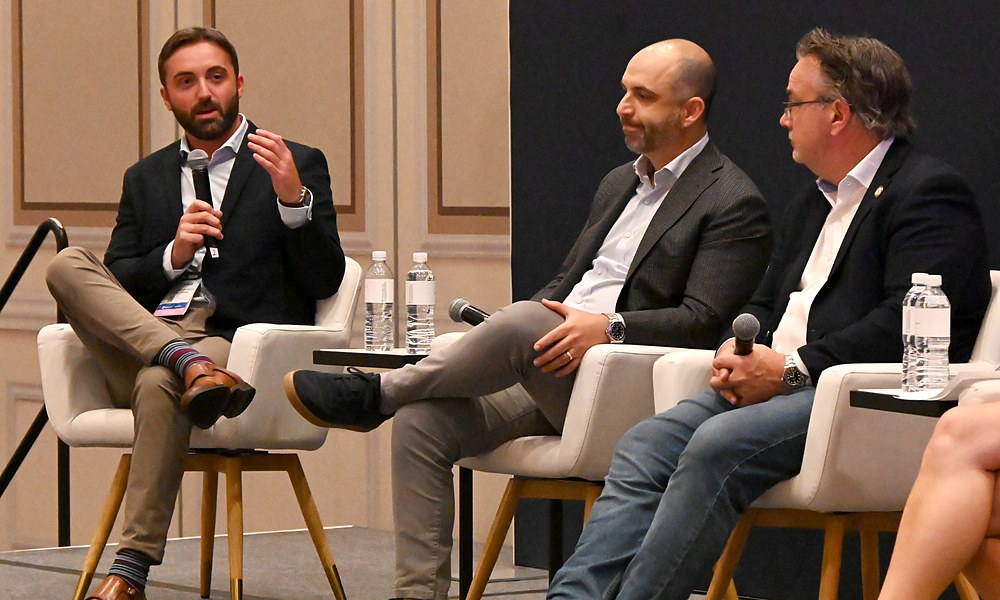
Nally discussed the opening of Alberta’s regulated online market last week during a panel discussion on Canada’s iGaming market at Global Gaming Expo at the Venetian Expo in Las Vegas.
Nally was joined on the panel by Cory Fox, senior vice president policy and sustainability at FanDuel Group; Steve Inglis, general counsel with the Alberta iGaming Corporation (AiGC); and moderator Elizabeth Croan, vice president government relations with GeoComply.
The AiGC oversees the iGaming market, while Alberta Gaming, Liquor and Cannabis serves as the market regulator. Under its regulations, iGaming operators retain 80% of their revenue, with 20% going to the government.
Inglis thanked iGaming Ontario for providing a large part of the framework that the province used to get the market up and running by July 13. He told attendees that clarity was important, especially when it came to anti-money laundering and privacy issues.
“Also informing teams as to what they next three, four months are going to look like from a process perspective,” Inglis said. “We wanted to get out policies and procedures out as early as possible … we put them in the hands of various stakeholders.”
Cronan asked Nally, who introduced Bill 48 last year to open Alberta’s market, what the province considers non-negotiable when it comes to gaming responsibility.
Nally admitted he had a difficult sell getting his measure through the provincial legislature, because not many of his colleagues had placed a sports bet before. One of the non-negotiables was there needed to be systemwide self-exclusion within the first 30 days.
Nally said AiGO committed to having the system completed on day one, but he the agency was able to get it done before launching the market.

The other non-negotiable, Nally said, was “operators had to be for treatment.” In Alberta, 1% of gross gaming revenues goes to pay for treatment, prevention and education.
Nally believes 1% will be enough based on their research, “but if it’s not, it’s not.”
“We know for most people placing a sports bet or (wager) is a recreational opportunity,” Nally said. “But like any regulated activity, there will be individuals that struggle with problematic behaviors.”
In terms of migrating activity from the gray market to the regulated market, Nally stressed that throughout this process the best was to do this was to have a strong, healthy legal market.
He admitted that some of his colleagues didn’t want to see any gambling advertising, but he would tell them that the “good guys advertise,” if the province says no, the illicit operators will still be online and on social media.
“You have to have a strong healthy market, and the healthier your market … more success you are going to have pushing the illicit market out of that space,” Nally said. “But you have to look sat every possible avenue to explore. So that means the big guys, Google, it’s Apple. It means all the social media.”
Nally confirmed they’ve had those conversations with those companies. He said the commitment he has given to the Alberta markets is that we will not go after the illicit operators until October 13.
“We don’t want illicit gaming operators in Alberta,” Nally said. “I can tell you, we are intrinsically motivated to deal with the illicit market, and we are going to pull every lever at our disposal to make sure that the new guys are reported.”
