

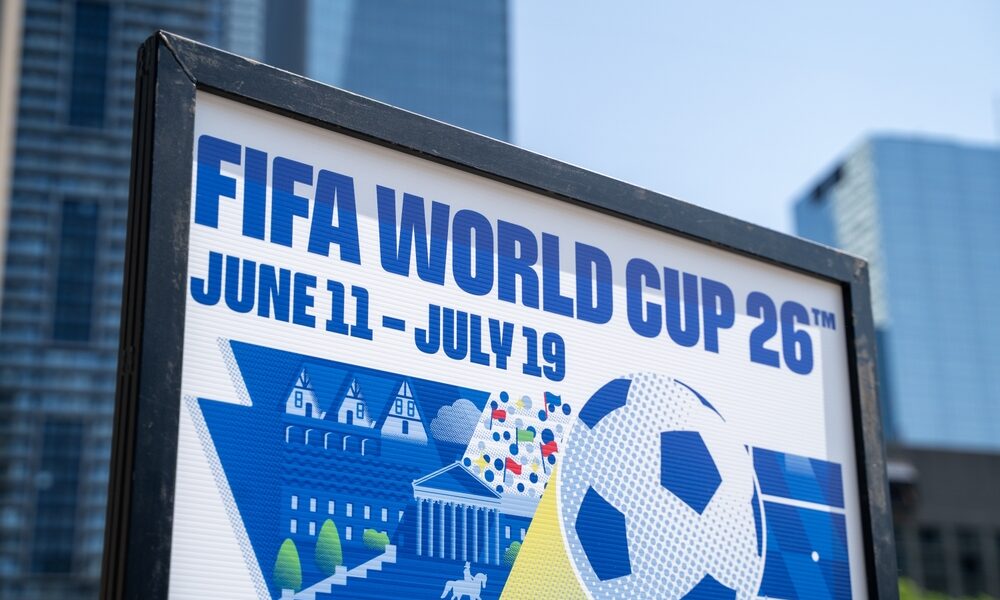

It is FIFA World Cup 2026: June 11, Mexico plays South Africa in Mexico City and South Korea is matched with Czechia in Guadalajara. The Federation Internationale de Football Association, FIFA, is holding its 23rd World Cup tournament, a competition to determine the best football team, soccer to Americans, in the world. The tournament takes place every four years and has been held since 1930, with the exception of the war years 1942 and 1946. Between June 11 and July 19, 48 teams will play in 104 matches in 16 cities in three countries. The competition will be fierce and the fans passionate. FIFA estimates 1.5 billion people will watch the opening match and as many as six billion will watch over the six weeks.
The tournament garners an immense amount of interest and wagering worldwide. The matches will be streamed to every corner of the world. The World Cup will be major news and eager supporters will lap up each story hungrily. The 48 teams that qualified have national fan bases and supporters in neighboring countries without a team in the tournament. Each time the World Cup is held, the world seems to stop. If a team is still in contention, the nation holds its breath; regardless of the team’s overall prospects, betting on the home team is a test of patriotism. And as the field narrows, patriotism rises.
Until recently, the tournament went almost unnoticed in the Unites States. Soccer is not exactly the national sport here. The World Cup was held in the United States in 1994. As the host country, the national team was given an automatic qualifier, but was knocked out early. The team’s best finish was in 1930, third. This year, the American team, U. S. Men’s National Team (USMNT), is more competitive. It is ranked 13th according to FanDuel. That will be enough to give local gamblers hope. This is also the first World’s Cup where betting on the game is legal in most states. And it is summer, the dog days of sports with nothing more than mid-season baseball to tempt a bettor. So the World Cup is bound to get some boredom bets.
Americans betting on the game will not be the most important factor in the total handle during FIFA World Cup 2026. It truly is a “world cup,” with billions of fans watching the matches and millions betting around the globe. In 2026, gambling on sports is a sport by itself and it exists even where one would not expect it. For example, the United Arab Emirates licensed an operation this week. ESPN published an article that estimated $2.8 billion in wagers will be made, with a possibility of $4.4 billion. Betting on the game is not legal in every country, but bettors everywhere have access to the internet; anyone with an online connection can find a way to place a bet. Although there is pushback.
Some countries, like Uzbekistan, China, South Korea, Singapore, and Malaysia, are warning their citizens that it is illegal to bet on the World Cup and promising to crack down on violators. Another set of warnings comes from countries like South Africa that are admonishing citizens of the risk of betting will illegal operators. Illegal bookmakers, offshore bookies, and other unlicensed operators are out there, lurking just beyond the reach of regulators.
The integrity of the matches is foremost in the eyes of gaming regulators everywhere. Every bet will be scrutinized by sophisticated algorithms. Cheating will not be easy. Not all of the illegal operators are crooks; some just don’t want to pay taxes or go through the hassle of licensing. In most discussions of unregulated, unlicensed, and therefore illegal activity, it is estimated that illegal wagers are at least equal with legal ones.
The proof of those statements is hard to find. Tracking legal wagering is sophisticated and accurate. Regulatory agencies require detailed reporting; no state wants to miss out on any potential tax revenue. Illegal bookies do not publish their results; estimates are therefore guesses. Some are very good, but still a guess. Even without proof, it is safe to say illegal/unlicensed online sports betting is a big industry. Even in the United States where placing a bet legally is easy, some gamblers prefer the unlicensed operators. Without having to pay taxes, the odds can be better.
And where gambling is illegal, gamblers are still looking for action. Gamblers in Asia, Africa, and the Middle East regularly make bets, especially now with the World Cup dominating the media worldwide. There are other complicating factors in the World Cup mix: the futures and prediction markets. Like the offshore unlicensed bookmakers, predictions are something less than legal. Certainly in the United States, any state with legal sports betting is fighting against the prediction markets. The operators are releasing some of their “contract” information and it is significant.
The world of sports betting is complicated, confusing, and distracting. The constant chatter in the media about gambling distracts from the narrative on the pitch. The matches in the FIFA World Cup are athletic contests after all. The play is the point of the contest and not the bets, right?
