
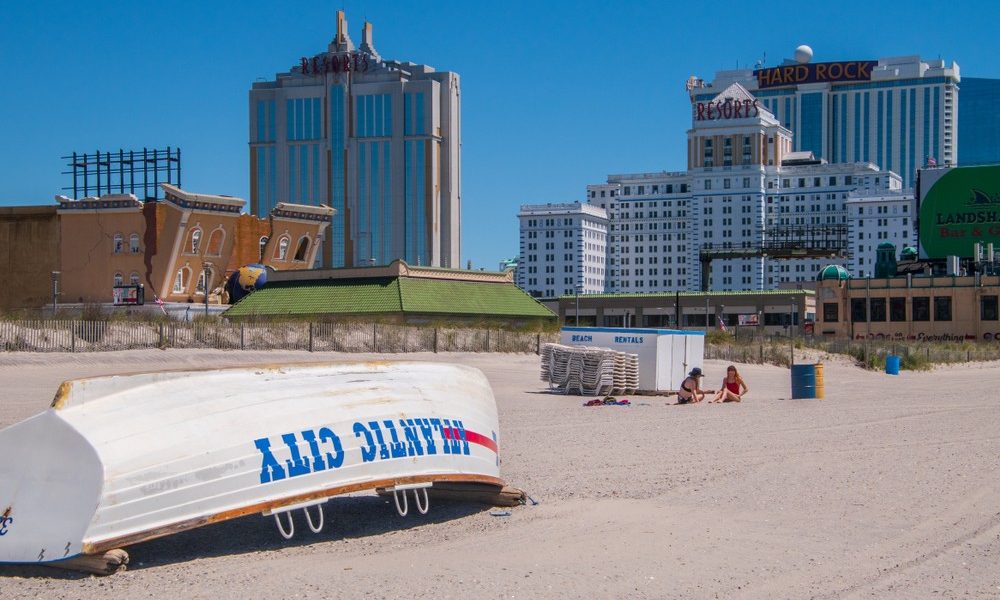

On January 16, the New Jersey Department of Gaming Enforcement reported the state’s gaming revenue for December and the full year 2025. Total gross gaming revenue (GGR) from the Atlantic City casinos, online casino gambling, and sports betting for December was $605 million, an increase of 15.9% from December 2024. The casino GGR was $216.1 million, down 6.7%. Online betting produced $273.2 million, up 19.8%, and sports generated $116.3 million, up 85 percent.
For all of 2025, total GGR was $6.98 billion, up 10.8% over 2024. The casinos generated $2.894 billion, up 2.7% from 2024. Icasino was $2.911 billion and sports $1.177 billion, up 8.2%. Over 97% of the total sports revenue came from online/mobile betting. Retail sports betting at $29.4 million was down 12.1% from the previous year.
The headlines reported 2025 as the first year that igaming exceeded retail revenue. However, that is not completely accurate: The $1.147 billion wagered remotely on sports properly belongs in the igaming column, bringing the remote versus retail more into perspective. The remote wagering total is $4.058 billion, 58% of the total GGR. Significantly, that percentage has grown every year since the pandemic.
The trend is important for several reasons, not the least of which is a paradigm switch. From the time casino gaming began in New Jersey in 1978 until its peak in 2006, casino revenue increased year over year. In 2006, the Atlantic City casinos generated $5.2 billion in GGR. The decline began in 2007. The next year was pivotal for two reasons: Slot machines were introduced in Pennsylvania and it was the beginning of the Great Recession. Casino revenue decreased year over year for eight years.
By 2015, casino revenue had fallen to $2.5 billion, less than half of its peak. In 2016, the revenue started to grow again, aided by the addition of legalized online gambling. In 2018, sports betting was added to the total and except for the pandemic year of 2020, overall GGR has grown every year. The operative term here would be overall GGR; casino GGR has not grown significantly. The $2.911 billion recorded this year is only slightly above the $2.903 billion reported in 2018.
In short, casino gaming in Atlantic City is on the decline. To make matters worse, New York has just approved three casino licenses for New York City. It is more than an existential threat to the casinos on the Boardwalk; the New York City casinos will capture Atlantic City’s customers just as Pennsylvania did 20 years ago. Atlantic City has no customers to spare. But it gets worse.
With the declining revenue, the casinos in A.C. will also not have the money to invest to attempt to compete with the multi-billion-dollar resorts that will be built in New York City. Although Resorts World NYC will be able to open its table games in March, there is still time for Atlantic City. It will take Resorts World at least two years to add a resort to its current racino operation. Hard Rock and Bally’s will take longer.
Igaming in New Jersey will continue to grow and eat into casino revenues, as some of the money being spent online comes from casino customers. The casinos are not in a total black hole, though. They have a piece of the igaming revenue and the casinos are owned by corporations with diversified portfolios. Bally’s is even one of the licensees in NYC. But regardless of how many casinos a corporation owns, it looks to each one to produce a return on investment and a positive cashflow.
No one knows what will happen in Atlantic City in the long run. We do know that igaming and sports betting will continue to grow. At the same time, casino revenue will continue to shrink over the long-term. Past that, everything is pure speculation.

There is, however, one jurisdiction that might be used as a model: Reno, Nevada.
When Reno lost much of its customer base to Indian casinos in its feeder market, it faced a similar crisis. As the return on investment dropped, the major players — Harrah’s, MGM, and Circus — stopped investing in Reno. In the case of Harrah’s Reno, the parent corporation closed the casino and disposed of the assets. In a declining market, selling is not a viable option, a fact that is well known in Atlantic City. At one point there, a casino could be purchased for less than $30 million; regardless of the price, some former casinos could not find a buyer. In Reno, the former crown jewel of the city’s casinos, Harrah’s, was sold to a developer. The development will be a mixed-use project, but is still a work in progress. In January 2026, years after closing, Harrah’s has a casino again, the Mint. The Mint is a sport bar with slot machines, a far cry from a building Bill Harrah would have put under his name.
Whether Atlantic City falls as far as Reno is another story. Reno generates less than 15% of the revenue that Atlantic City does. But at the current level of revenue, Reno is a reasonably healthy market. In the wake of Indian gaming in its feeder markets, Reno rightsized. In 2026, Reno does not have too many casinos.
Pennsylvania is on the same path, but it is not staring down a triple-barreled shotgun like Atlantic City, so the threat is less severe. Actually, the whole industry on the same path in a way, but there is a veil over our eyes. The success of new casinos and the expansion of freestanding video slots, igaming, and mobile sports wagering are hiding a trend that began with the pandemic: fewer customers in casinos.
Can the casinos in Atlantic City coexist with igaming and compete with New York City? It will take years to answer that question. In the meantime, we can watch igaming in New Jersey grow like a weed, hiding the struggling casinos like a veil on a blushing young girl out for a stroll on a Sunday in Spain.

