


Sports and event betting didn’t just arrive — it detonated. In a matter of a few years, it transformed from a niche casino amenity into the single most-discussed topic across every major business publication. From The Wall Street Journal and The Financial Times to more obscure relational media like Rolling Stone and Hacker News, they’ve all devoted substantial coverage to prediction markets and sports wagering in just the last three months. This isn’t harmless hype. It’s a warning flare.
Case in point: last week’s cover of Bloomberg Businessweek.
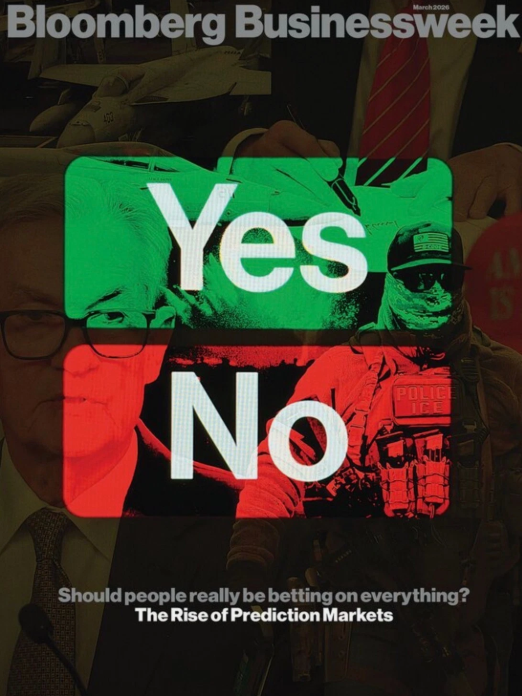
What caught their attention (and should catch yours) is that three of America’s newest billionaires built their fortunes creating virtually unregulated prediction markets, which is really just another word for sports wagering. And not one of them — Luana Lopes Lara, Tarek Mansour, or Shayne Coplan — has yet turned 30.
In BBW’s main article, it said that Lopes Lara speculated that “prediction markets will become bigger than the stock market, since they’re more relatable to the average consumer.”
Can you imagine at some future date you might have your 401(k) returns invested on whether or not Lady Gaga will again appear with Bad Bunny at a Super Bowl halftime show??
States and tribal nations are taking notice. If you’re heading to the Indian Gaming Association’s (IGA) Tradeshow & Convention next week in San Diego, block out the entire first afternoon: it has been devoted just to this topic.

If perhaps you’ve recently awoken from a two-decade long coma and know little about the basics of sports betting (from bookies to event derivatives), you need to get up to speed. Grab a copy of the new “All About Sports Betting,” an excellent book just out from Huntington Press. We’ll review it next month here on CDC Gaming. It’s good, so go ahead and buy it now.
The wound we’ve been reopening
All those hard-won gains we’ve made mitigating problem gambling are at serious risk. The Journal of the American Medical Association (JAMA) published a study last year titled “The Growing Health Concern Regarding Gambling Addiction in the Age of Sportsbooks,” documenting the explosion in problem gambling since the Murphy v. NCAA decision opened the floodgates in 2017:
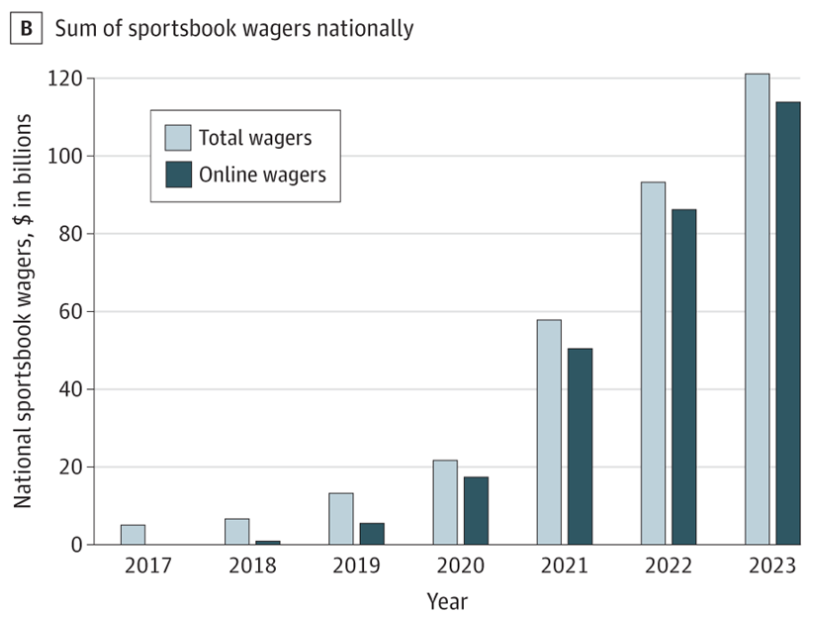
JAMA
A separate U.S. News & World Report poll fills in the human cost:
- One-quarter of sports bettors say they’ve been unable to pay a bill because of wagers they made. Some respondents say they bet their rent money on sporting events.
- Almost a third (30%) of sports bettors say they have debts they attribute to gambling. Of those with debts related to sports betting, more than half (51%) are facing debts of $500 or more.
Compare that to the 1% to 3% of casino gamblers with moderate-to-severe gambling problems cited by the National Council on Problem Gambling. The difference isn’t marginal; it’s a crisis, and it’s concentrated almost entirely among young men.
A classroom that tells the story
Three weeks ago, I delivered a guest lecture at the University of Nevada, Reno. I asked the three dozen undergrads in attendance: “How many of you have ever visited a local casino sportsbook?” Not one hand went up. When I asked who had a Kalshi or Polymarket app on their phone, most of the men in the room — and one woman — raised their hands.
That’s not an outlier. Testifying at a Senate hearing, Keith Whyte, long-time former executive director of the National Council on Problem Gambling, was blunt: “Gambling problems have grown sharply over the past six years, especially among young male online bettors.” Research confirms men are about twice as likely as women to develop compulsive gambling habits — and the more educated the person, the more likely they are to bet on sports.
The Chronicle of Higher Education ran a feature on exactly that last year, calling it “The ‘Perfect Storm’ of Sports Betting – Gambling is easier than ever, and students are part of the human toll.”

Graphic: The Chronicle of Higher Education
The prediction markets are making it worse by lowering the age barrier. Legal sportsbooks are regulated, taxed, and available only to those 21 and over. The new federally approved prediction markets? They’re open to 18-year-olds; even in states like California, Utah, and Hawaii that outlaw traditional sports betting. Student loans may not be the only debt weighing down the next generation of graduates.
The Atlantic says it better than anyone
The most vivid account of all this comes in the just-out April issue of The Atlantic, whose cover story is titled “Sucker.”
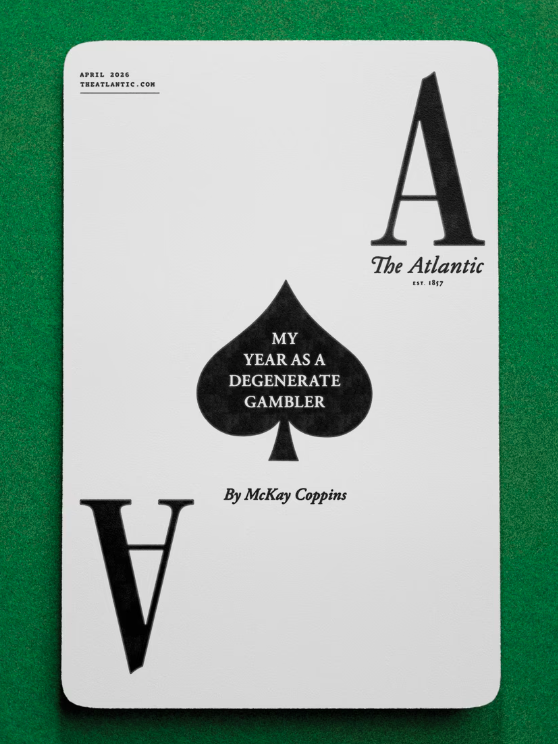
The editors handed their practicing-Mormon reporter, McKay Coppins, $10,000 of the magazine’s money to wager across this new landscape. He secured his bishop’s reluctant permission on the grounds that he wasn’t technically gambling his own money (the magazine was paying the bill). What followed was a slow-motion unraveling: a man who began the experiment certain gambling was “a waste of time” ended it by filling out a self-exclusion form in Virginia. At the end, he had done some damage not just his finances but to some of his relationships and behaviors with family and friends.
A few of his most striking lines:
- “For 200 bucks, I had purchased an artificial rooting interest in a game I had no reason to care about. I kept watching even after a weather delay pushed it late into the night, scrolling frenetically next to my sleeping wife in search of angles to exploit with late-game bets.”
- “The prediction markets represent the logical end point of the sports-betting explosion: Everything in American life — politics and culture, art and war — becomes a Las Vegas table game, tantalizing in its promise of profit, rigged against regular people, destined to demoralize and crush those who play.”
- “The recent decline of trust in sports is, to an extraordinary degree, self-inflicted and avoidable. By embracing gambling so completely — normalizing it, celebrating it, reaping massive profits from it — the leagues have all but ensured that many fans will see it as baked into the game itself.”
- “It is perhaps not a coincidence that the casinofication of America is taking place while the Oval Office is occupied by a former casino operator. Under the Biden administration, the Justice Department and the Commodity Futures Trading Commission opened investigations into whether Kalshi and Polymarket were flouting federal regulations. But the government scrutiny ended when Trump returned to office.”
Don’t hesitate to pick up the latest issue of The Atlantic. There are insights on every page.
A few glimmers of pushback
Not all the news is grim. Two recent developments are worth watching:
- Two members of Congress have introduced the “BETS OFF Act,” also known as the “Banning Event Trading on Sensitive Operations and Federal Functions” bill. It would prohibit prediction market contracts on government actions or outcomes known to just a single party. Rep. Greg Casar and Sen. Chris Murphy introduced the legislation two weeks ago.
- Maricopa County just filed a 20-count criminal complaint alleging Kalshi operates an unlicensed gambling business in Arizona and accepts illegal bets on elections. Courts in several other states have issued similar bans. Late last week, the 9th Circuit U.S. Court of Appeals upheld a lower Nevada court decision that Kalshi could be banned by state gaming regulators. Pessimistically, that also means these rulings will be heading to the U.S. Supreme Court, which has shown little inclination to reel in the current administration’s preferences.
The trends are moving fast, and not in our industry’s favor. The demographics are wrong, the regulation is thin, and the human cost is already visible. States’ tax streams and the economic survival of numerous tribes could be at stake.
If there’s an irony worth noting, it’s this: you can probably place a bet on Polymarket or Kalshi right now on whether any of this leads to lasting, irreversible damage to casino gaming. That wager might be the only hedge you can find (and one of the saddest) in the history of our business.
# # #

